By Manpreet Singh, Public Education Coordinator Fellow
There will be an online public workshop on May 20 for those interested in learning and offering feedback on local flood resilience planning, and two upcoming community workgroups — Vallejo on May 30 and Suisun City on June 13. Residents of Vallejo, Fairfield or Suisun City who are interested in being part of a workgroup can fill out this interest form.
As a lifelong resident of Vallejo, I have seen the effects of flooding on the city. Flooding has impacted my and other residents’ ability to walk and drive on local roads, commute via highways, and get access to essential health services and public spaces. My concern about flood risks in Vallejo has only grown in recent years with the harsh impacts felt by local residents and infrastructure from more dramatic King tides that hit the Vallejo shoreline in 2025 and early 2026 and learning that the entirety of White Slough, parts of Mare Island, and portions of South Vallejo are at risk of being flooded by 2050. This affects vulnerable community members, such as the unhoused population and children, and critical infrastructure that many residents use such as essential healthcare services, businesses, homes, and government buildings.
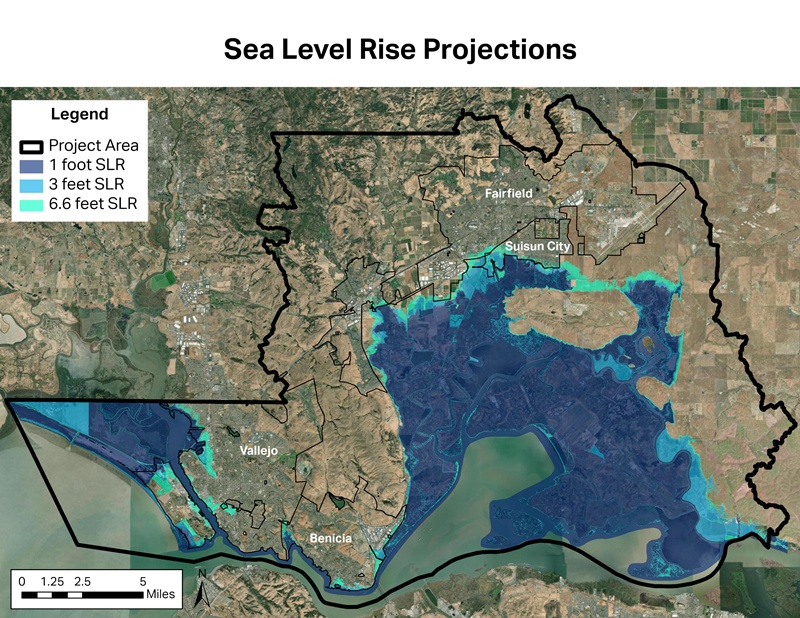
Sea level rise projections from the Bayshore Resiliency Project
As part of the Solano Bayshore Resiliency Project, I’ve had the opportunity to share flood risk projections with community members in Vallejo. Unsurprisingly, residents expressed similar concerns and highlighted additional infrastructure that is of importance to them and that they want protected from flood risks.
With an extensive coastline, rich ecosystem of estuaries, and low-lying lands along the Bayshore, Solano County is vulnerable to rising sea levels and flooding due to melting ice caps and thermal expansion of the ocean. Flooding can result in widespread damage and impacts can be further intensified as the Bay Area could see up to an additional 10 inches of sea level rise by 2050 and 2 – 7 feet of sea level rise by 2100. The sea knows no boundaries, which is why building resilience through a community-informed plan is key to ensuring that communities and critical infrastructure that are most vulnerable to sea level rise and flooding can adapt and be prepared for the more frequent and destructive flooding events in the coming years. Through the Solano Bayshore Resiliency Project, Solano County residents in cities vulnerable to sea level rise and flooding have the opportunity to share their voices and ensure that community priorities are centered in the planning process of the Regional Shoreline Action Plan.
Sustainable Solano and Greenbelt Alliance, collaborating partners on the project, are leading efforts to hear from community members to identify assets that are important to them and that they want protected from sea level rise and flooding. In February and March, both organizations led asset mapping activities and flood walks with over 150 residents across Fairfield, Suisun City, and Vallejo — frontline cities that are vulnerable to the impacts of sea level rise and flooding. These activities gathered information on areas important to local residents, bringing community members’ voices in as an important part of the planning to ensure adaptation and protection from sea level rise.
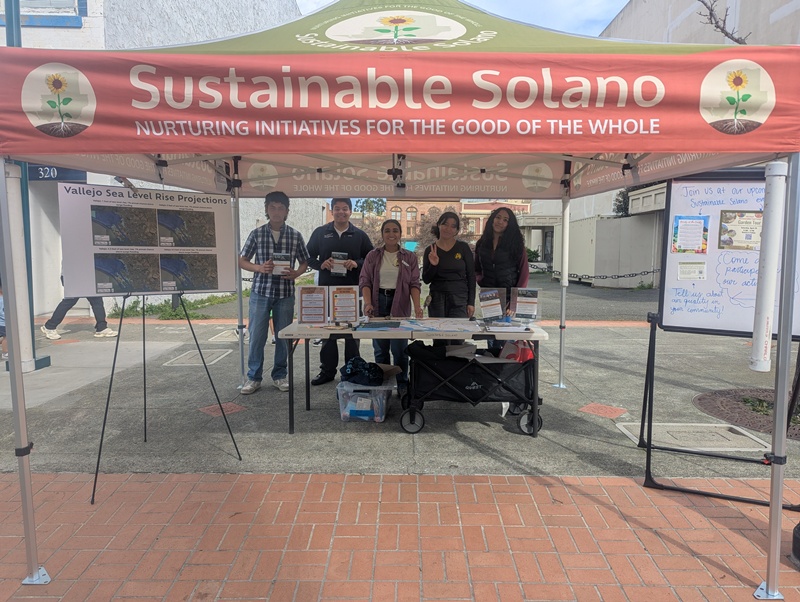
Manpreet (center) conducts community asset mapping for flood resilience along with Vallejo Environmental Leadership Fellowship interns at the Vallejo Farmers Market
Through the asset mapping activity, community members shared insights into where they have seen flooding and identified assets they want protected. This was an activity that I led in Vallejo where I assisted residents in identifying critical infrastructure and community resources such as Interstate 80 and Highway 37, the Vallejo Marina, local libraries, healthcare services, nonprofit organizations, and educational institutions. This data will be analyzed and incorporated into the Shoreline Action Plan as recommendations of what should be protected from sea level rise and flooding. Engaging with my local community provided me with the opportunity to hear about their experiences living in regions vulnerable to flooding and trends and patterns that they have seen over time. Moreover, I heard from residents what they love about their city, such as the diversity and the people, and where they see opportunities for improvement in their respective communities.
Through interactive flood walks, residents of each city had the opportunity to learn more about sea level rise, how it will impact their shorelines, and ways flooding could threaten homes, roadways, community centers, businesses, and natural habitats. During the Vallejo flood walk, residents responded to how development and land use changes have made areas more prone to flooding and how wastewater plants can be impacted by flooding due to being built on the lowest lying parts of the city and aging infrastructure.
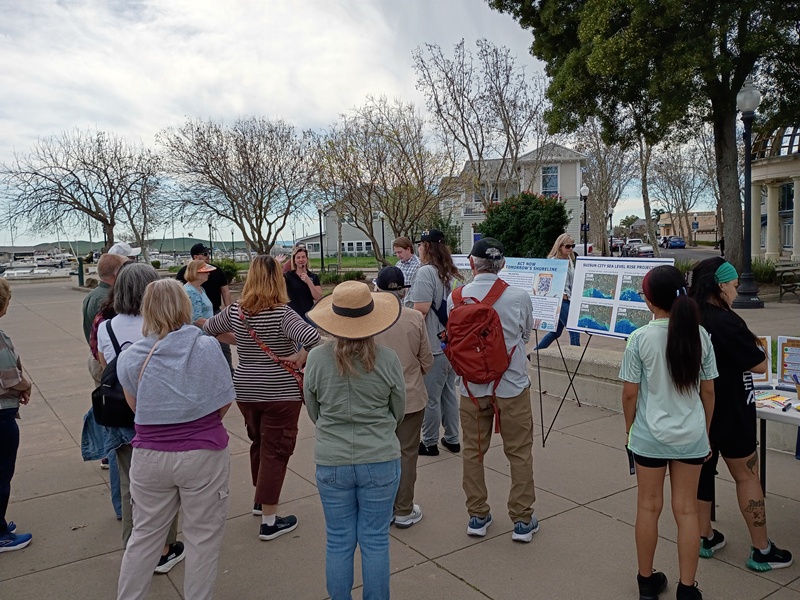
Suisun City Flood Walk
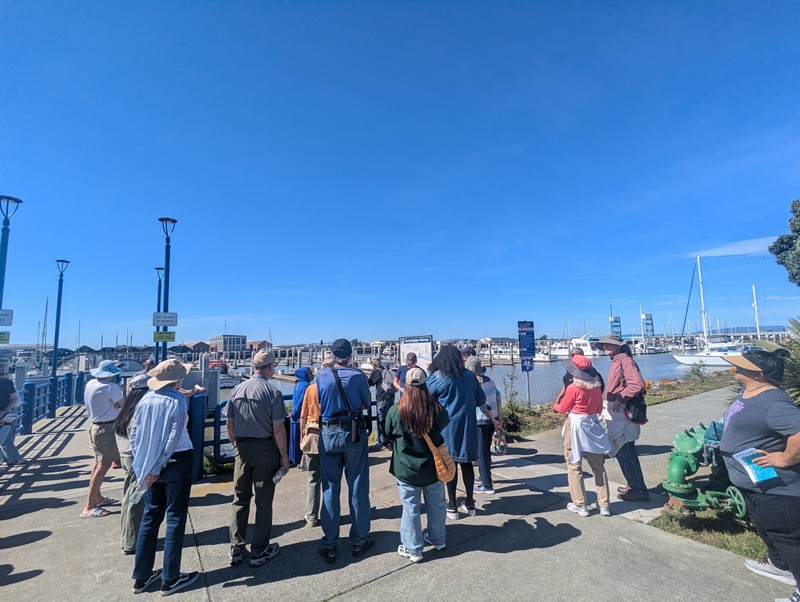
Vallejo Flood Walk
Community engagement is critical in addressing sea level rise and flooding impacts in Solano County. Residents have the opportunity to provide insights as the Bayshore Resiliency Project is an ongoing project with the Regional Shoreline Action Plan to be published in December 2026.