Heather Pierini, Landscape Architecture student at UC Davis and Birds, Bees & Beyond Food Forest Keeper, speaks on camera
Over the weekend, Sustainable Solano, with our wonderful Constance Beutel as camera-woman and director, shot scenes for a Water-Wise documentary video. The video was shot at Birds, Bees & Beyond, one of the Demonstration Food Forests, with commentary from Executive Director Elena Karoulina, Sustainable Landscaping Advisory Board Member Kathleen Huffman, and food forest keeper Heather Pierini.
Sometimes pictures tell a story better than a thousand words. This might be the case – the film shows the three components of our Wise Water approach – rainwater collection in the ground, roofwater diversion to the ground and L2L greywater. You’ll be able to see how these systems were put together and an amazing difference this secondary water makes in this garden. We will use the film for training, presentation, and inspiration. Stay tuned for its release!
On Sunday, April 2, as a part of the Benicia Sustainable Backyard program, about ten people gathered at a Benicia house for the final (for now) 2017 laundry-to-landscape hands-on greywater installation workshop. The host for the day was Mayor of Benicia Elizabeth Patterson, a supporter of sustainable use of water. There was a great group of participants from Vallejo and Benicia. A special group of attendees who had applied for the Vallejo Sustainable Backyard demonstration food came to learn both about greywater and about how the workshop was run as an educational experience.
The instructors from Greywater Action, Christina and Jessica, explained current regulation regarding greywater (you do not need a permit in California to install a simple, gravity-fed laundry to landscape system), and different parts of the system: the indoor – laundry three-way valve that will regulate the flow of laundry water to landscape, and the outdoor part – a pipe that will direct greywater to a few mulch basins placed next to the large trees in Elizabeth’s front yard. The group then split in two: half of the participants began installing a three-way valve, while the second half rolled out the water pipe and began digging. The groups changed places after lunch so everyone would get a hands-on experience on every aspect of installation. It took some tweaking and adjusting, but finally the water from the washing machine was flowing evenly to all mulch basins. Now this mature front-yard landscape has a reliable source of water, rain or shine!
Thank you, Mayor Patterson, for volunteering your house for a public workshop!
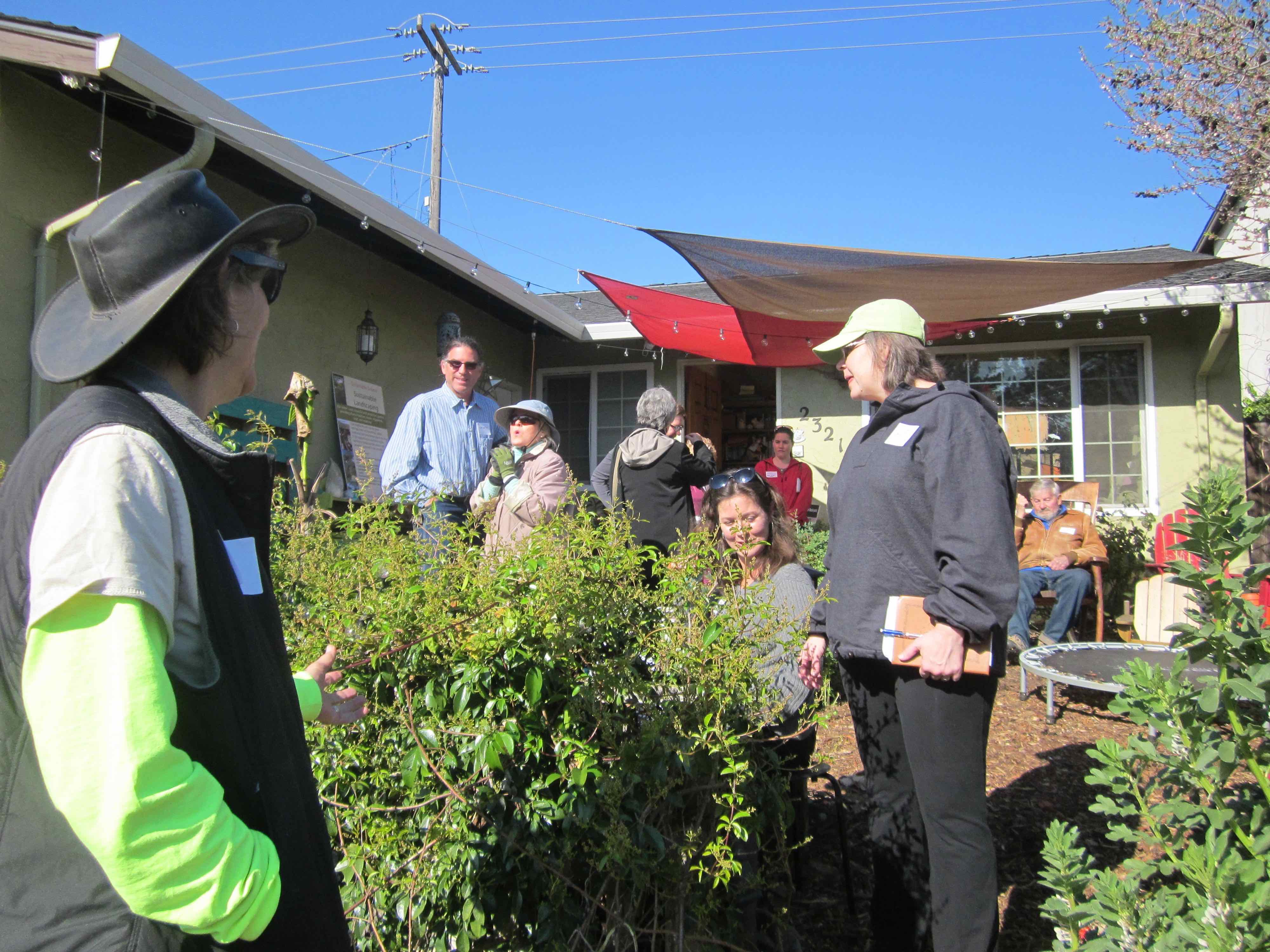
It was a cool and sunny day for the Greyhawk Grove Tour, and perhaps it was that, or that our tour is gathering steam, that nearly 30 people squeezed into a room to listen to Lydia Neilsen from the Regenerative Design Institute. She started with a brief overview of permaculture design principles: people care, earth care–and then dove straight into practical, simple applications to one’s garden, covering hands-on details of creating swales (or as someone coined them, “Magical ditches”), appreciating weeds and the natural succession of plant life, and mimicking that healthy ecosystem balance in tree and plant guilds. She fielded questions about greywater, and, noting that several Food Forest Keepers were in attendance, had them field questions as well. Attendees remarked on on simple, clear, and practical her talk was.
The overflowing group then spilled out into the demonstration food forest itself, were Lydia pulled up a giant fava bean to show the group the roots and speak about cover crops, nitrogen fixation and soil health. She also ate a nodule, declaring it tasted like peanuts and offered it to anyone who wanted to try. They were able to see the laundry-to-landscape switch and pipes, look at the greywater basins, the rainwater pipes that flowed straight into the two swales, how the natural slope and chicken coop was incorporated into the planning, and snuggle up the free range chickens who were milling about. “We used to have one of these at the farm,” said the farm director of Loma Vista Farms after she cuddled up a polish chicken–known for a mop of feathers on top of its head that looks like punk-rocker hair. “We used to call it our Tina Turner chicken. But now the kids don’t get the reference. I guess rockstar chicken still works.”
It was a rockstar day all around. And we look forward to the next stop in the tour–stop #6, “The Curious Garden.”
For more information and to register for “The Curious Garden”, please go here.
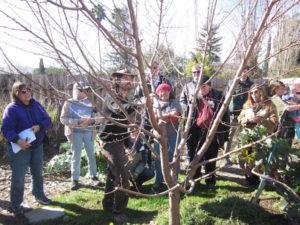
David Shaw of Santa Cruz Permaculture’s talk and tour turned into an extended one when the official event ended. Due to enthusiasm the talk portion ran long and the tour ran out of time. Attendees still had many questions, so David graciously agreed to travel directly to the Community Orchard where he continued answering pruning-related questions. As one participant noted, “That was so killer. I think I’ll be taking David’s permaculture course.”
What he was referring to was David’s quick overview of permaculture principles. What was an hour talk with handouts quickly blossomed into a nearly 2-hour one, complete with poetry recitation, and an explanation of how permaculture was similar and different to academic-based agro-ecology (he teaches at UC Santa Cruz in agro-ecology as well), and Q&A. There were over two dozen attendees, with several steadily streaming in after the talk began, and space became so limited that attendees joked about huddling together on the “huddle corner” of the living room couch, attendees sat on the floor and on pillows, and many stood.
The tour portion of the day commenced with only 15 minutes left, but the hosts Kirsten and Nick were amenable, and curious to learn about pruning their lovely fruit trees, so they extended the tour by half an hour. Yet even running half an hour over, attendees were delighted when David agreed to continue the talk at the Community Orchard and expressed his wish to stay for lunch and see more of the town.
Permaculture isn’t just about plants and trees, the self-proclaimed tree nerd and orchardist said, it is about community, resilience, and re-energizing. When someone asked why he didn’t use the word sustainability, he countered with a brief anecdote: “Well, look, if someone asks you about your marriage, would you want to say, ‘It’s sustainable’ or would you want to say, ‘It’s renewing and re-generative?'” And it seemed that many of the people who attended the even found it very much so.
Please note: For those still interested in a more in-depth workshop on pruning, the Community Orchards is hosting Ann Ralph of Grow a Little Fruit Tree on February 11th. The workshop is free from orchard members, $40 for non-members. There is a 20 person limit. More information and registration can be found here.
Our next stop is February 25th, at “Greyhawk Grove”, another one of our original installation food forests, with Lydia Neilson of the Regenerative Institute. The event is FREE, but you must pre-register for the location. More information can be found here.
Sustainable Solano would like to share a video that a friend, Kristian, made! It certainly highlights the most meaningful moments and makes us reflect on how moving of an experience this was for us.
Would you like to become a demonstration food forest keeper?
Would you like to convert your thirsty lawn into a thriving food-producing ecosystem fed by the laundry-to-landscape greywater system? Do you enjoy sharing your knowledge and resources with your community? Are you interested in sustainable landscaping, edible gardens, and especially permaculture? Do you own a house in Vallejo or Fairfield? Would you like to be a part of a growing permaculture community in Solano County?
If you answer “yes” to all of the above, you can be a good candidate to become a demonstration food forest keeper in 2017!
Imagine a thriving, vibrant eco-system in your front- or backyard! A few fruit trees surrounded by native and Mediterranean plants, berries, perennial vegetables, flowers, with enough space for your annual favorites.
How does this work?
We’ll design and facilitate an installation of a Seed Plot on your property. You provide volunteers (your friends and family make the best team: you learn and work together, and then you celebrate); we provide design, plants, material and expert advise, all free for you. During the installation, your laundry will become a classroom for “How to Install a Greywater System” hands-on workshop, and your yard will be open for public workshops. You then share with the community the progress of your Seed Plot for at least next 5 years: we’ll take pictures of your growing and evolving Seed Plot and advise you on maintenance and future design, while you let community in once or twice a year for a tour of your Food Forest.
We’ll have an open application process; the preliminary dates are February – March 2017 for Vallejo and June – August 2017 for Fairfield. You’ll be able to download the Application Form from our website. The Application includes a very detailed study of your proposed location for a Seed Plot and a legal part that defines parties’ roles and responsibilities.
Every application will be evaluated by our Advisory Board – a group of people with a Permaculture Design Certificate and experience in designing and building permaculture sites. The Program team will visit your site for an extensive survey and a conversation with you and your family about your potential Seed Plot.