Mar 26, 2018
by: Kimberly K. Fu
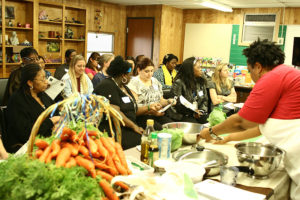
Image from www.sustainablefoodcenter.org
[Click here for The Reporter full article link]
Sustainable Solano is all about getting locally-grown food to local people.
Thanks to a grant from the United States Department of Agriculture (USDA), the nonprofit can move forward with the project.
On a recent day the group’s executive director, Elena Karoulina, and Stephanie Oelsligle Jordan, project manager and chef, shared insight into their ideas.
“We’ve been working on this for a long time,” Karoulina advised. “It’s a lot of work.”
The goal is to create access points, aka community food centers, where residents can pick up produce boxes from local farms, buy eggs and dairy and meat and other edibles and take cooking, nutrition and other classes.
In this way, Karoulina said, local farmers can sell their food, residents can buy them and learn how to prepare them and everyone gains better health.
It’s been a process, Jordan said, to locate all the farmers and others in Solano who might be a part in community food centers. As well, finding locations for those centers has been daunting.
But the 15-month Local Food Promotion Program planning grant from the USDA awarded in September at least provides necessary funding to get Sustainable Solano’s feet wet.
The group has partnered with researchers at the University of California, Davis; Solano County Department of Agriculture; and the Department of Public Health. On the agenda is a feasibility study, business plan and how to make a go of the food centers.
Engagement is a huge part of the project. To that end, Solano County Supervisors John Vasquez and Erin Hannigan have been instrumental in the project, Karoulina said, as have numerous other individuals and group.
Community talks are in the works.
Sought is input, lots and lots of input, on what people need and want and hope for. What locations would be great for a community center and is there a best time for such a facility to be open?
All thoughts will be taken under advisement, both women assured.
The study is set to be finalized this month.
The business plan and an outline of the implementation plan should be finalized by December.
Feb 28, 2018


[Common Grounds in the Baylands] [Public Outreach at SF Bay Flyway Festival on Mare Island]
Team Common Ground, a group of designers, engineers, scientists, and educators is working on a design study of the San Pablo Baylands and highway 37 corridor for the Resilient by Design|Bay Area Challenge.While the focus of the design challenge is on strengthening local and regional resilience to sea level rise, severe storms, flooding, and seismic events, the team is also trying to address other, sometimes more pressing challenges including lack of housing, displacement, limited access to public land, and outdated transportation.
Along with local stakeholders and the input of San Pablo Bay communities, Team Common Ground is looking at ways that people around San Pablo Bay could share and steward environmental resources while having more diverse means to connect with each other for work, living, recreation, food and health, and cultural ties.
This focus on San Pablo Bay has made understanding the work-to-date on State Route 37 (SR 37) and baylands conservation important aspects of the team’s approach. The project aims to reimagine the SR 37 corridor, support ongoing restoration of the Bay Area’s largest continuous marsh system, and equitably connect communities around San Pablo Bay through a resilient and diverse transportation network. To unite the communities of San Pablo Bay with the rest of the Bay Area, Team Common Ground envisions transitioning from predominantly single-function transportation infrastructure to a network of interrelated modes that encourage smart growth, are resilient to sea-level rise and seismic events, and that accommodate natural hydrological dynamics to incrementally restore vibrant and functional bayland ecosystems.
TLS Landscape Architecture Principal Erik Prince described the team’s scope, “We see our role as supporting and building on the work that’s already underway, communicating the risks of sea level rise, helping to provide an appealing vision of what the future of the SR37 corridor and baylands might look like, and working with community leaders to get broad-based stakeholder buy-in. We want our proposal to be realistic, but we also want to provide a fresh look at the problem while still drawing from and supporting the years of hard work that’s already been done.”
Team Common Ground consists of: TLS Landscape Architecture, Exploratorium, Sitelab Urban Studio, Michael Maltzan Architecture, Guy Nordenson & Associates, Rana Creek Design, Lotus Water, Richard Hindle, Dr. John Oliver, HR&A Advisors, Fehr & Peers Transportation Consultants.
Feb 26, 2018
by: Elena Karoulina, Executive Director
A couple weeks ago I had a great visit with Denise and Ben Lyons at their Lockewood Acres Farm in Vacaville. As a part of our work on the Solano Local Food System, I am getting to know local small farmers who are doing things right: they take care of the soil on their farms, plant diversified crop, pay special attention to the health of their water, strive for low-input farming (producing most of the fertility on the farm), and as a rule, look to work with nature, not against it, in harmonious, healing relationships with land, all living things and their communities.
Denise and Ben Lyons are this type of sustainable farmers. Their 10-acre beautiful, certified organic farm is located in the agricultural area between Vacaville and Dixon. When I came on a breezy & chilly February morning, both farmers were outside: Ben was fixing things around the barn, and Denise was wrapping up a meeting with Solano farmbudsman, Sarah Hawkins, going over rules and regulations governing various aspects of the farms’ operation. Even a small farm is a serious business, with its hard labor in the fields, barns and orchard, and different, but equally demanding work behind the scene: marketing, accounting, legal compliance, reporting… The work is endless and most of it is unseen by the community that gets to enjoy the fruits of this hard labor.
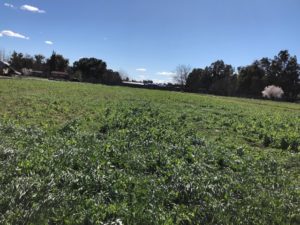
Most of the fields were resting for winter, covered by a green blanket of cover crop – fava beans, peas and other nitrogen-fixers. Before these plants go to seed, Ben will work this green manure into the fields, enriching and nurturing the soil, increasing its organic matter and improving water retention. This healthy soil will then feed the plants growing there that will eventually find their way to our kitchens and tables: tomatoes, cucumbers, eggplants, peppers, watermelons, salad greens, squashes, culinary herbs, and all sorts of root vegetables.
Fruit trees in the nearby orchard were also resting, waiting for the time when the sap will begin to flow, followed by beautiful fragrant flowers and then fruits. Apples, pears, all sorts of citrus, persimmons, plums, cherries, pomegranates, and figs – the list goes on and on of the bounty produced in this well-designed orchard. Olives are pressed in small batches in a local olive press – you can buy this olive oil directly from the farm.
Countless chickens were roaming the orchard, scratching the soil and adding natural fertilizers everywhere they went. Careful selection of heritage breeds provides for nutritious eggs in all possible colors: dark brown, light brown, blue, green, white.
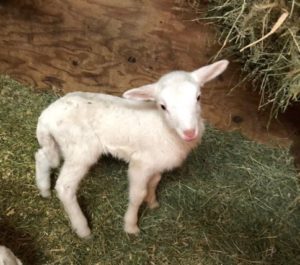
In the small barns, there were dairy goats and hard-working sheep that regularly provide grass mowing services in the orchard, surrounded by adorable little ones constantly looking for milk and warmth. Keeping animals on the farm ensures a reliable source of manure, the traditional foundation of soil fertility, that decreases the demand for the outside input and supports this vibrant ecosystem called “Lockewood Acres Farm”.
An apiary completes the picture of the farm. Raw, delicious honey is available for sale year around.
Denise and Ben’ journey to this farm started with a discovery of the benefits of earthworms. Their original vision was to develop a homestead to nourish the immediate family. The vision eventually grew to include feeding the community! After the initial skepticism (mostly from Ben), the couple turned to organic farming, which Ben now describes as a “common-sense approach to farming”.
Would you like to join the community of the Lockewood Acres Farm well-nourished customers? This is what the Community Supported Agriculture stands for! Sign up to become a member of this farm’s CSA program. For more details, click here. If you are at the Vacaville Farmers Market on Saturdays, stop by the Lockewood Acres Farm stand and please say hi from their friends at Sustainable Solano!
There are multiple ways to participate and the farmers are flexible to work with you and your budget to provide nutrient dense, wholesome food for you and your family!
Feb 22, 2018

In case you haven’t heard, Solano County is the latest area to establish a quarantine for the Mediterranean fruit fly also known as the Medfly. The quarantine started last fall and will continue until officials are sure the threat to the local orchards and farms has passed. Commercial growers are most impacted by this quarantine, but homeowners with fruits and vegetables in their home gardens also need to be aware of the regulations and impact of this action.
For those wishing to gather more information, click here.
California Exotic Fruit Fly Project: Frequently Asked Questions Regarding Exotic Fruit Fly Quarantines
Feb 1, 2018
“The Juice House Co. Improving Health Through The Power of Food Energy”
By: Tiana Duvauchelle, Owner
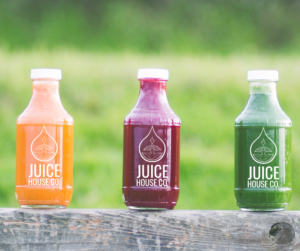
The Juice House Co. believes in the pursuit of positively impacting lives through the power of food energy. Together as a community, we unite as healthy beings through our offerings of Fresh, Raw, Organic Cold-Pressed Juice, Kombucha, Nut Mylks and Cold Brew Coffee.
I have shared my love of yoga at Yoga House Co. and to communities around the East Bay since 2012 and continue to, but in 2016 my sweet sister and I felt like we had more to give, more to share and more to offer to our local community; the dimension of FOOD YOGA. The journey of yoga begins with the physical body. The physical body “our food body” needs to be nourished. This body, consists of a material body built from the food we eat. With that as our forefront, we must feed our bodies with the most purest form of energy; organic fruits, veggies, nuts and grains. We built the Juice House Co. as a medium of offering food in its most purest form through my creative expression of love and devotion to all being everywhere.
Deep down, we all have the desire to eat healthy and be healthy, but we also live lives where we eat compulsively, away from home and so convenience it key. The Juice House Co. is here to offers this new flavor, with this new take on healthy indulgences
We work closely with our local, organic suppliers to create the best product with the best ingredients for our all favorite juice junkies. We strive to minimize waste through recycling/reusing bottles, to sharing our leftover compost with local growers, to upcycling our coffee grounds!
All Juice, Kombucha, Nut Mylks & Cold Brewed Coffee are locally sourced, pressed, bottled, and enjoyed! The Juice House Co. team is excited to share this food energy, this food yoga, one of the greatest wonders of life, pure raw energy given to us by Mother Earth.
Find us on First Street in Benicia for our fresh goods, friendly staff, great jams, good vibes and loving spirits….or order your goods online for pick up!