Sustainable Solano Land Caretakers Training/Internship Program 2016-2017

We are please to announce that the enrollment to our second training class is now open!
 

Sustainable Solano, in partnership with Solano County Small Business Development Center, is taking initiative to provide intensive training and to expand employment opportunities in the growing field of sustainable landscaping practices.

Why? Given the continuing drought, it’s important that water-retention techniques for landscaping be widely implemented throughout communities. Sustainable Solano’s aim is to give eligible individuals the basic training necessary to start and manage a “sole proprietorship” landscaping business that can design and help create more sustainable home gardens to conserve water and provide healthy food.


Focus Areas:

Rainwater harvest and retention; laundry-to-landscape greywater systems; edible landscaping; chicken-keeping; small business start-up and operation; Solano urban agriculture laws and more!

When:   October, 2016 –  March, 2017  (2 Tuesday evenings and 2 half-Saturdays a month)

Where:  Benicia

Who:     residents and businesses of Solano County are given the first priority; we’ll consider application from surrounding counties on a case-by-case basis (some restrictions may apply– please inquire)

Cost: Free

Preferred: background in horticulture and/or small construction / handyman / plumbing

Goal: launch new and/or support existing small businesses focused on helping local residents transform front- and/or backyards into thriving, sustainable ecosystems; support creation of a cooperative of people with hands-on practical sustainability skills for the Solano community.

To apply: please send Sustainable Solano c/o <info@sustainablesolano.org> a letter of interest describing your background, current business (if applicable), and your vision for your personal contribution to our community’s sustainability.


Interested? Here’s more info on the Land Caretakers Program:

Sustainable Solano (formerly Benicia Community Gardens) has partnered with Solano County’s Small Business Development Center to support the launch of several pilot small businesses engaged in sustainable edible landscaping.

In conjunction with our Benicia Sustainable Backyard Program, Sustainable Solano will train a select number of qualified local residents who have some foundational knowledge in horticulture and/or small construction (plumbing), in practical aspects of permaculture and sustainable landscaping, water re-use, chicken-keeping, and also, business, legal and human aspects of running a small business in Solano County.


Our vision:

After completion of the six-month training program, participants will be capable (and well positioned in the local community) to create their own sole proprietorship businesses to offer such services in Solano County. Sustainable Solano will provide ongoing support and promotion for those new businesses and will employ them, where appropriate, for other projects and programs in the community. We are creating a Land Caretakers Association of sustainable landscapers in Solano County to support this work.

We would also encourage and support our graduates to form a cooperative and work together to jointly offer services to local residents to transform their land into thriving ecosystems that use all the available resources wisely and that provide food, inspiration and beauty. (A cooperative arrangement would not prevent individual members to carry their own licenses and establish solo proprietorship businesses). The combined skill set should include: water retention on site (bio-swales, rainwater catchment and diversion to landscaping), water re-use (laundry-to-landscape greywater systems and potentially, shower-to-landscape conversions), permaculture food forest design and management, incorporation of edible plants into existing landscapes, conversion of annual vegetable gardens into more perennial food forests; construction of a chicken coop/chicken run and guidance in chicken-keeping, understanding of basic bee-keeping.

Our instructors and guest speakers are experienced sustainable landscaping professionals.

Focus Areas of Land Caretakers Training:

  • Permaculture and ecological / edible landscaping (perennial agricultural design and practices)
  • Water re-use (rainwater harvest/retention; laundry-to-landscape grey-water systems)
  • Chicken-keeping as an integral part of a sustainable household
  • Legal and business aspects of running a small sustainable/edible landscaping business
  • Human aspect (working with clients, listening for their vision, offering guidance)


By completion of the Land Caretaker’s program, participants will be proficient to:

  • Develop, design and start solo proprietorship business in sustainable edible landscaping;
  • Understand and work with basic characteristics of land: sun, wind, soil, water movement;
  • Demonstrate simple rainwater harvesting techniques including contour and diversion swales; roof rainwater catchment and diversion;
  • Install simple laundry-to-landscape greywater systems;
  • Convert established edible gardens into more sustainable, perennial-focused food producing ecosystems;
  • Incorporate perennial and annual food producing plants into established ornamental landscapes;
  • Develop on-going maintenance plan for established edible landscapes and permaculture food forests*, including further expansion and plant replacements (as needed);
  • Consult homeowners on how to incorporate chicken-keeping into household routines, outlining procedures and chicken care “basics”;
  • Understand basic beekeeping requirements and establish working relationships with professional beekeepers in Solano County (who can, in turn, incorporate bee colonies into sustainable landscapes of future clients);
  • Understand basic legal requirements for urban agriculture in Solano County (zoning, small animal husbandry ordinances, beekeeping ordinances, other local rules and regulations relating to local food production and other practical sustainability activities);
  • Understand small business start up and maintenance process, legal requirements, licensing, professional development;
  • Understand logistics and finance of running a landscaping business: start up minimal cost; cost analysis and job estimates; sourcing plants and materials; job scheduling; dealing with unexpected;
  • Gain insights into working with clients – the human part and heart of any business.


  • 72-hour permaculture design training is recommended, but not required. Programs teaching permaculture design and techniques are offered in a few Bay Area locations ongoing.
Sustainability: Continue the Conversation

By Roman Johnson


As you know, Benicia Community Gardens has become Sustainable Solano, to better reflect what we do.

In our efforts to open the conversation, we asked you to participate in what we have been calling The Sustainability Thought Experiment. We asked you to draw what this topic means to you, how it affects your lifestyle, and how you visualize a world that “works for everyone.” We were extremely pleased with the result and we thank you so much for your enthusiastic and creative input! For the past few weeks, we have been using this input to brainstorm the vision and how to incorporate sustainable living into daily lives.

Sustainability, in business terms, is a taboo phrase. The reason for this is because sustainability is often viewed as an alternative to growth, as a plateau that urges flat-lining instead of moving upward, the difference between surviving and thriving. As a result, environmentalists compromise. We replace sustainability with terms like “efficiency”; “audits” have morphed to “assessments.” Dancing around the essence.

The practical side of my brain embraces this. Speaking for the bees and the trees is a hard sell to business owners trying to hit their bottom lines and for parents struggling with rent and putting food on their family’s tables. I empathize. However, the idealist in me craves more. Of course, ecological factors are important. We are all organisms of this earth, whether we stop to think about it often or not. Survival is based upon the function of these systems. But sustainability is bigger and more relatable than people give it credit. Sustainability is the means by which businesses stay afloat and families keep their kids in schools with a roof over their heads. It’s about spending money, time, and energy within your means.

In this modern era, we have reached a point in which there are few frontiers left to explore. We are pushing the limits of expansion, setting our sights on “other worldly” entities, most notably space. Our fascination with space is understandable. It carries with it existential questions about our place in this universe. While this topic is for another discussion, I mention it because there are frontiers within our own world worth fleshing out more. Thinking in a more ethereal sense, what about the frontiers of compassion? Teamwork? Sharing? We posit exploring these frontiers in earnest before venturing on to the next.

This is the idea we have been running with. If we imagine this mission as the earth itself, we see these phrases as comprising the core, ingredients of the abstract vision. From there we move to the Mantle, which incorporates more concrete, tangible values that manifest our mission. This is the portion of the map we are developing with care. Once this realm is fleshed out, we will have the foundation to create the soil that makes up the crust, the seeds, and the plants that grow to sustain mutually beneficial ecosystems, our most lofty goal.

We see our role as something like social and environmental midwives, someone who acts as a catalyst, bringing life into this world. Sustainable Solano seeks be the liaison to help bring the fresh ideas of the community to reality. Practically speaking, this means acting objectively, connecting and synthesizing the great work and resources being developed by other organizations in the region and providing the platform to further these conversations.

Essentially, our expanded mission seeks to encompasses each aspect of our identity, how we grow, and how we relate to the broader community. I am in no position to say that I live in a sustainable fashion. My mind: all over the place. My finances: in shambles. My diet: horrendous. However, nature is a struggle for equilibrium, a forever-cycle of adjusting the seesaw back into balance. We are all working for our own sense of that equilibrium. Exploring this realm is exploring what it means to live as a sustainable human within a sustainable society. We encourage you to explore with us and continue providing your input. After all, this is your community.

Dream with us;

Build with us.


Walk in a Food Forest

Created with Nokia Smart Cam


Have you ever been to an urban food forest? Did you help us establish one (or a few) of the seven Benicia demonstration food forests? Did you attend one of the public laundry-to-landscape greywater system workshops?

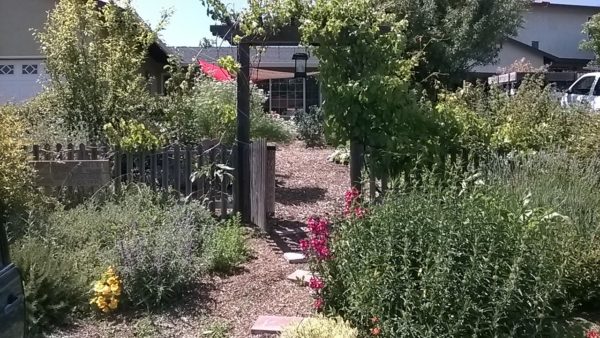
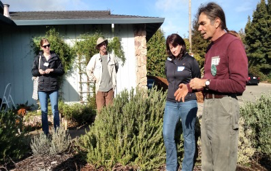
We are inviting you to see our budding permaculture demonstration food forests established in 2015 – 2016. Each month, you will have a chance to visit a food forest, hear a talk by a permaculture or sustainable landscaping professional, and have a guided walk through these gardens in the backyards and frontyards of Benicia residents.

You will see how rainwater is retained in the ground, how roofwater is diverted and harvested, what a difference greywater makes in a garden, and various plants selected either for their high yield food producing capacity or supporting role for these thriving ecosystems.

Here is the list of the dates and the gardens. Please watch our website and newsletter for further announcements about the speakers for each date and other details.

1. September 17 – “Nourishing Provision”

2. October 29 – “Bees, Birds and Beyond”

3. November 19 – “Marina Place Food Forest”

4. January 28 – “Barley’s Bountiful Backyard”

5. February 25 – “Greyhawk Grove”

6. March 25 – “The Curious Garden”

7. April 22 – “The Living and Learning Garden”

May 20, 2017 – “A tour of Seven Gardens”: your unique chance to see all seven gardens in one day. More details to come.

Read more about these gardens and the Sustainable Backyard program:


A Blueprint for a Better World

By Rob Rogers

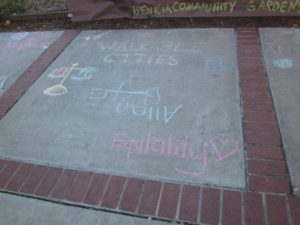
Every Thursday night from April through October, those in search of a healthier meal or a greener lifestyle have prowled the booths and stalls of Benicia’s Farmer’s Market, home to everything from organic dinosaur kale and farmstead cheeses to solar panel installation. On July 22, those visitors gave something back: a recipe for a better world, written in bold strokes of colored chalk outside Benicia’s community garden.
For a few brief hours, couples, families, seniors and teens on their way to and from the market paused to answer the question: “What would a world that worked for everyone look like?”

Not a single visitor mentioned a political candidate, despite the event falling squarely between the Republican and Democratic national conventions. Instead, the responses ranged from the general – “No Cars,” “No Guns,” “People and the Environment on Equal Ground” – to the specific: “Paid Maternity Leave,” “Healthcare for All,” “Walkable Cities.”

“It was the adults, mostly older ones, who added the very specific notes,” said Nam Nguyen, the communications committee volunteer who coordinated the event. “The teenagers had the big ideas. And at the center of the matter, it was the young kids who knew what makes a world work for everyone: love.”

With the exception of one contributor – who wrote “Clean Water for All” across a section of sidewalk – few of the comments gleaned from the market’s visitors discussed community-supported agriculture, the establishment of a local food web, or any of the other initiatives BCG is supporting.

Instead, said Executive Director Elena Karoulina, those ideas written in chalk provide an idea of what “sustainability” really means to the people of Solano County – an inspiration and a framework for the organizations’s future endeavors.

“What gives me a lot of hope is that people did not jump into ‘solar panels’ and ‘conserve water,’ but talked about tolerance and love instead,” Karoulina said. “I see that universal respect and reverence for our own humanity as a root of sustainability. Without this foundation to our work, all our sustainability efforts – practical, measurable programs – would be in vain.”

Of course, not every sidewalk suggestion will become part of the organization’s mandate. Many contributors only wrote their names, while one wrote “meow” – a suggestion, perhaps, that the world might be more workable if everyone adopted a cat.

Perhaps the evening’s most positive comment came from the first visitor to answer the question.

“It looks like Benicia,” he wrote.

Land Caretakers: Reflections and Renewal

By Kathleen Huffman, LCT Graduate


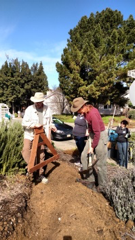
When I was asked to write a short piece about the “Land Caretakers” program, at first I was at a loss as to what to write about. So much has happened in the course of my time with the program that to try and get it all into one article is difficult at best.  What an amazing adventure these classes have been. Some classes are hands on, and we get to install urban food forests in various places around the city. Some sessions are “off campus” and are wonderful field trips to visit various people and places. And then some days are opportunities to learn to run a profitable business.

David Mudge Consulting

David Mudge Consulting

First we spent weekends learning so much about the fascinating world of sustainable gardens and bio-swales with the delightful David Mudge , who’s easy demeanor and delightful personality, made a day behind a shovel and pick ax just about the best day ever! David is always eager to answer any questions about sustainable gardening and has wonderful stories to tell as well!

We then went to UC Davis where we spent 2 days learning about how to select, house and care for chickens. While there we visited with experts in all areas of poultry science…from pedigree to pests, from the eggs formation to its final inspection by the “egg police”. Even for someone who grew up taking care of the family chickens was so much more I was able to learn.

We also spent several weekends learning about “wise water” and how to “slow it, sink it and spread it”. We all watched as we adjusted water flow out of gutters and into swales. We crawled under houses to learn about laundry to landscape applications and running pipe in some very small places, my claustrophobia not withstanding…..

We also attended a week long  gray water installers course lead by the amazing Laura Allen, author of “The Wise Water Home”, where we were not only taught the history, policy and processes of gray water installation, but we made lots of wonderful new friends as well.

Laura Allen of Gray Water Action teaching gray water installation

Laura Allen of Gray Water Action teaching gray water installation

We were able to visit with several owners of existing urban food gardens with chickens and help then make additions to their landscape. There were also “makers” nights where we got together and built a chicken coop for one of these gardens.

These are just some of the opportunities I would never have been given had it not been for the Benicia Land Caretakers program. And the best part was that I was able to immediately apply what I had learned and by the end of the weekend a new skill was aquired, more importantly the program provided me with the fruit of possibility.

Leveling a swale

Leveling a swale

As one of the first graduates of the Land Caretakers Program, I know how much I learned from all the wonderful instructors and classes the program offers. Going through the program presented me with an enormous amount of information in various areas of organic farming and wise water usage. As the months went by I grew with each weekend class and blossomed with each completed garden installation.

As each new garden was installed, not only my knowledge grow but so did my love for what I was doing. Every weekend I saw how much these families were impacted by the gardens we were installing. When I was able to visit one of our first gardens after a year of growth I was blown away and it became apparent I needed to be even more involved with the Benicia land caretakers program.

Me doing some planting

Me doing some planting

So when this new group of caretakers begins this fall I am excited to say that I have been lucky enough to pick up some additional responsibilities and will be working more with the garden installations. I am looking forward to spending time speaking with others about an amazing array of water savings programs and the potential of the urban food garden.

Because my garden roots started on a small family farm in Oklahoma I understand the value of the garden to a family. We raised organic vegetables for additional food and income for the family and sold them from the back of our pickup truck. I spent many of my before and after school hours working the gardens with my father, dutifully picking bugs from the tomatoes and potatoes and learning a keen sense of appreciation for all that grows. Little did I know that these early years on the farm would help guide my career choices later in life….

More recently, my background in landscaping has been in a more traditional role. As a supervisor at a typical “mow, blow and go” landscaper, I saw firsthand the lack of bio –sensitive business practices in the industry.  We tore out yard after yard and replaced it with rocks, caring little for how we left the earth. Surprisingly, even with the potential catastrophic effects to the industry from the looming drought, many in the industry are slow to change traditional practices.  I believe that a big part of caring for the land is education. If I can help someone better understand what is happening in the soil in their garden, then they will have a better appreciation of the ground beneath them and not just see it as “dirt”.

Since graduating from the land caretaker’s course, I have started my own sustainable/edible landscaping business and have helped many people start a garden of their own. Whether it’s because of space or budget, most people start small, with just a few plants or a single fruit tree. As the garden grows, so does the excitement of future fresh fruits and vegetables, with each ripe tomato it seems a dream blossoms into reality.

landcaretakers5So you can see why I am so excited to start the new semester of the Land Caretakers program. I have been so lucky to take this class that I want to pass this opportunity on to others. Right now we are still finishing up the details of the program, but from what I see, the next class is going to be even more amazing than the first. The classes are the perfect mix of class room presentations and hands on training. The emphasis is on understanding the overall premise of water conservation and urban farming. The implementation of the strategy and processes for laying out the landscaping are taught in real life situations, not just from a textbook. The people and gardens work together to educate the caretakers and provide food for the families involved.
So that’s just a bit of the information about the program, hope this sparks a fire within you to come and learn in a spirit of not just sharing but doing. We all dream of a world where water wasting lawns are replaced with plants and trees that are providing for the family, but until we are breaking ground with a shovel it is just a dream. Come join us to be part of the team that is doing something to change the world….one lawn at a time!