Jun 13, 2018
Participatory Budgeting (PB) is a democratic process in which community members recommend to the City Council how to spend part of a public budget. It enables taxpayers to work with government to make the budget decisions that affect their lives. Developed first in Brazil in 1989, Participatory Budgeting is now practiced in over 1,500 cities around the world.The City and Vallejo residents’ involvement in Participatory Budgeting has made Vallejo a model for city and government institutions worldwide. Through new partnerships with universities and educational institutions, non-profit organizations, generated recognition from The White House,
The Atlantic,
Slate Magazine, Time and
National Public Radio, Vallejo has become the gold standard for public participation and collaborative government.
What is the Participatory Budgeting Steering Committee?
The Participatory Budgeting Steering Committee facilitates the PB process, which includes recommending program rules, planning public meetings, and conducting outreach with diverse communities.
Members work with City Staff to ensure that PB Vallejo is transparent, fair, and inclusive.
The committee has a total of 11 seats, comprised of organizational and at-large members.
Committee members serve for 2 cycles of Vallejo’s PB process (Approximately 2 years).
Currently, there are 6 member vacancies and 3 alternate member vacancies.
Applications must be received no later than close of business on Friday, June 15, 2018.
City Council interviews have tentatively been scheduled for the weeks of July 2 through July 16 starting as early as 5:30 p.m.
Applicants must attend the interview in order to be considered for appointment.
Jun 7, 2018
 The Common Ground Team led by TLS Landscape Architecture has presented the “Grand Bayway” vision at the Resilient by Design Challenge in San Francisco, May 17th. The proposal looks at a resilient future for flood threatened and congested State Route 37 connecting the northern edge of San Francisco Bay as well as a vast restored marsh and tidal complex adjacent. The result creates a new Ecological Central Park bigger than the area of San Francisco itself.
TLS collaborated with architect Michael Maltzan, on an iconic bay crossing on a braided, elevated causeway with separated lanes and diverse transit options 25 feet above migrating tidal marshes. It creates a scenic experience of views to bay landmarks like Mt. Diablo and Mt. Tamalpais, and a front door on the immense open space of tidal sloughs and restored wetlands. Bike and pedestrian trail also “unspool” and provide access to trails, boardwalks, kayak routes, floating fishing camps, 19th century ghost towns that provide excursion train stops.
The marsh complex, largest in the Bay Area is also threatened with inundation by rising tides and flooding. Working with the local ecological community, a spectrum of terra-forming techniques for marsh and benthic habitat recovery will create a vast working laboratory for experiments and pilot projects to benefit similar conditions found around the Pacific Basin.
Urban gateways from the diverse and rapidly growing cities of Vallejo and American Canyon invite new populations to this 21st century, ecologically-oriented open space. Visitors can arrive at intermodal hubs by car, ferry, or train and be equipped and launched for explorations into a part of California, previously unknown to the public. First stage projects will take shape with the next 2 years and engineering of larger scale initial phases will be coordinated with Caltrans alternative planning over the next year.
Working with Exploratorium and Rana Creek Design, the team has also released an explorer’s map for the North Baylands as an outcome of this project which allows people to explore hidden cultural and ecological stories as they hike, bike, drive and kayak through the Baylands.
Team Common Ground
TLS Landscape Architecture
Exploratorium
Michael Maltzan Architecture
Guy Nordenson and Associates
Sitelab Urban Studio
HR&A Advisors
Lotus Water
Rana Creek Design
Dr. John Oliver
Richard Hindle, UC Berkeley
Fehr & Peers Transportation Consultants
Project video:
https://www.youtube.com/watch?v=Suv-_jKwLzU
Mar 29, 2018
On March 21st, The League of Women Voters hosted a panel discussion on climate change, rising sea level, water shortages and increased water cost in Benicia. The panel consisted of three key Solano County residents. Jerry Potter, a Nasa Climate Scientist, spoke about climate models used to predict global warming and shared overwhelming data regarding increasing temperatures on earth. Not one person in the room argued against the evidence. He emphasized that storms and drought will be more intense as temperatures increase.
Andy Florendo, from the Solano County Water Agency covered the history of Lake Berryessa, Lake Oroville and our Solano County water shed. He stressed the disturbing fact that California water shortages will remain chronic and if do do not begin using water more efficiently. Mayor Elizabeth Patterson talked about integrated water management and highlighted the importance of working together as a County to be more efficient with our use of water in our Mediterranean climate.
During the Q&A session, one main concern voiced from a woman on a fixed income was the high cost of water in Benicia. From the shakiness in her voice, the room could sense how deeply increasing water costs were impacting the financial health of her household. She was making significant changes to conserve water in her household yet her water bill remained a financial burden. This is a problem with no real easy solution. The cost to treat poor water quality is a major component to why bills are so high.
Mayor Patterson was kind enough to listen to my question after the allotted time for Q&A. I asked, “What incentives are being done to motivate Benicia residents to install laundry-to-landscape greywater systems?” Residents are washing their clothes weekly, so why not recycle this water to irrigate the landscape? Using secondary water sources such water from your washing machine is a steady water source during the summer and can be used to water fruit trees, berry shrubs and many other plants.
Mayor Patterson commented that would like to hear from the Benicia community about ways to come together to conserve more water. Show up to the next town hall meeting and collaborate with the community for creative solutions to use water more wisely. The next city council meeting is Tuesday, April 3 at 7:00pm held in the Council Chamber at City Hall. Hope to see you there!
Feb 28, 2018


[Common Grounds in the Baylands] [Public Outreach at SF Bay Flyway Festival on Mare Island]
Team Common Ground, a group of designers, engineers, scientists, and educators is working on a design study of the San Pablo Baylands and highway 37 corridor for the Resilient by Design|Bay Area Challenge.While the focus of the design challenge is on strengthening local and regional resilience to sea level rise, severe storms, flooding, and seismic events, the team is also trying to address other, sometimes more pressing challenges including lack of housing, displacement, limited access to public land, and outdated transportation.
Along with local stakeholders and the input of San Pablo Bay communities, Team Common Ground is looking at ways that people around San Pablo Bay could share and steward environmental resources while having more diverse means to connect with each other for work, living, recreation, food and health, and cultural ties.
This focus on San Pablo Bay has made understanding the work-to-date on State Route 37 (SR 37) and baylands conservation important aspects of the team’s approach. The project aims to reimagine the SR 37 corridor, support ongoing restoration of the Bay Area’s largest continuous marsh system, and equitably connect communities around San Pablo Bay through a resilient and diverse transportation network. To unite the communities of San Pablo Bay with the rest of the Bay Area, Team Common Ground envisions transitioning from predominantly single-function transportation infrastructure to a network of interrelated modes that encourage smart growth, are resilient to sea-level rise and seismic events, and that accommodate natural hydrological dynamics to incrementally restore vibrant and functional bayland ecosystems.
TLS Landscape Architecture Principal Erik Prince described the team’s scope, “We see our role as supporting and building on the work that’s already underway, communicating the risks of sea level rise, helping to provide an appealing vision of what the future of the SR37 corridor and baylands might look like, and working with community leaders to get broad-based stakeholder buy-in. We want our proposal to be realistic, but we also want to provide a fresh look at the problem while still drawing from and supporting the years of hard work that’s already been done.”
Team Common Ground consists of: TLS Landscape Architecture, Exploratorium, Sitelab Urban Studio, Michael Maltzan Architecture, Guy Nordenson & Associates, Rana Creek Design, Lotus Water, Richard Hindle, Dr. John Oliver, HR&A Advisors, Fehr & Peers Transportation Consultants.
Feb 26, 2018
by: Elena Karoulina, Executive Director
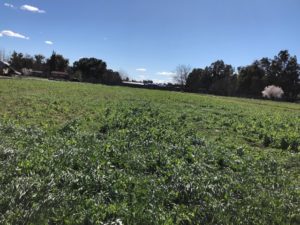
A couple weeks ago I had a great visit with Denise and Ben Lyons at their Lockewood Acres Farm in Vacaville. As a part of our work on the Solano Local Food System, I am getting to know local small farmers who are doing things right: they take care of the soil on their farms, plant diversified crop, pay special attention to the health of their water, strive for low-input farming (producing most of the fertility on the farm), and as a rule, look to work with nature, not against it, in harmonious, healing relationships with land, all living things and their communities.
Denise and Ben Lyons are this type of sustainable farmers. Their 10-acre beautiful, certified organic farm is located in the agricultural area between Vacaville and Dixon. When I came on a breezy & chilly February morning, both farmers were outside: Ben was fixing things around the barn, and Denise was wrapping up a meeting with Solano farmbudsman, Sarah Hawkins, going over rules and regulations governing various aspects of the farms’ operation. Even a small farm is a serious business, with its hard labor in the fields, barns and orchard, and different, but equally demanding work behind the scene: marketing, accounting, legal compliance, reporting… The work is endless and most of it is unseen by the community that gets to enjoy the fruits of this hard labor.
Most of the fields were resting for winter, covered by a green blanket of cover crop – fava beans, peas and other nitrogen-fixers. Before these plants go to seed, Ben will work this green manure into the fields, enriching and nurturing the soil, increasing its organic matter and improving water retention. This healthy soil will then feed the plants growing there that will eventually find their way to our kitchens and tables: tomatoes, cucumbers, eggplants, peppers, watermelons, salad greens, squashes, culinary herbs, and all sorts of root vegetables.
Fruit trees in the nearby orchard were also resting, waiting for the time when the sap will begin to flow, followed by beautiful fragrant flowers and then fruits. Apples, pears, all sorts of citrus, persimmons, plums, cherries, pomegranates, and figs – the list goes on and on of the bounty produced in this well-designed orchard. Olives are pressed in small batches in a local olive press – you can buy this olive oil directly from the farm.
Countless chickens were roaming the orchard, scratching the soil and adding natural fertilizers everywhere they went. Careful selection of heritage breeds provides for nutritious eggs in all possible colors: dark brown, light brown, blue, green, white.
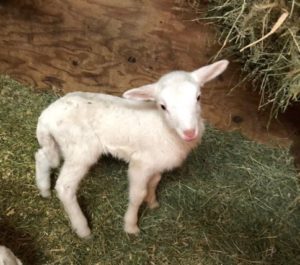
In the small barns, there were dairy goats and hard-working sheep that regularly provide grass mowing services in the orchard, surrounded by adorable little ones constantly looking for milk and warmth. Keeping animals on the farm ensures a reliable source of manure, the traditional foundation of soil fertility, that decreases the demand for the outside input and supports this vibrant ecosystem called “Lockewood Acres Farm”.
An apiary completes the picture of the farm. Raw, delicious honey is available for sale year around.
Denise and Ben’ journey to this farm started with a discovery of the benefits of earthworms. Their original vision was to develop a homestead to nourish the immediate family. The vision eventually grew to include feeding the community! After the initial skepticism (mostly from Ben), the couple turned to organic farming, which Ben now describes as a “common-sense approach to farming”.
Would you like to join the community of the Lockewood Acres Farm well-nourished customers? This is what the Community Supported Agriculture stands for! Sign up to become a member of this farm’s CSA program. For more details, click here. If you are at the Vacaville Farmers Market on Saturdays, stop by the Lockewood Acres Farm stand and please say hi from their friends at Sustainable Solano!
There are multiple ways to participate and the farmers are flexible to work with you and your budget to provide nutrient dense, wholesome food for you and your family!
Nov 1, 2017

Solano County middle and high school students and their teachers are being asked to “Imagine a Day Without Water”- this year’s theme for the 2018 Water Awareness Video Contest, sponsored by the Solano County Water Agency and local water utilities. Participating students and teachers will have the chance to win up to $1,500 in cash by creating an original 60-second Public Service Announcement video on a variety of water efficiency topics, highlighting actions that can be taken each day to use water more wisely.
Solano County teachers who sponsor multiple students will receive an additional incentive of Amazon gift cards.
The contest is open to middle school and high school students in Solano County. Submissions will judged on entertainment value, originality, videography, style and organization, audio/sound, movie content and accuracy. The deadline to enter is Wednesday, April 11, 2018.
For contest rules and entry forms and tips on using water efficiently, visit the video contest page at www.solanosaveswater.org