Growing Healthier Plants and Ecosystems Regeneratively With Biology

By Michael Wedgley, Permaculture Designer and Soil Food Web Lab Technician

We are excited to be working with Michael and Hampton Bay HOA on the designs for two pilot sites that will demonstrate how lawn in common areas can be replaced with low-water, low-maintenance sustainable landscaping that is healthy, beautiful and natural. Here, Michael shares about the importance of healthy soil biology as part of that equation.

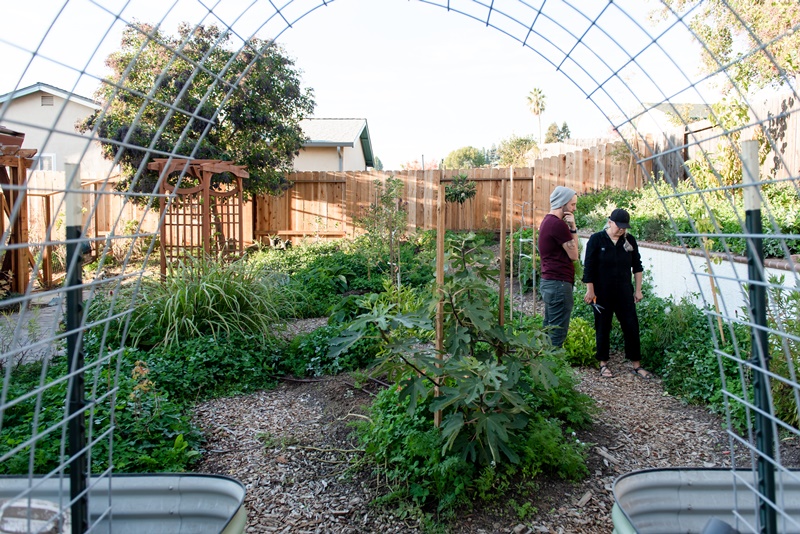
Michael Wedgley meets with a client in a permaculture garden he designed with healthy soil biology in mind.
Photo courtesy of GMC Photography and Video

Growing with biology is a decision to strike symbiosis with the natural world and allow natural systems to support the life of your plants. We can create greener, more vibrant ecosystems that support wildlife and humans more effectively and abundantly. We eliminate the need for toxic and time-consuming applications to “feed” plants and keep disease and pests at bay. By introducing biology into systems that are lacking and nurturing their establishment we can achieve balance in a system that allows us to let go of the wheel and let nature take over. This blog is meant to give a brief introduction to the natural process in action that allow for this transition.

Learn more about the Hampton Bay HOA project and Permaculture Designer Michael Wedgley on our HOA Projects page.

Who Are the Players

Fungi – Mushrooms are the fruiting body of a group of organisms known as Fungus. There are Fungi that break down material like leaves and wood, Fungi that form beneficial relationships with plants, and Fungi that parasitize plants. Fungi is the dominant nutrient-cycler in an old growth forest.

Bacteria – There is aerobic (oxygen preferring) and anaerobic (lack of oxygen preferring) bacteria. Most beneficial soil bacteria is aerobic; most disease forming bacteria is anaerobic. Bacteria help to mine nutrients from parent material and create structure in soil.

Nematodes – Nematodes are like microscopic worms. There are 3 primary groups to be aware of; bacterial feeding, fungal feeding, and root feeding. Root feeding can cause plant disease.

Protozoa – Large single celled organisms that feed on bacteria.

Nutrient Cycling

By ensuring that soil has adequate numbers of each of our microbial populations we eliminate the need for fertilizers. All soils have the necessary nutrients for plants to thrive. The biology in the soil makes those nutrients plant available through the nutrient cycle. This semi-complex interaction starts primarily with bacteria and through predation by nematodes and protozoa, excess nutrients are released into the soil.

Diversification and Disease Prevention

By ensuring that we have high and diverse populations of beneficial microbes we ensure there is no room for disease organisms to dominate and thrive. In general, just as in the human body, disease organisms in the soil and on the surface of the foliage of plants need a weak ecosystem to establish and thrive. By creating a diverse and abundant ecosystem of microbes we create a system that is impenetrable by diseases and pests.

Fungal to Bacteria Ratio and Weed Suppression

By customizing the ratio of the amount of Fungi in the soil to the amount of Bacteria in the soil, we can actually select for which plants we want to grow and eliminate weed species. To understand this, consider an old growth forest. You’ll notice that there are ferns, there are large coniferous trees, but nowhere can you find your typical garden weeds. The reason for this is the form of nitrogen released by fungi. This form of nitrogen (ammonia) is a lower ph. This is why you hear people say “blueberries prefer acidic soil.” On the other end of the spectrum (bacterially dominated) you have early succession plants like grasses. This is because the exudates created by bacteria are more alkaline. You don’t see many trees in prairies. Applying different compost preparations that have higher fungal to bacterial ratios we can begin to affect the ratio in the soil and have healthier plants and select against weed species.

Thermophilic Compost

The process in which we create compost to ensure the highest diversification of beneficial organisms and that we are able to eliminate pest organisms is through Thermophilic Composting. Using a diverse source of material, in the right balance, while maintaining aerobic conditions we are able to raise the temperature of a pile to the point that disease and pest organisms are destroyed while beneficial ones are left to thrive given the rich and diverse foods provided. We monitor the pile’s biology by assessing it under a microscope. Once the biological numbers are at our desired numbers it is ready for a number of applications.

Applications

With a microbially dominant compost that has our desired ratio we can apply the microbes through 3 primary applications.

  1. Direct compost applications – This application is recommended if the organic matter is lacking in dirt we wish to grow in. We can either till in some compost or apply to the surface of dirt.
  2. Compost extract – In this application we actually extract the microbes out of the compost and they become suspended in water. We can then apply this as a root drench to put the biology right where the plants will use it, or at areas of compaction where the bacteria can begin to loosen it up and create aerobic conditions with improved soil structure.
  3. Compost teas – Once we have an extract, we can “brew” it by adding oxygen into the water with some foods for the microbes. We let the extract bubble with aeration for roughly 24 hours while monitoring the growth under a microscope. Given time, bacteria and other microbes are able to multiply and form glues that allow them to stick to surfaces. We then spray this compost tea on the leaves of plants giving them a protective barrier from disease-causing organisms as well as allowing for nutrient exchange on the foliage of plants.

The number of applications necessary to establish a resilient and sustainable colony of beneficial microbes in the soil varies given many variables. The best way to picture what it takes is to think of settlers settling America, according to Elaine Ingham, microbiologist and researcher who created the Soil Food Web approach. Sometimes the first to arrive didn’t survive or few survived. The next ship was better prepared, or there were some settlers previously that made conditions slightly more hospitable so more were able to survive. Every subsequent ship going forward led to increasingly successful population growths until they became sustainable and reproduced and growing. It is the same with the microbes, and varies depending how hospitable or inhospitable the soil is to begin with, and how well it is protected during colonization.

Fertilizers, Pesticides, Salts, and Chemicals in Water

In establishing and maintaining healthy plants and healthy soil in a biological method we need to ensure the health and safety of the organisms. We must become caretakers of the invisible life that populates the soil beneath our feet and the foliage up above. A critical piece of this care is to ensure that their environment is not compromised by salts or chemicals which can completely eradicate the microbial populations. Fertilizers are a form of salts. All salts will dehydrate the cells of the microbes and cause death. Pesticides are created to destroy life. Even “targeted” pesticides have unwanted casualties and can upset the balance. Lastly chlorine and chloramine in water are designed to ensure lack of microbial growth in the pipes and therefore can do the same in your soil and on your plants. It is extremely important that we understand how fragile ecosystems can be. In general, these natural systems are extremely resilient, but when humans come in with their toxic approaches we upset the balance. Nature will always find a way back towards its attempt at turning everything into an old growth forest, but that takes time. If we want to have healthy and natural environments we have to help the biology along and make sure we don’t destroy it with our products.

Compost Happens 101

By Lori Caldwell, CompostGal

Lori Caldwell covered all the basics of successful home composting during her recent talk. In this blog, she takes the opportunity to answer some of the most common questions and some of your specific questionsYou can watch Lori’s talk in the video here and read her responses below.

Find the handouts from Lori’s talk and more soil resources here.

Connect with Lori:

Lori Caldwell

compostgal@hotmail.com

Facebook & Instagram @compostgal

Thank you so much for your attendance and participation at our last webinar about the wonders of making and using compost! As promised, here are some answers to some of your questions. I’ll be throwing in some links, etc. as well. Composting is a wonderful addition to any garden!

Can we compost weeds?

As a new rule, I’ve stopped putting weeds in my compost pile. My concern is that the seeds, stems, roots of the weed would not be killed off by the lower than needed temperatures in my compost pile.

Can you include small flooring samples?

This is one of the items on the Do Not compost list. Wood products that contain glues, waxes, resins, etc. will do harm in the bin and most likely never break down.

Are maggots bad in compost? My compost has hundreds of them. What should I do?

Maggots are not welcome in a compost pile. If maggots are seen in the pile, most likely there’s something in your pile that shouldn’t be. Items such as cooked food or meat will attract the maggot fly. Remove the item from your pile, water and aerate. Top this pile with a thick layer of browns (leaves or chipped wood).

Do you have suggestions for getting rid of beer brewing grains?

Absolutely! These will be a great addition to a compost pile. Just a heads up: They will have a lot of nitrogen and if added fresh, also hold a lot of water. You’ll need to aerate often and help absorb the moisture by adding those browns! You can also expect your pile to get hot as well! Lucky!!!

Are there special worms to get? I heard there’s worm that are not earthworms.
So, if you are talking about worm composting, yes! The red wriggler (Eisenia fetida) is the specific worm used in vermicomposting. They are the type of worm you’d see on a hike, under the leaf litter. If we are talking about basic composting, then the purchase of worms is totally unnecessary. When you place your compost pile on top of the soil, then you have a direct line to the “wormverse.” They will come and go in your pile in great numbers, enriching your compost with their castings.

Can I just bury the kitchen scraps next to the fruit tree root as compost?

Pit/trench composting as it’s usually called is a much slower way of composting in place. Digging a hole/trench at least 6-12 inches deep and burying your scraps can work, but since there’s no aeration or addition of water it breaks down much slower than basic composting. You still must make sure there’s a balance of browns and greens. Personally, I wouldn’t recommend pit trenching too close to existing plants. If the balance isn’t right, then the materials break down without the aid of oxygen (aka anaerobic). Anaerobic conditions can be problematic for adjacent plants.

Should newspapers be shredded?

When you include newspapers in your pile, hand shredding is the way to go. You want thicker pieces to help absorb excess moisture. Just be mindful when you add newspaper to the pile that it can mat quickly. More aeration will help with that.

Will the heat in the bin kill any diseased plants?

If you can get your bin to temperatures above 130 degrees and if you can maintain those temps for about three days, then yes. Getting temps that high will require some extra work on your part:

  1. Creating a pile 3’x3’x3’ or larger
  2. Utilizing high nitrogen feedstocks such as grass clippings from untreated lawns and/or fresh chicken manure

What should I do with my compost bin during cold winter months?

Winter climates doesn’t mean that composting must stop! The goal is going to be trying to keep temperatures high as possible and to keep it from getting too wet. In preparation for the snows, you should try to increase the size of your pile (3’x3’x3’ or larger). Some composters like to surround their piles with bales of straw too. I’d consider covering the pile with a tarp to keep it from getting too wet and even an old blanket or rug to help insulate from the top. Keep maintaining it as usual.

I have mushrooms growing on top of my compost pile
Completely normal!! Fungus is part of the process, so a welcome sight. Sometimes you’ll see white, cobwebby matter in the bin. Again, totally normal! Actinomycetes is present. It’s what gives compost a sweet, earthy smell. Sometimes, items germinate in your pile too. Potatoes and tomatoes are the usual suspects.

I spoke briefly about the Marin Carbon Farming Project during the talk. I’d thought you’d like to read the article. Compost rules always!

Marin Carbon Farming Project

Video: How to use compost

https://youtu.be/G87wRvVCuCg

Video: Planting Seeds with Compost

https://youtu.be/JH4Hp0o1EWg


If you are looking to purchase compost in bulk for your larger projects:

Marketplace | Lawn to Garden

Enjoy the talk? Take this survey to help us determine future sustainable landscaping classes.

The talk was generously funded by Republic Services and the Solano County Water Agency.

A Lesson from the Rain on Healthy Soil

By Alexis Koefoed, Soul Food Farm

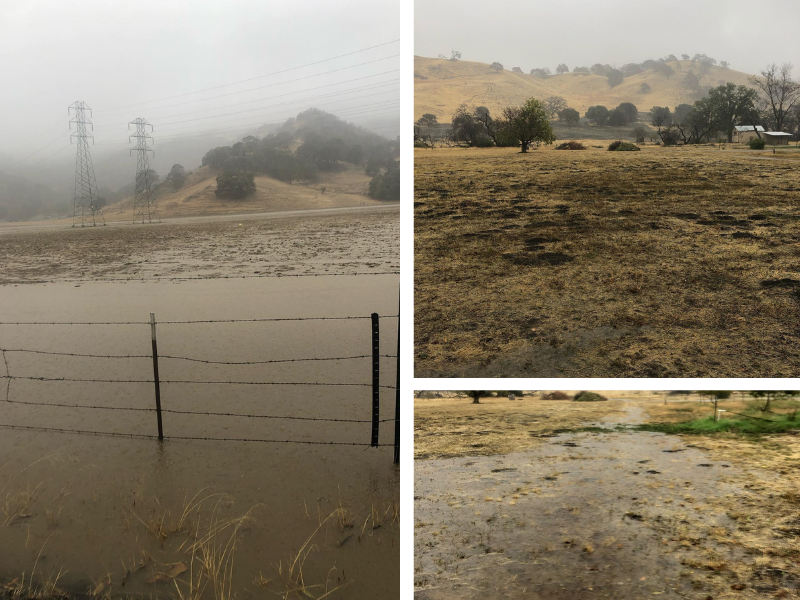
Soul Food Farm‘s Alexis Koefoed shared these photos and thoughts during the rainstorm Oct. 24 that over the weekend brought more than 10 inches of rain to parts of Vacaville and at least 4 inches or more to other areas of Solano County. We wanted to share her insight about the importance of healthy soil in helping to address extreme weather events — a why farms like hers that use regenerative practices are so important.

Photos courtesy of Soul Food Farm

I thought today was a good opportunity to talk about the benefits of leaving living roots in the ground.

The first photo is the ranch directly across the road from Soul Food Farm. For 20 years this field was grazed by cattle and then rotational hay cropped, seeded and baled. While those old time farmers would not have called their farming practices regenerative, they knew how to take care of their land resources. Every year the soil provided grazing and hay crop.

Two years ago a new owner took over the same property and immediately began to overgraze the field with his cattle. To the point that the soil became completely pulverized.

Durning our frequent wind storms, a huge cloud of fecal dust blows over Soul Food Farm.

I’ve watched this living, thriving soil become degraded. A property I used to enviously wish was mine now is watched with worry about how its failure will impact our farm in a severe weather event. Like today.

So the first photo shows major flooding. Without soil cover, weeds, a crop, wild grasses, etc. There are no roots to hold the soil in place. And by extension no biology in the soil to convert carbon drawn from the air into food for the billions of living organism found in vibrant soils.

The next two photos are the fields on my farm. Where we have been practicing and learning to implement regenerative and no till practices for the last six years. The photo of the large field has no flooding.

The photo with some sitting water is roads and walking paths. A mini example of what happens when you have exposed dirt without a living plant on top.

Today while we celebrate the rain, but worry about such a huge moisture dump in a short period, I’m reminded of how important it is to manage our farmlands with integrity.

Extreme weather events are not going to diminish. And we have a huge opportunities as farmers, big or small, to use our soil as buffers to extreme weather conditions.

Healthy soils translate immediately into clean water ways, carbon sinks, healthy crops, thriving microbiology and productive domesticated animals.