Simple Greywater Systems Bring Laundry Water to Your Landscape

By Sustainable Solano

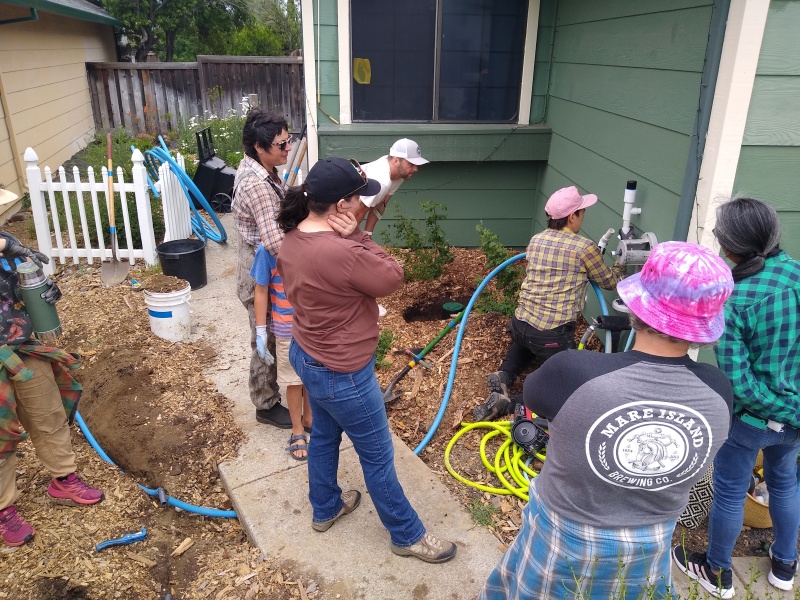
Participants learn how to install a laundry-to-landscape greywater system at a Vallejo home

With California in a state of severe to exceptional drought, it is a good time to think of water conservation and reuse to keep your trees and shrubs alive during the dry months.

Sustainable Solano works with our partner organization, Greywater Action, to bring hands-on workshops to Solano County where you can learn how to install a laundry-to-landscape system at your home. These simple systems reuse water from your washing machine to irrigate mulch basins, often around trees, in your yard. The systems require a few tweaks in habits – you have to use specific kinds of laundry detergents that will be kind to your plants and have to remember to switch the three-way valve to send water to the sewer when using bleach, washing diapers, etc. But it is a great way to reuse water to keep your landscape healthy.

SuSol is currently looking for Solano homeowners who are interested in hosting one of these workshops. Homes must meet certain criteria to be a good site for a workshop, for example the washing machine must be located by an exterior wall. Simpler setups are best for teaching others how to install a system at home. If you would be interested in welcoming community members to your home to get your laundry-to-landscape system going, please fill out the interest form at this link: https://www.surveymonkey.com/r/ZC36ZMC.

We will review the interest form and contact those with compatible homes for a site visit.

Suisun City Seeks Community Input on Addressing Biggest Local Climate Challenges

Aug. 24, 2022
For immediate release

Media Contact: Allison Nagel
805-512-0901
allison@sustainablesolano.org
Interviews, photos and other materials available upon request

Suisun City Seeks Community Input on Addressing Biggest Local Climate Challenges

Suisun City faces threats in the years ahead from a variety of climate-related issues, most notably flood risk from sea level rise and more severe storms. A new report outlines some of these issues and will serve as a starting point for community conversations around risks and possible solutions for the city to pursue.

Details from the report and opportunities for community input will be covered in a presentation to the Suisun City Council at its meeting Tuesday, Sept. 6. Alex Lunine, Sustainable Solano’s Resilient Communities program manager, will give the presentation.

The report comes out of a Community Resilience Building Workshop hosted by Sustainable Solano through its Resilient Neighborhoods program and under the guidance of The Nature Conservancy. This June workshop brought together city residents, business owners, city leaders and environmental professionals to talk over environmental hazards and outline some preliminary community priorities. The Nature Conservancy created a summary report from this meeting that will now be used by Sustainable Solano, the city, and a core team of community members and local officials to seek resident feedback and guidance.

Mayor Pro Tem Alma Hernandez, who also is a member of the core team, noted that Suisun City is the first West Coast city to host a Community Resilience Building Workshop with The Nature Conservancy. She said there is potential to help other cities in the region benefit from those efforts and find similar ways to connect with community members around climate challenges.

“Suisun City in Solano County is emerging as a leader in the environmental and climate space,” she said.

The United States Conference of Mayors recognized Suisun City this summer with a Local Climate Action Award for its city-wide energy and infrastructure program to curb greenhouse gases.

“We definitely have much more work to do, which is why we are proactively engaging with Sustainable Solano, BCDC [San Francisco Bay Conservation and Development Commission], and other agencies to continue to work on pressing environmental concerns such as sea level rise,” Hernandez said.

Highlights of the report include identifying some high-priority areas for possible action, including

  • Access grants to install preventative flood infrastructure such as living-levees and critical pump stations;
  • Implement hazard and warning signs along flood-prone roadways to increase public awareness;
  • Bring findings to City Council to get flooding prevention measures enacted and to incorporate successful actions by neighboring Bay Area communities;
  • Secure funds to continue vulnerability assessments and planning over the next 10 years.

Other risks discussed in the report include wildfires, earthquakes and high wind events.

Suisun City residents are encouraged to read through the report and take advantage of a number of opportunities to engage around the environmental issues outlined.

These include attending the City Council meeting on Sept. 6; attending a meeting of the city’s Environment and Climate Committee, which meets on the fourth Monday of each month; or participating in a special listening session as part of the Suisun City Climate and Environmental Festival planned for Saturday, Oct. 22. The Festival will have a special focus on the report this year, with a speaker on the challenges Suisun City faces, presentations from Sustainable Solano’s Resilient Neighborhoods interns, and a listening session with city officials and community leaders around the report and community-directed action to address these challenges. 

Sustainable Solano will be at the #IARTSuisun community art event on Saturday, Sept. 17 — another opportunity to discuss the environmental challenges and the report in advance of the Festival. Community members are also encouraged to participate in a Suisun City Flood Walk offered from 4-5 pm on the second and fourth Saturdays of the month, where they can learn more about the flood risks faced by the city and share their insight.

Sustainable Solano has also created a simple feedback form to gather community input or questions about the report that can be shared with city leaders.

About Sustainable Solano

Sustainable Solano is a countywide nonprofit organization that is dedicated to “Nurturing Initiatives for the Good of the Whole.” The organization, now in its second decade, brings together programs that support and sustain one another and the Solano County community. Initiatives include sustainable landscaping, local food, resilient neighborhoods, youth leadership, sustaining conversations and community gardens.

For more information, visit sustainablesolano.org 

Sustainable Solano’s Resilient Neighborhoods program is funded through the Pacific Gas & Electric Corporation Foundation.

Learn more here: https://sustainablesolano.org/project/suisun-city-resilient-neighborhoods/

Important events to offer Climate report feedback:

6:30 pm Sept. 6: Suisun City Council meeting (with public presentation)

6 pm Sept. 26. : Environment and Climate Advisory Committee meeting

Oct. 22: Climate and Environmental Festival (with listening session on the report) (more details will be available soon)

Relevant links:

Suisun City Community Resilience Building Summary Report: https://tnc.app.box.com/s/wg7eby3hcn01ngvyon42rirm1srotw0d 

Suisun City Council: https://www.suisun.com/government/city-council/ 

Environment and Climate Advisory Committee: https://www.suisun.com/government/citizen-governance/environment-climate-committee/ 

Climate and Environmental Festival (2021): https://sustainablesolano.org/climate-environmental-festival-reconnects-community-to-create-change/

#IARTSuisun: https://www.facebook.com/iartsuisun/

Upcoming Flood Walks: Sept. 10: https://www.eventbrite.com/e/910-suisun-city-marina-flood-walk-tickets-406485467977

Sept. 24: https://www.eventbrite.com/e/924-suisun-city-marina-flood-walk-tickets-406485959447 

Feedback Form: https://www.surveymonkey.com/r/BZQHSGW

Classic Andalusian Gazpacho

Photo Credit: Unsplash

Recipe from Chef Lisa Núñez-Hancock of UR What U Eat

Ingredients:

2 medium cucumbers, peeled
5 medium ripe tomatoes
1 medium red onion
1 medium bell pepper (red or green)
2 cloves of garlic
4 cups French or Italian rustic style bread
4 cups cold water
1/4 cup red wine vinegar
4 teaspoons sea salt
2 teaspoons paprika
4 Tablespoons extra virgin olive oil
Freshly ground pepper to taste

Coarsely chop cucumbers, tomatoes, onion and bell pepper. Reserve a small amount of each for garnish. Mince garlic and combine vegetables in a large bowl. Remove crust from bread (reserve for croutons for other recipes) and cube interior of bread. In a separate bowl combine vinegar, water, salt and paprika. Combine chopped vegetables with cubed bread and liquid mixture.

Ladle mixture into a blender jar and puree until the mixture is smooth. You may have to do this in a few batches. When the ingredients are thoroughly blended stir in olive oil. Pour soup into a large bowl and cover, chilling it in the refrigerator for at least 2 hours and up to 12 hours. Just before serving, whisk mixture to recombine. Garnish each bowl with a little of the reserved chopped vegetables: cucumber, bell pepper, onion and tomatoes.

It is optional, but if you like, you can also top the gazpacho with parsley and chopped egg.

Serves 6.

Download a printable version of the recipe here.

Zucchini Salad with Lemon Zest

Photo Credit: Unsplash

Recipe from Chef Lisa Núñez-Hancock of UR What U Eat

Ingredients:

4 cups grated zucchini
1/4 cup grated lemon zest
1/4 cup lemon juice
2 teaspoons local honey
2 Tablespoons extra virgin olive oil
Salt & pepper to taste

Grate the zucchinis into a large bowl and set aside. Zest the lemons and add to the zucchini. Make vinaigrette by combining lemon juice olive oil, local honey, salt and pepper. Gently combine vinaigrette with the zucchini mixture, and enjoy!

Serves 4.

Download a printable version of the recipe here.

Lavender-Infused Beet Salad with Balsamic Vinaigrette

Ingredients:

Vinaigrette:
½ t. minced shallot
2 drops Dijon mustard
2 T. Il Fiorello Lavender Blackberry Balsamic Reduction vinegar
6 T. Il Fiorello Pendolino extra virgin olive oil
Salt and pepper, to taste
3-4 pinches fresh lavender blossoms, minced

Place shallot, mustard, vinegar, lavender and a couple pinches of salt and pepper in a small, deep bowl.
Whisk to combine. Drizzle in olive oil while whisking to emulsify. Taste and adjust seasonings.

Salad:
8 cups tender salad greens (red leaf, green leaf, butter lettuce, etc.)
1 ½ lbs. beets (red, yellow, chioggia, etc.)
About ½ t. dried culinary lavender
¼ cup toasted pine nuts
8 oz. goat cheese or feta cheese
Additional lavender blossoms for garnish

Prepare the beets: Preheat oven to 400 degrees. Line a roasting pan with aluminum foil for easy clean-up. Cut beets (if needed) into uniform sizes. Place beets and about ½ cup water into the pan and add the dried culinary lavender. Cover the pan with foil and crimp the edges to seal. Roast until beets are tender and a paring knife slides in easily (check after 30 minutes). When cool enough to handle, rub peel off beets and slice as desired. While still warm, drizzle 1-2 T. vinaigrette on the beets and set aside.

Meanwhile, wash and dry the salad greens. When the beets are done, turn the oven down to 350. Place the pine nuts on a small sheet pan and toast until golden (check them after about 8 minutes;
they burn easily!)

Gently toss salad greens with some of the vinaigrette. Place greens on plates and top with beets, then goat cheese and pine nuts. Sprinkle some lavender on top as garnish and serve.

(Serves 6-8.)

Download a printable version of the recipe here