Sep 16, 2018
 [Read SF Chronicle full article here]
“The accelerated destruction of the sacred headwaters of the Amazon in Ecuador and Peru alone will disrupt the entire Earth’s distribution of rain.”
As leaders of the Sapara people, part of the confederation of 11 indigenous nations of the Ecuadoran Amazon living in harmony with nature in the most biologically diverse terrestrial ecosystem on Earth, we have made the long trek to the Global Climate Action Summit in San Francisco for reasons that may surprise Americans and other natives of highly developed countries.
Most citizens know by now that climate change has gone beyond the threat of disrupting the delicate balance and interconnection among the nearly 4 million species of plants and animals in the Amazon (one-third of all species on Earth).
Most know that the ecology of the vast Amazon rain forest is being jeopardized by flagrant, irresponsible, and visionless drilling, logging, mining, and the slash-and-burn clearing of thousands of acres of pristine forest each day. Imagine the overwhelming sight if every tree and bush between San Francisco and San Mateo were leveled today. And then between San Mateo and Palo Alto tomorrow. And then on to Cupertino the day after. Some know that illegal and immoral disrespect for both our land and culture moves entire indigenous nations closer to extinction, along with the ancient knowledge base that our remaining elders possess.
That is our reality, but we did not come to California to ask to be saved.
The real reason we have made the 30-hour journey by foot and canoe, small propeller plane, and bus, and then international flight from our capital, Quito, to San Francisco is to deliver an urgent message to the chiefs of industry, the policymakers, and to citizens who are caught in the trance of short-term consumption: The hectic pursuit of material gain is not sustainable.
The accelerated destruction of the sacred headwaters of the Amazon in Ecuador and Peru alone, a 60-million-acre area more than half the size of California, will disrupt the entire Earth’s distribution of rain. Two and a half acres of our forest contains more species of trees than are found in the entire United States. The rivers within the clouds above our forests are larger and mightier than the Amazon River itself. They drive the planetary weather system and replenish the Earth’s cycle of fresh water. Which means the fresh water that comes out of your faucet — and the long hot showers you enjoy each morning in America or Europe or Asia — are in jeopardy.
We are here to plead with you to see that our survival is yours too.
As guardians of the Amazon for thousands of years, we know intuitively when danger is near. Our belief system is based on what our ancestors observed in the natural world. Predating Western civilization, our ancestors identified the energies and powers in all living things as spirits. As you may go to church or temple or mosques to connect with your deity, we grow up listening to the messages that come from our symphony of trees and plants, the oldest and most original species still living on Earth.
We observe the transformation of animal life, the habits of our birds, the migration of our insects, the power in our waterfalls, and the voices from our caves. Our spiritual tools for knowing are antecedents to western philosophy and scientific enquiry, and the core curricula of epistemology.
Our culture does not know the dream of the individual, the single person. We have never lived with the dream of the self-made man. We only know a world of symbiotic coexistence, one universe, and shared perpetual interconnectivity. And that is what we wish to share, considering the destruction of the headwaters of the Amazon and the “aerial rivers” of vapor will affect both the residents of your Fisherman’s Wharf and our Sapara community of Naku.
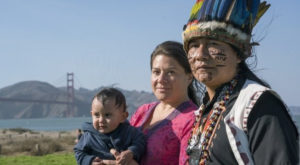
We are the parents of a beautiful 11-month-old boy named Tsamaraw, which means “neutral energy” in our Sapara language, which itself is nearing extinction. Tsamaraw’s future is intricately connected with the lives your babies also can expect. We come to San Francisco as an act of love for all the babies.
We bring an alert. We know how Americans have such gratitude and pride in their first responders when danger and disaster strikes. Think of us as the first responders who arrive before an impending catastrophe.
We come to add the indigenous voice to the plethora of voices that need to be heard, the politicians, the economists, the entrepreneurs, the scientists, the Pachamama Alliance members, and even the skeptics.
Our country has a painful history of industrial pollution with toxic waste of oil extraction entering our water table, provoking the rise of cancer, and contaminating the plants we use for food and for medicine, many of which contain the very source of medicines that international pharmaceutical companies have used to manufacture profitable and life-saving treatments and cures. And most of that oil from our Amazon is exported to refineries in California also polluting your communities. But we don’t come to blame or to point fingers.
We’ll be in San Francisco to listen to all the others. We’ll listen to the corporations and mining and oil companies, the loggers and the climate deniers, but please listen to the message we bring from the heart of the planet’s hydrological system.
On behalf of the 1,000 remaining Sapara, the 16,000 Achuar, and the 150,000 other indigenous people in the sacred headwaters of the Amazon, we will be in San Francisco to embrace all living souls, to share a life-affirming message direct from our collective heart, and to invite you to exit from a trance of reckless development and consumption. That trance forgets that the world we pass on to our son, Tsamaraw, and to your children, and theirs, embodies the future that we would want to be remembered for, one that is guided by Nature from which we come and to which we belong.
We are in San Francisco to help you change the dream of the modern world.
Manari Ushigua, a shaman, is a leader of the Sapara Nation. Belen Paez, his life partner, directs the Pachamama Alliance in Ecuador and co-ordinates the Amazon Sacred Headwaters initiative.
Sep 5, 2018
By Stephanie Oelsligle Jordan, Local Food Project Manager
I once came across a birthday or anniversary card that said something like this: “I love it when you whisper those 3 little words in my ear…..Let’s Eat Out!” It’s true. Making dinner has become something we all love and hate at the same time, and the complexity surrounding it is likely multiplied by how many jobs/children/after-school activities/deadlines you have. Even as a trained chef, I find myself at times guiltily turning to easy, processed food from a box (i.e. mac & cheese!) for my two boys on any given weeknight.
More truths: the demand for prepared food has become stronger, and the quality of some prepared foods has become very questionable. Wouldn’t it be nice if someone were around to cook you healthy dinners, made from ingredients that came from local, organic farmers in Solano County? Well, that is exactly what has been happening for the past 4 weeks. In mid-August, I began working on a pilot program with Cultivate Community Food Co-op – funded by Solano Department of Public Health – which I’ve been calling “Community Supported Dinners.” These dinners are much like what we envisioned within our original Community Food Center model – homemade meals made by local chefs from local ingredients.
The main purpose of this 6-week pilot is to test costs, logistics and other factors involved, which will provide us with information to fine tune the vision. Greg Morrison (Board Treasurer of the Co-op, and on our USDA Local Food Advisory Board) has organized a distribution plan to get raw food products from the farms to me in the commercial kitchen at Vallejo’s Dan Foley Cultural Center. Deliveries come Monday and Tuesday mornings, and by Tuesday afternoon, my assistant Veronica Bearce and I have meat or vegetarian dinners cooked, cooled, boxed, labeled and ready to get delivered to folks in Benicia and Vallejo. Speaking of Veronica, she is also the chef-owner of Veronica’s Veggies, which specializes in vegan food.
The participants for this project are largely Co-op members (sorry – it’s not open to the public yet!), who also have the option to purchase raw ingredients directly from the farms through an online ordering system. Feedback from the farmers has been positive, because they can get direct-to-consumer sales without having to stand at a farmers market or utilize other resources to get their products to people. Fresh produce for the project comes from Eatwell Farm (Dixon) and Lockewood Acres (Vacaville). Meat products are sourced from Tara Firma Farms (Petaluma), and fish is sourced from Real Good Fish, which supports sustainable fishermen/women up and down the California coast. While I have been ordering products based on consumer counts, I am more interested in knowing whether people would sign up in advance for dinners (similar to how a CSA operates). Would you pre-pay for, say, two months of dinners every Tuesday? I promise I won’t make mac & cheese.
Menus thus far:
Aug. 14: Caribbean Chicken / Black Beans with Sofrito + Coconut Quinoa with Cilantro + Roasted Seasonal Veggies
Aug. 21: Indian Spiced Lamb Meatballs / Indian Spiced Eggplant + Tzatziki Sauce + Chickpea-Tomato Salad with Feta Cheese + Whole Wheat Pita
Aug. 28: Spanish Paella with Chicken & Pork Linguica / Paella with Roasted Peppers & Onions + Lemon-Garlic Aioli + Fig Salad with Mixed Greens, Walnuts, Goat Cheese
Sept. 5: Mustard-Glazed Salmon atop Cannellini Bean & Tomato Ragu + House-made Focaccia + Classic Greek Salad
Special Thanks to Eatwell Farm, Lockewood Acres, Tara Firma Farm, and Real Good Fish for assisting with this project!
Sep 3, 2018
By: Marcella Licea
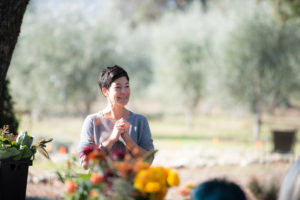
[Photo: Alexis, Owner of Soul Food Farm, Source: thepollenmill.com]
Through years of hard work and developing a deeper connection with the land, Alexis and Eric began to further immerse themselves in issues around community land use, the true cost of feeding people, workers’ rights and the humane treatment of animals. Today, Soul Food Farm is working on a number of new expansion projects that will add layers of diversity and variety for community members, such as heirloom peaches, apricots and pears. In addition to more fruit trees, they also plan on extending the olive orchard and are in the planning stages of a farm store, tentatively scheduled to open in the spring of 2019. This farm store will not only sell Soul Food Farm goods, but produce and other products from local farms in the region.
Every year, Soul Food Farm hosts a wide variety of workshops on the farm. Everything from artisan cooking classes, photography, herb gardening, basic chicken care, and so much more; our calendar of events has something for every pallet. This month on Saturday, September 22nd from 1:00pm-4:00pm, engage in a panel discussion between six of the most successful and driven women entrepreneurs of the Bay Area at Soul Food Farm’s first annual Women of Abundance Conference: Women Entrepreneurs in the Regenerative Culture, Economy, and Community. The conference stemmed from Alexis’ interest to explore the dynamics between food and agriculture and its intersection with social justice movements– both integral parts woven into the fabric of Northern California. This event will examine the ideas of competition, explore the realms of abundance and manifestation, and cultivate the possibilities of growing together in success through collaboration and support. Click here to register and ticket information.
Sep 3, 2018
By Elena Karoulina, Executive Director
We continue working on our big vision for the environmentally and economically sustainable and socially just local food system in our county. As a part of our Community Food Center project, funded by USDA, we are finalizing the feasibility study of the agriculture production available for the needs of the county. In June-July, our mighty working team of Sustainable Solano staff, UC Davis interns and a representative of the Solano Public Health, our key partner in this vision, embarked on reaching out to our farmers and meeting face to face with them to better understand the reality of farming and feeding the community in Solano County.
We reached out to 60 farms. Most of them are small to mid-size operations, producing a variety of food (mostly produce, but also honey, olive oil, eggs, meat and dairy). Not everyone was available or interested to talk with us about the emerging local food system, and we totally understand and respect this reservation. However, many opened their hearts and minds to this vision, and we are immensely grateful to the farmers who took time off their busiest season of the year to sit down with us and to tell us the true story of local food production and distribution.
We are still finalizing the results of our interviews and integrating them with relevant statistics from USDA and Solano Department of Agriculture to form an accurate picture of the state of agriculture production suitable for the local markets. What we see so far is a rather weak supply, a lack of infrastructure and most importantly, a week demand for Solano-grown food. If we are to change this picture, if we are to create a resilient local food economy, we’ll have to revisit our relationship with local food, our commitment to buying locally and our priorities as consumers.
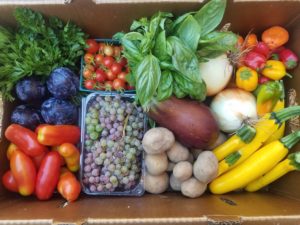 Sustainable Solano is committed to continue working with various stakeholders and community partners to strengthen our local food economy. However, we cannot do it without a broad support of this vision from our communities! Please give your personal and family food supply a thought! To find out more, attend one of our many public educational events and consider buying truly local. For the list of Community Supported Agriculture, farm stands, restaurants and retailers, please click here.
From the bottom of our hearts, THANK YOU to the owners and operators of the following farms who communicated with us during this process and contributed to our understanding of the current state of our local food economy:
Acquistapace Farms, Fairfield
Be Love Farm, Vacaville
Brazelton Ranch, Vacaville
Cherry Glen Beefmasters, Vacaville
Eatwell Farm and CSA, Dixon
Everything Under The Sun, Dixon
Grabishfarm, Dixon
Il Fiorello Olive Oil Company, Fairfield
Lockewood Acres Organic Farm, Vacaville
McCormack Ranch
Menagerie Hill Ranch, Vacaville
Pleasants Valley Honey Company, Vacaville
Robledo Produce, Fairfield
Rock Hill Ranch Chickens, Fairfield
Saechao Family Farm, Fairfield
Sepay Groves Olive Oil, Fairfield
Sierra Orchards, Dixon
Solano Mushroom Farm, Vacaville
Soul Food Farm, Vacaville
Tenbrink Farm, Fairfield
The Cloverleaf at Bridgeway Farms, Dixon
The Collins Farm, Dixon
Aug 15, 2018
 As part of a large, multi-stake Solano Local Food system project, Cultivate Community Food Co-op, in cooperation with other county organizations, will be working on a pilot project through September 21st with local farmers and chefs to offer participating co-op owners weekly home delivery of local, sustainably-grown produce and locally prepared meals. There will be no charge for home delivery for this pilot, though participants will need to pay for any food purchased.
The purpose of this effort is to collect data in regards to the costs of labor, equipment and time that is needed to develop and implement a local food network that supports Solano County consumers, farmers, and chefs. The results obtained will be used to better understand the opportunities and challenges that exist to achieve the goal of building the community and economy while improving access to healthy, sustainably grown food.
Cultivate Community Food Co-op (CCFC) will be Solano County’s first community-owned, natural grocery store providing high-quality, locally-sourced, culturally-relevant, ethically- produced and affordable products.
Click here for information about how to become a member.