Doing Good: Morningsun Herb Farm

By Sustainable Solano

Rose at Morningsun Herb Farm in Vacaville

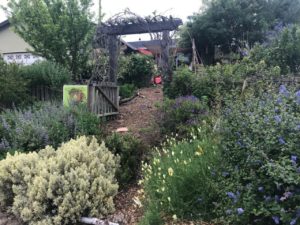
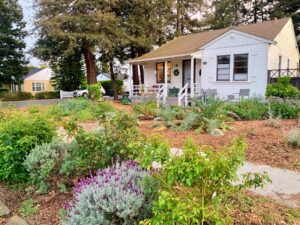
Tucked away on 3 vibrant acres in Vacaville, Morningsun Herb Farm has been a beloved part of the community for over 30 years. What began as a personal love of growing herbs blossomed into a thriving nursery and farm thanks to the vision and dedication of founder Rose Loveall.

“I never thought I would have a business,” Rose reflects. Before starting Morningsun, she spent years growing plants for the U.S. Forest Service in Placerville. At the time, she was limited to cultivating just five species, but her heart was set on growing hundreds. That dream took root when she stumbled across a magazine article about a small herb business, sparking the idea that she could do the same on her own terms. ​​

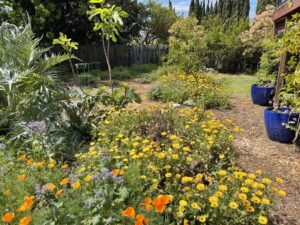
Today, Morningsun offers over 800 varieties of culinary, medicinal, and fragrant herbs, as well as drought-tolerant perennials, heirloom vegetable starts, and fruit trees. The nursery has become known for its extraordinary selection of hard-to-find and specialty plants, many of which are propagated from seed and cuttings collected right on the property. For Rose, one of the greatest joys is when a customer lights up after discovering a plant they’ve been searching for, sometimes for years.

Sustainable Solano is naming Morningsun Herb Farm as a recipient of our Doing Good business award program. Their commitment to Earth Care and Fair Share is evident in every corner of the farm.

“We go out into our own garden, collect our seed, and do our own cuttings,” Rose explains. “A lot of the plants we sell we’ve seen from start to finish.”

The farm’s beautiful demonstration gardens serve as a source of mother plants — mature plants that provide cuttings to grow the next generation. Even the plants and seeds that don’t sell find purpose through donation to schools and organizations in the community or composting. “It’s all circular,” she says. The compost and used soil are either returned to the land or shared with other farms, reinforcing a system where nothing goes to waste.

One of the things that makes Morningsun so valuable is its ability to support a spectrum of needs including therapeutic experiences. During the early days of the pandemic, the farm offered a chance for people to safely experience the beauty of the natural world. The lush gardens invite visitors to linger and breathe. “We were a place where people could come and bring their families,” Rose said.

Beyond the farm and nursery, Rose also dedicates a significant portion of her time to land advocacy. As an active member of the Pleasants Valley Agriculture Association, she works to protect Vacaville’s rich agricultural heritage. “We are so close to the Bay Area, we see ourselves getting eaten up by development,” she said. As housing and commercial projects sprawl outward, farms like Morningsun face increasing pressure.

During our visit, Rose led us to a gleaming copper still named “La Bruja”, Spanish for “the witch.” This traditional distillation machine is used to transform fresh flowers into pure essential oils, and on this particular day, it was filled with fragrant lavender. The harvest came from friend and neighboring farmer Alexis Koefoed of Soul Food Farm. Rose and Alexis run Hierbas y Flores as a collaborative venture focused on lavender oil and products. The two laughed about getting “lavender drunk” while removing the flowers from the machine. Even the byproduct of the distillation process, hydrosol, doesn’t go to waste. This aromatic floral water can be used in natural skincare products, room sprays, and therapeutic blends. Another example of how the circular system that sustains Morningsun also nurtures relationships between local farmers.

When asked what advice she’d give to others that want to make their businesses more sustainable, Rose emphasized the importance of autonomy for her employees. “I really trust my employees. They get to rebuild gardens and change things around. They know better than me who does what job the best. … If you have employees, it’s better to give them a lot more freedom.”

Doing Good

The Doing Good business recognition program spotlights Solano businesses that stand out in their efforts to support people and planet. Sustainable Solano’s work is informed by the practice of permaculture to form healthy ecosystems. The three ethics of permaculture are Earth Care, People Care and Fair Share. In business, this can mean authentic sustainability practices, how companies care for their employees, and giving back to the community. Our program recognizes businesses that excel in any of these three areas.

Know a business that is Doing Good in Solano County? Let us know by submitting a nomination form here.

Solano’s 3rd Permaculture Design Course Starts in August

By Anne Freiwald and Lydia Neilsen of Vital Cycles

We are excited to have Anne Freiwald and Lydia Neilsen of Vital Cycles return this summer for our next Permaculture Design Certificate course in Benicia — starting Aug. 23! In this blog, Anne and Lydia reflect on past programs, talk about what will be covered in this year’s program, and we share a few videos and upcoming talks. The program will run through December and is a great opportunity for people who are interested in an internationally recognized certification on how to design in a way that works with nature. Past participants have included landscaping professionals, passionate backyard gardeners, staff from land conservation and sustainability organizations and others. The program has attracted participants from around the region. We invite you to be part of building community in this year’s cohort! Learn more about the PDC and register here!

Participants in the 2023 PDC program install a garden during their hands-on weekends

We are thrilled to be returning to Benicia for another five-month deep dive into permaculture with Sustainable Solano. We are continually impressed and inspired by the commitment of Sustainable Solano and the larger community to regenerative practices and community resilience. Over the years the level of education and the multiple amazing projects that have been manifested are truly making a difference in the community. Do you want to be a part of it? Are you ready to find out what permaculture is all about and take the first or next steps on your permaculture journey? Join us this fall for your own deep dive into permaculture practice and design!


From August through December, monthly classes will guide participants through the permaculture curriculum, which covers patterns in nature, patterns in culture, design, water on the landscape, soil health and vitality, trees, plant communities and their pollinators, how water soil and plants stabilize climate on earth, urban considerations, greywater, sustainable technology, design for resilience and so much more. Hands-on activities for every topic bring conceptual learning into the practical realm. Every month will connect to the previous so that all material is integrated into one relational whole, closing loops, restoring cycles, and offering a paradigm shift in how we think about sustainable human culture. The course culminates in a group design project that brings it all together. Past projects have involved ideas for re-envisioning and rewilding public and urban spaces, designing homesteads and habitats, and healing spaces. They have gone beyond the landscape to look at how these reimagined sites could serve people and communities.

Come join us and make like-minded friends, open doors of opportunity for a career shift or just transform your own yard!

Learn More & Explore

If you’re interested in learning more about permaculture, check out these two exciting talks being offered in partnership with the Benicia Public Library. SuSol staff will be on-hand to answer questions about the PDC as well.

  • 6-7 pm July 9: Summer Gardening Series: Designing Your Garden with Nature with Heath Griffith of Grow with the Flow

Natural ecosystems can be incredible models for our own home gardens and landscapes, if we know how to tap into their abundant wisdom. As a certified permaculture designer and water-harvesting practitioner, Heath will lay out principles from the natural world that can guide us in designing landscapes that create sustainable beauty and nourishment. Whether you’re a seasoned gardener or just starting to get your hands dirty, this presentation is ideal for anyone interested in collaborating with nature to grow sustainably.

  • 6-7:30 pm Aug. 7: Summer Gardening Series: Song Birds, Caterpillars, and Native Plants with Lydia Neilsen

A yard full of songbirds is a joy to behold! Did you know that 95% of song birds feed their babies caterpillars, and they won’t nest where they can’t find enough? Many people see caterpillars as pests who eat our plants, but they are actually an essential part of a healthy ecosystem, and provide extremely nutritious food for birds and other creatures. These caterpillars are the larvae of our native moths and butterflies, which need native host plants on which to lay their eggs. It’s all connected! Come find out which are the best plants to provide good caterpillar populations for the wildlife we love, how to support our native songbirds in general, and create a beautiful garden adapted to our local conditions in the process!

Ready to sign up for the PDC now? Register for the PDC here

2025 Benicia & Vallejo Tour: Featured Gardens

Scroll through the list below to read about the Benicia and Vallejo gardens that are featured on this year’s tour, and to learn about special offerings at some of the gardens!

Register for the April 26 tour here!

Benicia Food Forest, Pollinator & Community Gardens

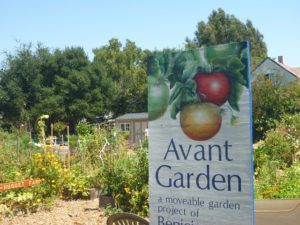
Avant Garden

The spring garden tour will begin at 9 am at Avant Community Garden in Benicia with a Permaculture 101 talk from Anne Freiwald. She is an experienced permaculture designer and always inspirational! Anne Freiwald and Lydia Neilsen will teach this year’s Permaculture Design Certificate course that starts in August, so this is a great opportunity to learn more about that program as well. Itinerary pick up will be from 9-11 am. Sustainable Solano Board Member Maggie Kolk, a Master Gardener, will host a Master Gardener information table. Come with your questions! Also during that time, Benicia interns will be highlighting their final project with a local food tasting, seed planting, handing out a scavenger hunt for youth and more.

Bay Vista Homeowners Association

 In June 2024, Bay Vista HOA in Benicia transformed its common area lawn into a waterwise, sustainable landscape to reduce water and beautify the space.

Michael Wedgley from Soilogical was the designer for this project. A lot of consideration went into plant selection. It was important to provide plenty of native species for habitat and food for native insects and birds, while also considering aesthetics as a critical aspect in HOA common spaces.

The plants selected and water catchment from the roof downspouts to the in-ground basins makes the landscape more resilient and builds healthy soil.

Learn more

Greyhawk Grove

Greyhawk Garden after installation

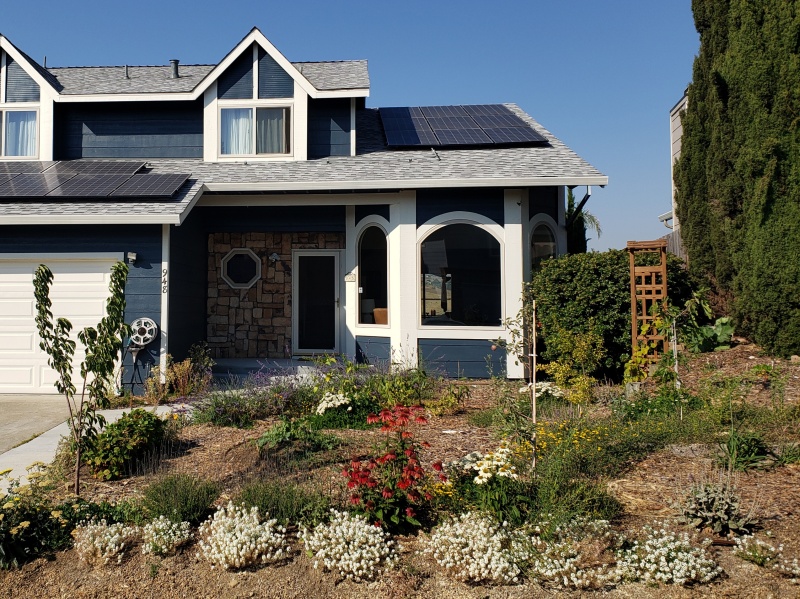
A 10-year-old established food forest with two swales that are dug out and refreshed every 2-3 years, laundry-to-landscape greywater to fruit trees, and chickens. The drip irrigation system was removed four years ago and the garden is thriving! Annual beds are hand-watered once a week during the growing season. Water elements in the form of fountains were added last year, which lured in a wild (non-venomous) snake who can sometimes be seen lounging between flagstones, and a frog who can be heard at night. Special thanks to Solano County mosquito abatement for the mosquito fish who overwintered and continue to thrive in the fountains. Greyhawk Grove is a “high-traffic-survival-of-the-fittest” garden.

***There may be lemonade and baked goods for sale by children, as well as products from the garden to give away (dried calendula, lavender, herbs, eggs, fruit, etc.).

Learn more

Living and Learning

Established front yard food forest that replaced a lawn in 2016 with two swales, a laundry-to-landscape greywater system and a diverse group of plants and fruit trees that has now expanded throughout the property. There are small spaces for relaxing and enjoying throughout the garden.

Learn more

Redwood Guild

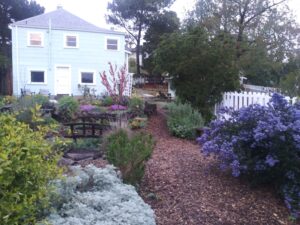
Food forest garden and greywater system installed as part of Sustainable Solano’s 2021 Permaculture Design Certificate course, with students transforming the front lawn with rain-capturing swales and planted berms and converting the sprinkler system to drip irrigation. The side yard is watered by a laundry-to-landscape greywater system and includes edible plants and native pollinators. This home has its own redwood grove, and certain plants were selected that do well in the unique conditions created by redwoods. The food forest keepers are using that knowledge to add other plants to the garden that will thrive alongside the redwoods.
Learn more

Wild Cherry Way

Southern slope food forest focused on pollinators, shrubs and native plants. This garden also includes fruit trees, perennial and edible plants, swales and a laundry-to-landscape greywater system.

***Sustainable Solano Board Member and Permaculture Consultant Ron Kane will be on-site to offer tours and answer questions.

Learn more

Yggdrasil Garden

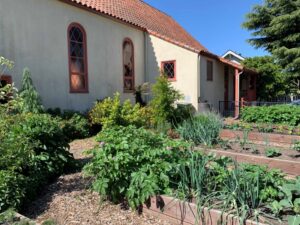
An evolving food forest garden and greywater system installed as part of Sustainable Solano’s 2022-23 Permaculture Design Certificate course.Students transformed the front yard with a rain-capturing swale and planted berms with native and pollinator-supporting plants. The west side yard’s passionfruit vines and fruit tree guilds are watered by a laundry-to-landscape greywater system. The monarch butterfly-hosting back gardens were designed by Soilogical, nurtured with specially prepared compost, and supported by a Water Service Irrigation design created as part of a Sustainable Solano irrigation class. The site’s current steward, Heath Griffith of Grow with the Flow, cultivates edible landscapes with flowers and medicinal herbs, with an eye towards community engagement and ecological justice. An herb spiral was created with bricks repurposed from the chimney of the circa 1850s historic home, retaining walls were built from pieces of historic on-site stables, and patios were made from slate and brick on-site. The east side yard (in development) is watered with both a rain-capturing swale and a laundry-to-landscape system. Displays feature the historic aspects of the home; its background and ongoing tradition of art, design, and healing; information about the Ohlone Sogorea Te Indigenous Land Trust and rematriation of Carquin land; and various permaculture systems and landscape elements.
***Heath Griffith will be on-site to talk about permaculture, water harvesting, sustainable water use, and more! They participated in the 2022-2023 PDC and will be supporting this year’s PDC course in the fall. The garden will also feature kid-friendly hands-on activities and live music!

Learn more

Vallejo Food Forest, Pollinator & Community Gardens

First Christian Church

The church has two separate gardens: one is a peace garden with mostly flowers, cactus and trees, and the other is the vegetable garden, called Johnson Ranch. The vegetable garden was revived through the Solano Gardens program. The food grown is donated to the local food pantries (Faith Food Fridays, Amador Hope Center, etc.).

***Solano Gardens Program Manager Parick Murphy will be on-site to share DIY Landscape Design templates for both edible and water-efficient gardens. He also will be highlighting opportunities to get involved with local community gardens and available to discuss interest in future community gardens within the county.

Learn more

Loma Vista Farm

Loma Vista Farm is a program of the Vallejo City Unified School District. Students come to the Farm every week to participate in hands-on plant and animal science lessons.

The Farm is partnered with the Friends of Loma Vista Farm, a community-based nonprofit organization, which fundraises to provide all the expenses for the day-to-day operation of the farm, including all the animal and garden expenses, as well as major ongoing capital improvements.

This has been a treasured part of the community since it began in 1974. Families and individuals are welcome to visit on a drop-in basis during open hours and enjoy seeing the many animals and gardens. The farm is also a field trip site for schools and groups on a reservation basis from all over the Bay Area.

The Food Forest Garden provides a beautiful demonstration to the public on how they can plant their own yard in a variety of fruit trees, perennial vegetables, herbs, native plants and pollinator rich plants.

***This year’s tour is on the same day as Loma Vista Farm’s annual Spring Open House, making it an extra special day to visit. Plants that the students have grown will be available in the greenhouse for sale, animal feeding will be available, as well as entertainment such as a puppet show. For more information check out Lomavistafarm.org.

Learn more

Morningside Botanical Bounty

Morningside Botanical Bounty food forest was created as part of the Resilient Neighborhoods Program. This backyard garden has a laundry-to-landscape greywater system, fruit trees (pruned to keep them short and easy to harvest), swales, drip irrigation, bee-friendly plants, native plants and shade trees.
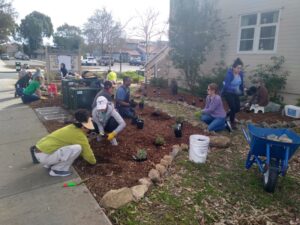
It’s now the sixth year after the install and many of the plants are still thriving. The greywater system irrigates the bougainvillea and butterfly bushes, which are popular with bees and hummingbirds. The drainage from the gutters to the swale and hugel mound prevent the yard from flooding during the rainy season. The water is stored in the earth and is available to the trees, artichoke, and roses. The peach tree, selected to be a variety resistant to leaf curl, has provided fruit even in years when most other peaches in Vallejo fail. Once a week watering of the trees on site allowed them to grow deep root systems, and they haven’t needed irrigation the last two years.

Learn more

Pollinator Pathway (Vallejo People’s Garden)

Pollinator food forest garden filled with a variety of California native plants that support the habitat of butterflies, bees, moths, wasps, hummingbirds and so much more. This garden was installed in February 2023 as a collaboration with a variety of organizations including Vallejo People’s Garden, Vallejo Project, Solano Resource Conservation District and Monarch Milkweed Project. Alana Mirror wrote three songs inspired by the installation, featured in her Pollinator Pathway Lawn Transformation Mini Series!

**Solano Resource Conservation District and Vallejo People’s Garden will be on-site promoting the Bay Area Butterfly Festival on June 1 with information on how to support pollinators! Solano RCD will have six-packs of Milkweed plants for sale for $10.

***Suzanne Briley from Vallejo People’s Garden will be giving talks on Creating Spaces for People and Wildlife, looking at ways to have garden spaces for ourselves while supporting wildlife. Talks and tours will be from 1-2 pm and 2:30-3:30 pm.

Learn more

Vallejo Unity Garden (Vallejo Project)

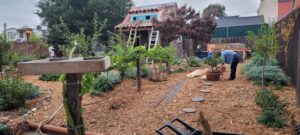
Vallejo Project’s Unity Garden initiative restored an abandoned lot that was once filled with sand and garbage and turned it into a multi-level food forest with internationally influenced farming techniques, a mealworm farm and chickens. This garden is focused on urban agriculture.

Vallejo Project imagines a Vallejo strengthened by new generations of youth and young adults who are inspired to give back to their community as role models, advocates, entrepreneurs, and leaders, and who are able to articulate and implement solutions to challenges in the community based on their learned experience and knowledge gained through youth development programs.

***Free annual veggie and companion plants to take home while supplies last

Learn more

Partner Garden: 4th Second’s Cherry Community Garden


Since February 2024, 4th Second’s Cherry Community Garden has been a space rooted in well-being, hands-on learning, and nature-based experiences. The garden is home to organically cultivated produce and serves as a hub for addressing food security, advocating for environmental justice, and expanding opportunities via mentorship.

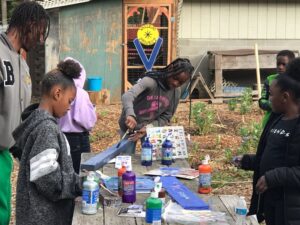
All community members are invited to actively engage by leading different garden projects that can intersect with practical life skills to further the 4th Second Youth Program’s overall mission of developing positive coping skills toward a life of self-determination. Garden guests will learn about the youth’s hands-on efforts in the garden and youth-designed projects.

***There will be multiple youth coordinators that are fluent in Spanish, and one of them is a former Rising Sun extern that is fluent in Tagalog.

Learn more

Inspired Garden (Sure-Would Forest)

The homeowners had a nearly blank slate when they purchased this property in 2021, and soon started working on enriching the soil, retaining rainwater, and laying the groundwork for a food forest. This garden was inspired by Sustainable Solano gardens and a love of fresh fruit. In just over two years, the site has gone from food desert to food forest with the ability to eat from the garden year round. The homeowners attended a design class taught by Joshua Burman Thayer with Native Sun Gardens in 2023 through Sustainable Solano’s backyard program. In June 2023 they hired Joshua to update the design and add drip irrigation.

Inspired by rainwater harvesting systems seen on the 2023 demonstration food forest tour, the homeowners bought and installed four IBC totes to collect water from their downspouts. The irrigation system for Sure-Would Forest is designed to feed from either city water or rainwater storage tanks, allowing over 1,000 gallons of rainwater to be used to irrigate the garden.

**At 2 pm, the homeowner will talk about how he converted IBC totes to capture water and irrigate his garden.


We are incredibly grateful for the generous support of our funders. Magic Cabinet is supporting this year’s tour through its sponsorship.

The first seven food forest gardens were made possible through funding from the Benicia Sustainability Commission; the Solano County Water Agency supported the Sustainable Backyard Program throughout the county  from 2017 through 2024. Occasionally we combine funding from other programs to make larger projects possible.

EcoFarm Insight: Reflection, Observation & Irrigation

By Patrick Murphy, Program Manager

I had the opportunity to attend EcoFarm’s 45th Anniversary conference this year and had a wonderful time. My colleagues and I attended a variety of presentations and participated in a number of wonderful discussions with people from around California who work on similar projects related to urban agriculture, local food, and creating connections in their community.

There were a number of wonderful presentations that affirmed going back to basics like water retention, soil health, building up organic matter and biological activity, as well as taking your time to plan each project.

Again and again I heard from folks working in agriculture, education, farms and gardens that they had the most success when they took their time to reflect and observe before acting. Taking deliberate and well-paced steps to mulch, to build up organic matter in the soil, to increase water infiltration, and to develop rich and biologically active soil were the most impactful things they did. They stressed the importance of avoiding jumping into an idea that sounds good but is untested — the sheer force of nature is too powerful to work against.

Some key recommendations:

  • Take your time when you’re planning, and revisit a site multiple times before beginning work, with and without your plans.
  • Install a flow gauge and Schrader valves (similar to bicycle tire valves) in your irrigation system, and use a pressure gauge to check your system for leaks and issues.
  • Heat stress can make plants more prone to pest issues.

Here is a breakdown of some of the presentations:

Regenerative Landscaper Erik Ohlsen gave a talk about the importance of getting to know a site. He said that to truly understand a location, you should be visiting it in the rain, at night and early morning, and you should always check and recheck your plans with the reality of what is on the ground. Ohlsen also stressed the number of career opportunities which exist in landscape design.

Cameron McDonald from Santa Cruz Resource Conservation District spoke about the importance of monitoring water systems using flow gauges and pressure gauges. McDonald spoke about how farmers (and homeowners) can balance design, operations and maintenance, and irrigation scheduling to maximize yield, conserve resources, minimize nutrient loss, ensure uniform crops, and reduce fuel costs.

The mantra was “You can’t know what you don’t measure” — measuring flow rates is essential, and tools like flow meters for home gardeners, or telemetry systems, data loggers, and remote data collection for large-scale operations provide an enormous amount of information. SRCD has a number of common recommendations they offer to improve efficiency on farms, (1) use pressure regulators (these $13 units have saved Sustainable Solano hours of work), (2) fix leaks, (3) add spaghetti lines to direct the flow of water and (4) opt for oval-shaped hoses to reduce accidental kinks.

McDonald reiterated the standard recommended pressures are 0-30 PSI for drip irrigation and 100 PSI for sprinklers. Proper pressure management is critical for uniform water application; use a hand pressure gauge and Schrader valves to check your systems pressure, use one hand gauge to check the whole system to ensure consistent calibration. Elevation changes also impact pressure — every 2.3 feet elevation changes PSI by 1 PSI (increasing PSI when descending down, decreasing PSI when going uphill). Be mindful of the water hammer effect, a rapid change of pressure caused by quickly turning on/off valves, and look for unexplained pressure loss. Everyone should be flushing their irrigation system more often (once per year at least) and install or use soil moisture sensors for better field or lawn management. By implementing these strategies, farmers and homeowners can optimize irrigation systems for efficiency, cost savings, and irrigation uniformity.

Bill Snyder gave a presentation on a study he and his graduate students conducted on whitefly infestations attacking squash crops. In a 2016-2017 drought, potato whitefly infestation exploded. They had a theory regarding bidirectional stress on cotton plants, where the larva of the whiteflies were born and developed. Cotton plants under extreme heat stress are unable to fight off white fly infections, while populations of bugs and animals which traditionally consume these insects are also decimated by heat stress and overuse of broad spectrum pesticides. Snyder and his team found correlation between these extreme droughts and high volumes of insecticide use (per acre). In a natural experiment using center-irrigated fields and increased mulching practices, the Georgia team feels confident that the combinations of heat stress on plants and insects were a driving cause in the rise of whitefly populations. Learn more about his research here.

Sustainable Solano would like to thank the California Department of Food and Agriculture, Solano County Public Health and CHIP (the Child Health and Improvement Plan) for their support to attend the 45th EcoFarm Conference. Their support allowed us to learn so much about the state of urban agriculture, local food, and what other folks in our state, community and nation are working on. Thank you to the presenters and all the friends we made along the way.

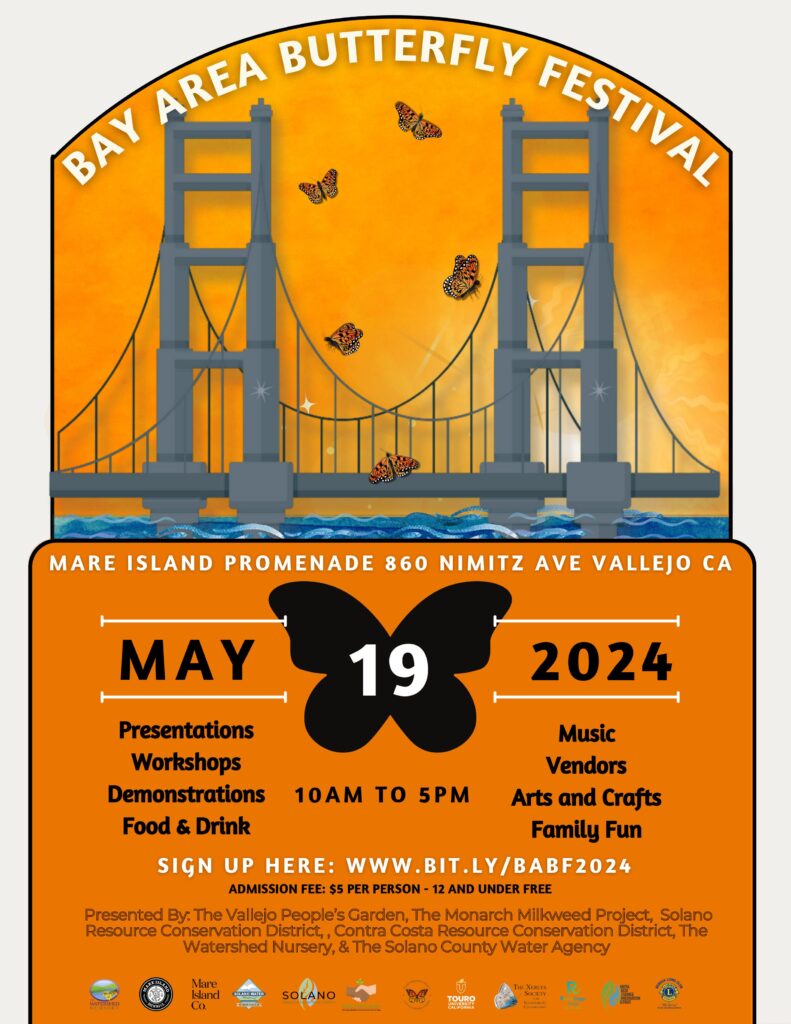
Bay Area Butterfly Festival Lands May 19

By Annina Puccio, executive director of the Monarch Milkweed Project

The Monarch Milkweed Project and the Vallejo People’s Garden are hosting the inaugural Bay Area Butterfly Festival on May 19!

Join us and experience the beautiful view of the Carquinez Strait from the boardwalk on Mare Island while learning about the importance of protecting our pollinators. This is a family-friendly community festival!

On two stages, fantastic performers and live bands will delight you with their talents. Children’s free games and hands-on activities will entertain young ones throughout the day. Musical performances will fill the air — dancing is not required, but it is definitely recommended! Artisans and small businesses will sell their art, wares, and many fantastic sustainable goods.

On a third stage, community groups will lead pop-up workshops on a wide range of exciting topics, which will include a talk sponsored by Sustainable Solano by Heath Griffith of Grow With The Flow on how to turn your lawn into a native garden. Food vendors and food trucks will offer a variety of cuisines, including vegan and gluten-free options.

We will be hosting over 100 vendors/exhibitors from various organizations and nonprofits at the event. There will be a focus on sustainable living, clean water practices, and environmental education.

This festival is a low-to-no-waste event focusing on commemorating the historic monarch overwintering site on Mare island, as well as the importance of sustainable practices and saving our pollinators — especially the iconic monarch butterfly and our various native bee species.

Learn more about attending here

On Facebook: https://fb.me/e/3uncrnQqk

Register on Eventbrite: www.bit.ly/BABF2024

Volunteer here

All volunteers get the following: free food and drink, a volunteer festival T-shirt and two free classes at the Vallejo People’s Garden.

Sign up here: https://forms.gle/o3Bx27kFusyriu2P6

2024 Benicia & Vallejo Demonstration Food Forest Garden Tour: April 27

By Nicole Newell, Sustainable Landscaping Program Manager

Loam Sweet Loam garden in Vallejo

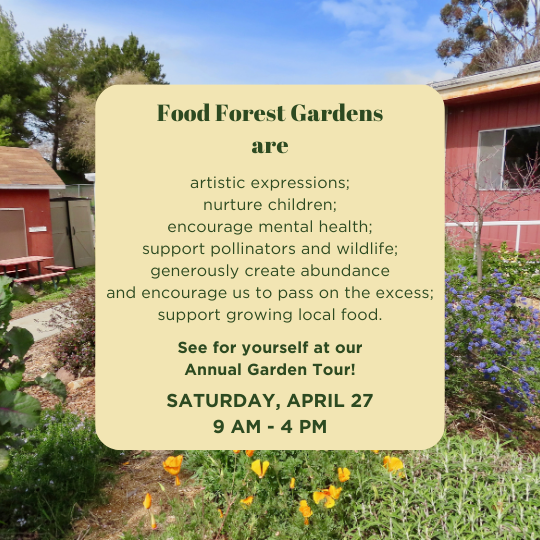
Sustainable Solano’s annual tour of demonstration food forest gardens in Benicia and Vallejo returns on April 27 for its eighth year. Join us for our largest tour of some of the longest-established food forests in the county!

The day will include speakers and activities to keep you inspired and engaged. Register here!

We will start at 9 am at Avant Garden in Benicia with a talk about the many roles mulch plays in supporting a water-efficient garden with Heath Griffith from Grow with the Flow. Learn about:

  • What is the difference between wood chips and bark?
  • Why is mulch one of the superheroes of permaculture?
  • Does mulch increase or decrease fire risk around houses?
  • How does mulch support a water-efficient garden?

Attendees will pick up the itineraries from 9-11 am at Avant Garden for a self-guided tour of the Benicia and Vallejo gardens. This year’s tour will continue to provide education on topics related to sustainability and highlight the amazing organizations and ways people are involved in uplifting the community. In addition to education, we will also have music, an adventurous scavenger hunt for our youth, two inspired gardens and a special guest that will be present to chat about calming calendula.

The Benicia gardens will be open from 10 am-1 pm, and the Vallejo gardens will be open from 1-4 pm. Attendees who can only participate in the afternoon can pick up the itineraries for Vallejo at the Pollinator Pathway garden on Mare Island from 12-1 pm.

You can learn about each garden and the special events going on at the gardens here.

To prepare a garden tour event that is in service to our community is a gift. As I learn what inspires our food forest keepers to live, grow and contribute, I am inspired in return. Spring brings new possibilities to discover what seeds we want to plant, in our garden and in our life. Each garden serves so many functions that support an abundant, healthy life. I invite you to explore these gardens and gain your own inspiration for your gardens, your communities and your lives.

This program is made possible by the generous support from the Solano County Water Agency.

How It Will Work

You can choose to tour for the whole day or for half a day.
Benicia Demonstration Food Forest Gardens will be open 10 am-1 pm
Vallejo Demonstration Food Forest Gardens will be open 1-4 pm

Register here

Itinerary pickup and special events:

9-11 am: Itineraries will be available at Avant Garden in Benicia (400 First St.). This itinerary will include all of the demonstration food forest gardens in Benicia (open in the morning) and Vallejo (open in the afternoon). Families can pick up a scavenger hunt sheet that will make the day more fun!

9 am: Heath Griffith of Grow with the Flow will talk about the importance of mulch at Avant Garden.

12-1 pm: Itineraries for the Vallejo garden sites (open in the afternoon) will be available at the Global Center for Success (1055 Azuar Dr/BLDG 733).

Throughout the day: Special speakers, activities and information will be available at various gardens.