Vallejo Food Rescue Project Promotes Community Collaboration to Share Information, Resources, Food
By Sustainable Solano
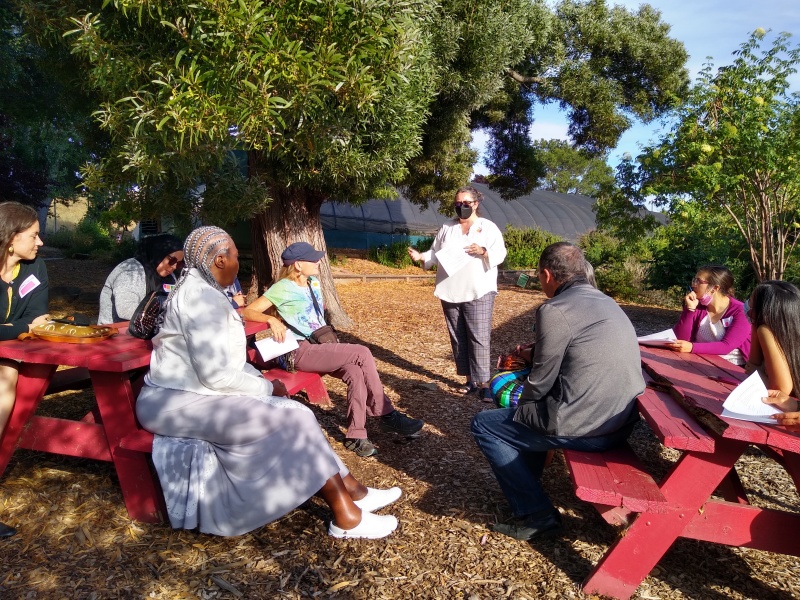
The Vallejo Food Rescue Project had its official launch meeting in early June at Loma Vista Farm, bringing together people from organizations involved in current food rescue and distribution operations in the city and seeking guidance on how to streamline and shape food rescue efforts in Vallejo.
“So much of what we do is not about lifting a box of food,” Food is Free Solano Executive Director Heather Pierini said. “It’s about getting food to people in need.”
The Vallejo Food Rescue Project seeks to do just that in a pilot project that could serve as a model for elsewhere in the county — perhaps elsewhere in the state and nation.
Starting the meeting in the shade of the large tree that centers the entrance to the educational farm and surrounded by pollinator and native plants, the attendees acknowledged the indigenous stewards of the land’s history and shared about their own work in the food system. Organizations represented at the meeting included the Islamic Center of Vallejo; Emmanuel Arms Community Inc., the nonprofit arm of Emmanuel Temple Apostolic Church; Catholic Charities of Yolo-Solano; and Vallejo Together.
Many related how the need for food has grown in the community and they could serve many more people if they had more access to food for distribution. Food pantries quickly empty out, and hundreds of people show up for meals or to pick up food.
Heather noted that the meeting brought together a diverse group of individuals and organizations. Each of these groups can reach different communities, and it’s important to make sure resources are spread out so that people feel they have someone to reach out to, she said.
 The Vallejo Food Rescue Project is a joint effort between Food is Free Solano and Sustainable Solano under a grant from the Office of Environmental Justice at the EPA. It seeks to support current efforts by creating a network of organizations and individuals and develop an app that can be used to streamline the giving and receiving of excess food within the city. The app is being developed by Kim Quach of FreeBites.
The project is using a collaborative problem-solving approach under EPA guidance.
“The people doing the work actually design the solution,” said Lauren Gucik, the SuSol program manager involved in the project.
That’s why it was important to have this first meeting with selected stakeholders. Upcoming meetings will be open to the general public and involve more wide-ranging discussion around how the Vallejo community can share food between institutions, organizations and individuals.
The issue is two-fold: The state is now requiring that excess food go first to people, then animals, then compost to keep food waste out of landfills. There is also an increased need for food, with hunger rising sharply in the county during the pandemic. Organizations that seek to distribute food run into myriad challenges, from restaurants that are hesitant to donate food due to liability concerns to not having enough ways to get information out to people about the food distribution and other services they are offering. The Vallejo Food Rescue Project seeks to address that by increasing collaboration, food security, better health for our communities and a reduction in landfill waste, said Cristal Gallegos with Food is Free Solano.
A big part of that is the app, which the group discussed. Kim developed FreeBites while a student at UC Davis. She witnessed first-hand how food was often thrown away after university-catered events, while at the same time there were students who were hungry on campus. She created the app as a direct response to this and to help bridge the disconnect. As part of this project, she’s further developing the app to help with the logistics and build community around food sharing.
The app will allow posting of surplus food, create a map that shows available food resources based on distance, and match donors and recipients.
Heather likened the use of the app to the way someone might post an item on Facebook Marketplace. It’s a way to share what is available locally with those who might be interested. But through using filters, those donating food and those receiving it are able to narrow down who gets the notifications. So if a caterer has 30 extra meals, their post would go only to those organizations that have said they could take that many meals and distribute them properly.
“That right there takes me five texts,” Heather said. By shortening the communication chain through the app, the process can become easier and more efficient.
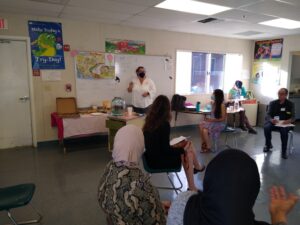 The excitement and interest around the app was apparent as the group discussed what support they could use. But something else was also going on during the meeting — connections were happening within the room.
“I’d like to acknowledge the collaboration happening here,” Cristal said, noting how when the meeting started people were talking about how they didn’t know what each other’s organizations offered, and now that they had shared and did know, they were already seeking ways to work together.
By the end of the meeting, people were inviting each other to come volunteer and observe their distribution events and to find other ways to connect. They said they left feeling hopeful, optimistic, informed and energetic and that doors were opening and help was on the way.
The project will be working on a prototype of the app through the end of July. At the next meeting, on Wednesday, Aug. 17, members of the food rescue community and the general public will be asked for feedback on the app and the possibilities and challenges they foresee.
Vallejo Food Rescue Project Community Meeting
The next VFRP community meeting will be Aug. 17 at the John F. Kennedy Library at 505 Santa Clara St. in Vallejo. The meeting will be an opportunity to learn more about the project and the app.
More details will be announced soon. Learn more here.
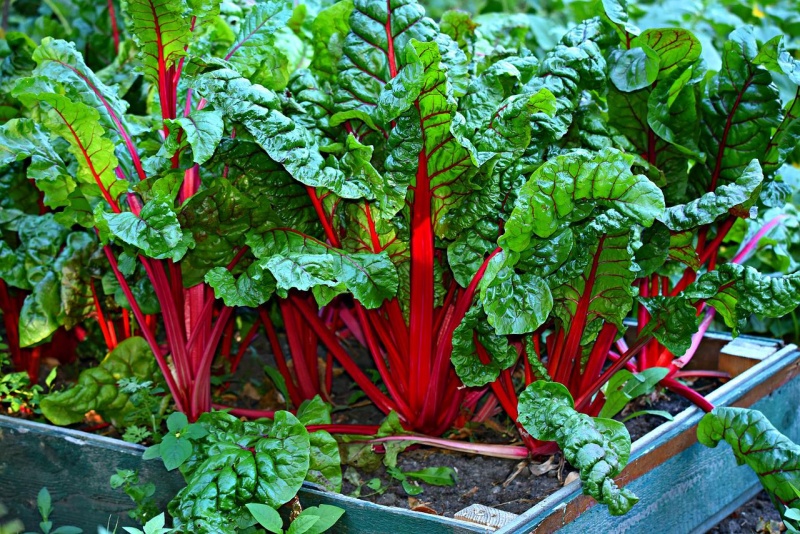
 In a lovely British accent, she then proclaimed that what I had just done by giving her the chard was the highlight of her day. “You see, what is happening in Ukraine has brought back so many terrible memories.” With tears in her eyes, she went on to explain that as a child in London she lived through the Nazi bombing known as the Blitz and had spent days underground with her family trying to survive. She was about to celebrate her 89th birthday and she could not believe that she lived to see the horrors of war in Europe again. But the beautiful chard … she would go home and call her family in the UK and tell them what a wonderful gift she had just received. As she parted (yes, I had tears in my eyes now) with her little dog and bag of Swiss chard, I asked her name (Julia) and assured her that any time she saw me in the garden she was welcome to stop by for a chat, chard or any other goodie we might have growing at Avant Garden … and she does! That day, Julia herself was a gift to me. For the last five years that I have been volunteering as garden coordinator, I never know who or what gift will present itself, but I know I will be surprised and grateful.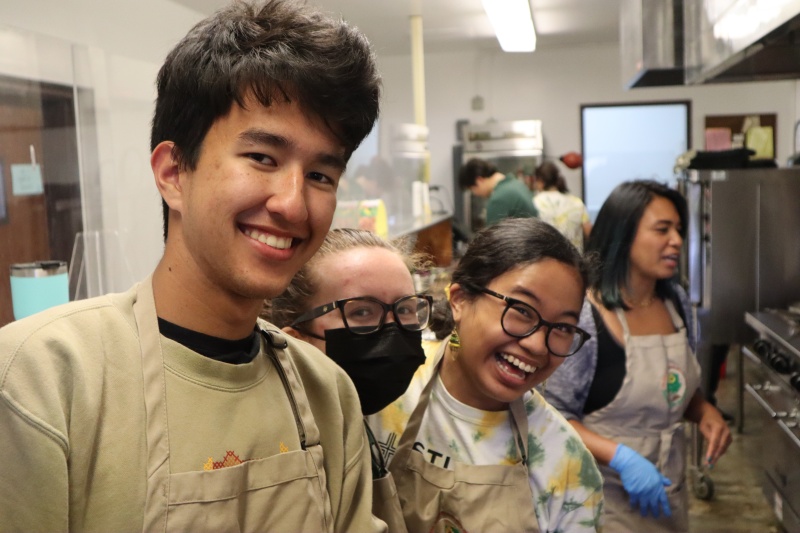
 On the first day of class, I cooked tofu stir fry with rice. The preparation of the meal went rather smoothly. Other than a few near mishaps with a knife and the flame on the kitchen stove, everyone walked out with all ten fingers and eyebrows intact. I sat at the table anxiously awaiting our meal. There was not a chicken tender or bottle of ketchup in sight. But the moment that I picked up my fork and reluctantly shoveled the concoction of onions, carrots, spinach, and celery into my mouth, my mouth curled up when I began to chew. It was pretty good! With just a little taste, my love for cooking came to fruition and it provided a new outlet to relieve my stress. And with a little bit of practice and patience, however, cooking became less daunting and more enjoyable. Being able to cook my own food and making an effort to eat sustainably also had a positive impact on my health. I also shared my affinity for cooking with my family as I became in charge of making Saturday night dinners. The sly looks that I once received at the dinner table were replaced with hearty laughter and the sound of our mouths voraciously eating our food.
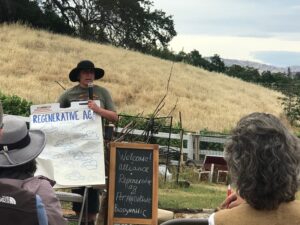 The crowd did its best to answer the question. Regenerative agriculture is ancestral traditions, self-sustaining, biodiversity, organic, no waste, healing, no till, place-based, nutrient-dense, abundant, soil-building, interdependence … the list had more than 25 suggestions.
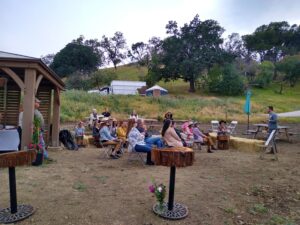 The event was held at the farm site of
 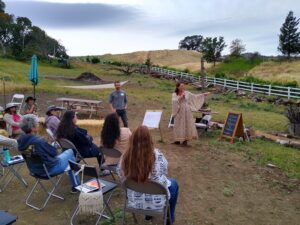 Property owner Shea McGuire said the hope is to instill stewardship in the Pleasant Valley School students, giving them an understanding that they are part of the ecosystem and to “keep the noise of the world out of childhood.” Elena and Shea signed the partnership agreement for the demonstration project at the beginning of the meeting. We invite you to join us for a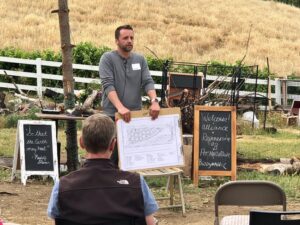
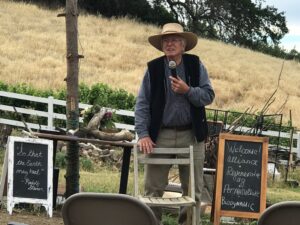 Harald Hoven, a retired biodynamic farmer who still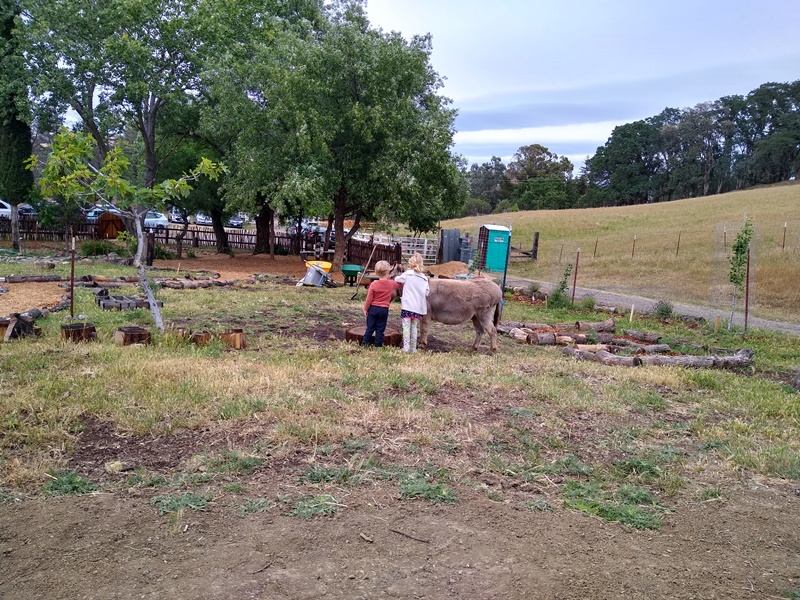
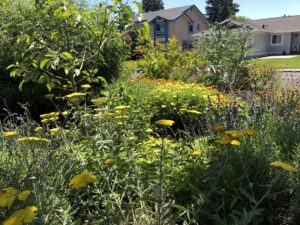 This garden was a front lawn conversion in 2019. It is filled with vegetables, fruits, herbs and more, building healthy soil and harvesting water from the roof.
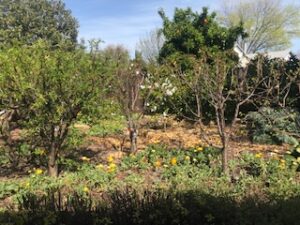 Installed in 2017, this backyard food forest has 21 fruit trees pruned annually to 5 feet, making it easier to access the fruit. The majority of the trees are watered by rain funneled into a swale, while others are watered from the laundry-to-landscape greywater system. An automatic drip system is used during the dry periods. All the fruits are shared with neighbors, friends and family. Additional plantings of salvia and calendula draw in honey bees and hummingbirds.
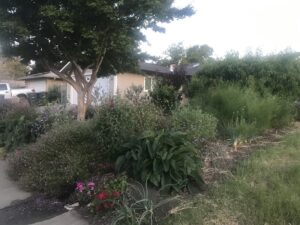 This food forest garden was a front yard lawn conversion and displays what can be accomplished in less than 18 months.
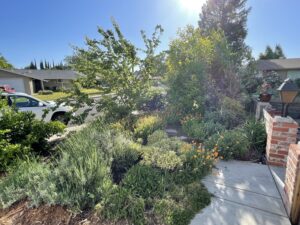 This garden has eight thriving fruit trees in a small front yard, as well as a plethora of herbaceous and shrub plants. The vegetation is watered through a combination of swales that collect rainwater, greywater from the laundry, and (rarely utilized) drip irrigation. The yard has, like any good forest should, taken on a life and energy of its own, constantly changing and morphing year over year, but never failing to provide the residents, neighbors, and several local food banks with fruits and vegetables.
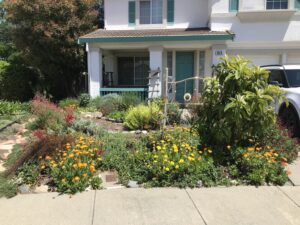 This three-year-old front yard garden welcomes the neighborhood to pick as they please. The yard extends to the backyard with pollinator plants intermixed with edibles, chickens, repurposed items, a native sedge field and so much more. This yard integrates systems to benefit the whole property.
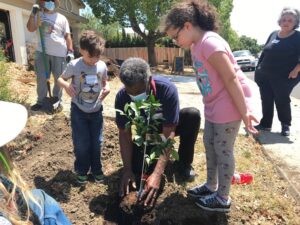 This newly established front yard garden was installed in May 2021 with the focus on growing food and a desire to share with neighbors. A large swale in the front wraps around the yard and supports fruit trees and pollinators.
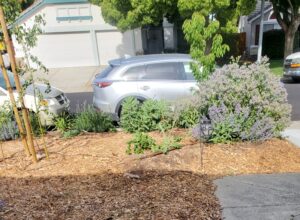 This small, beautiful, low maintenance front yard garden offers easy access to culinary herbs and three fruit tree guilds supported with yarrow, comfrey and borage.