Armijo High Students Reflect on Healthy Local Food

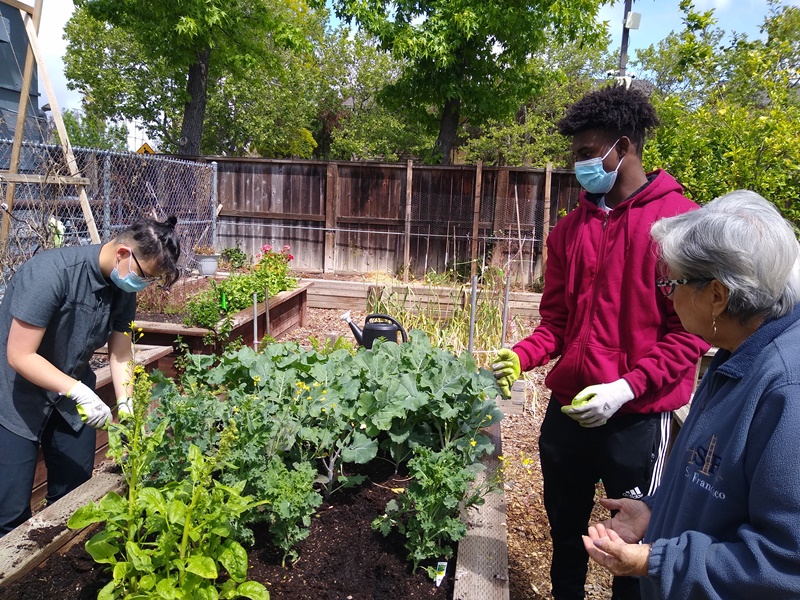
The Healthy Local Food program at Armijo High in Fairfield brings together 30 students each week to learn about healthy, seasonal, local food in both the school garden and culinary sessions. The program is offered through two SuSol programs — Solano Gardens and Local Food Cooking Education — in partnership with Innovative Health Solutions, Armijo High School and the school’s multimedia and garden clubs. Students will share what they have learned through final multimedia projects. Here, two students in the program reflect on their early experiences. Follow their progress on Instagram @healthylocalfoods
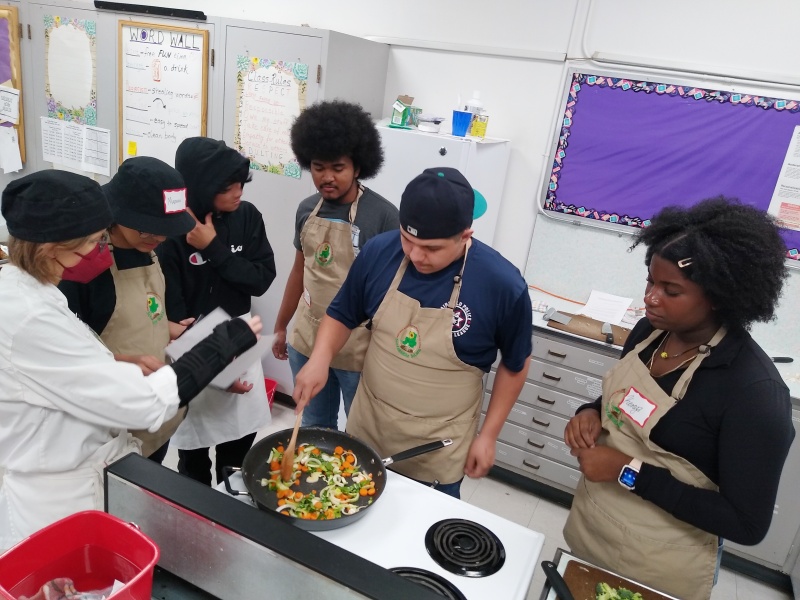
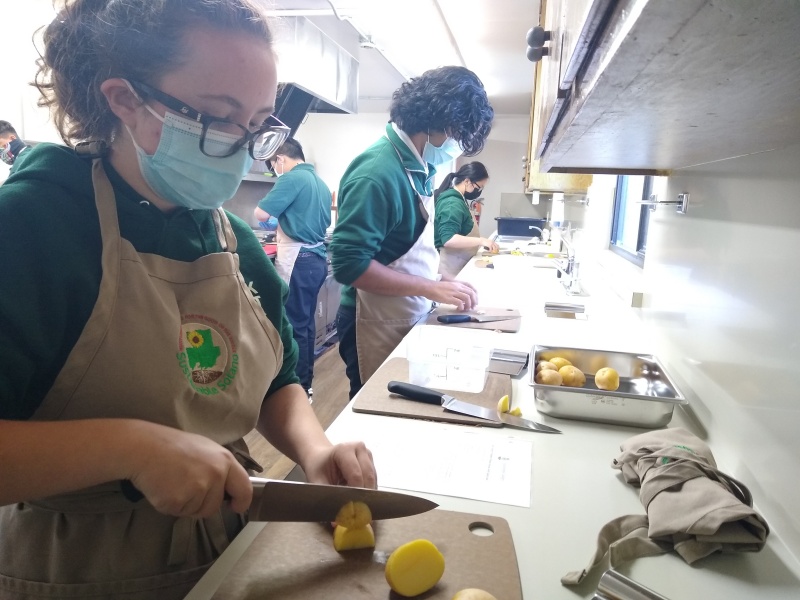
Matthew Madrigal (second from left) and Kenya Jackson (right) participate in the recent stir-fry cooking class. They offer their reflections on the program below.

Connecting in the Armijo Garden

By Kenya Jackson

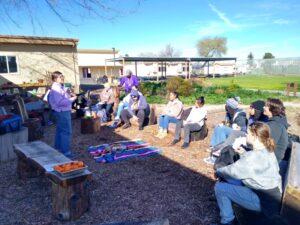
When we first walked into the garden we were met with SuSol instructor Lauren Gucik holding a huge bag of stuff. She had asked us to gather in a circle wherever we liked. We immediately moved to a more circle-ish form but not too far from each other as we were all very nervous. We, as a group of kids, were very quiet because we were nervous. Thankfully, Lauren was very considerate of this and while encouraging us to talk, she didn’t mind talking to keep conversation going by herself.

Lauren went into quite a bit of detail about her past and told us all about her journey into becoming so in touch with nature. She asked for our input and acknowledged all of our nonverbal answers. We soon became very comfortable around each other as well as her. Once Lauren took notice she asked us to introduce ourselves and establish this as a safe space where we could take a break if we are ever in need of one.

While in the circle we were given seeds to break open and toy with, they were ours. Most of us peeled off the seeds and discovered they were beans! Luca’s beans had started to grow while inside the pod which we then passed around as we found it quite interesting and cool. Lauren had taken notice of Mariah raking her hands through the beans and took the time to teach us about sensory stimulation. She pulled dried cobbed corn out of her bag and gave one to each group that was established the week prior.

As we pulled the kernels off of the cob, we fell into steady conversation of our ancestry and where we are from. We talked about all we had in common culturally. Lauren’s ancestors are from Northern Europe, meaning she can’t burn sage since it’s Native American, so she burned rosemary, another protective plant.
Cooking in the Kitchen

By Matthew Madrigal

For our sixth week we made a stir-fry! But before we did that we discussed smells of foods that remind us of dishes that are important to us. We then went over the ingredients. Then we got to the actual cooking. Every time I cook in the program I just get reminded how fun it is. My team and I did pretty well. I and some others were even interviewed for a bit! When we finished, everyone’s dish was fantastic. It was a great day. I’m glad I get to be here.

Solano Gardens is funded by Solano Public Health. Funding for culinary instruction was made possible by the U.S. Department of Agriculture’s (USDA) Agricultural Marketing Service through grant AM22SCBPCA1133. Its contents are solely the responsibility of the authors and do not necessarily represent the official views of the USDA.
Farm to School Brings New Garden to Vallejo’s Griffin Academy

By Patrick Murphy, Program Manager

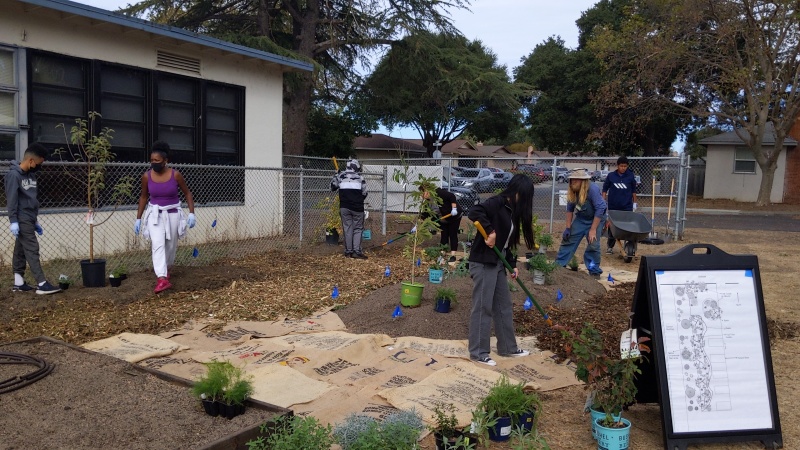
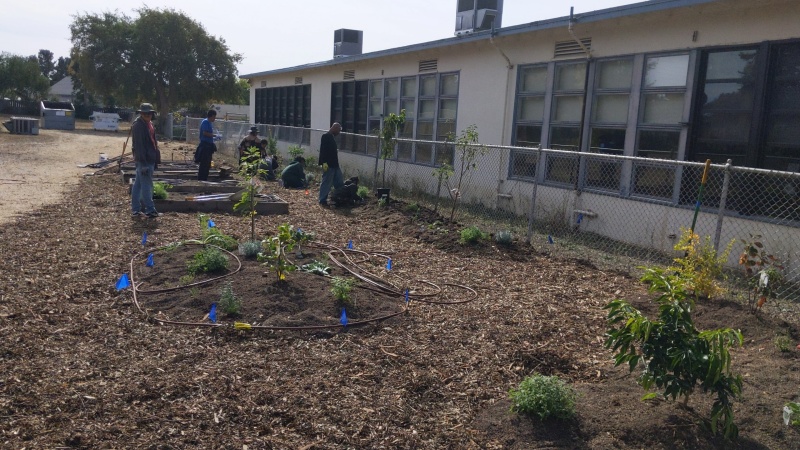
Sustainable Solano’s Farm to School project would like to express a very warm thank you to everyone who assisted us in completing a food forest garden at Griffin Academy in Vallejo this year. With the assistance and support of so many people, we were able to bring this collective vision into reality. Beginning in the new school year, students at Griffin Academy will be able to access fresh fruits and vegetables from the garden thanks to a grant by the USDA’s Food and Nutrition Service.

Once a desolate and unappealing section of campus, the new Griffin Garden will feature over six unique fruit trees, five repurposed garden beds, two berry guilds, and at least a dozen different additional plants, providing shade, wind cover, and nutrients. The previous garden site at Griffin was slated for removal by a campus renovation. Sustainable Solano worked together with the school leadership to secure a larger, more visible location for the garden at the school. This new site also was much closer to garden champion Tianna DeSliva’s biology classroom. This new location will not only be more productive and visible, but also will use less water than the previous garden. An automatic drip irrigation system will allow the site to survive the long dry summers with minimal maintenance. Additional features include an in-ground swale running parallel to the school building. This swale will capture rainwater and store it in the soil for the plants to draw from. Sustainable Solano’s Solano Gardens program will support the garden and work with Griffin Academy to assist in the long-term stability of the garden. We hope to use the space in the future to encourage other schools to create a garden on their own campus!

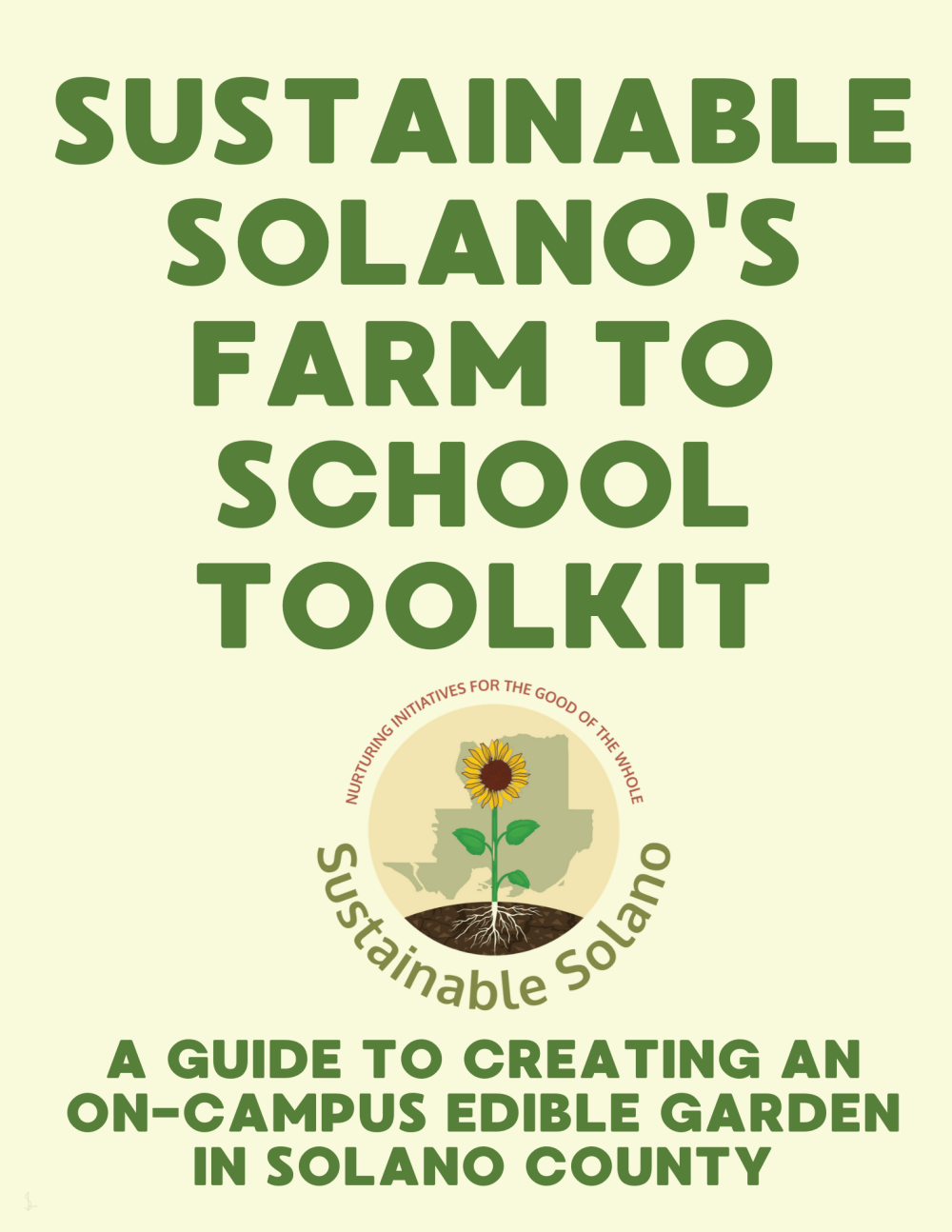
Reflecting on the lessons learned from this project, Sustainable Solano has developed a toolkit for other Solano County schools and even community groups to create their own food forest gardens full of perennial and annual plants. This toolkit also contains step-by-step instructions on how to get food from a garden into a school cafeteria. You can view and download the toolkit here.

One important lesson learned from this school garden project was that it is essential to work with a supportive team of individuals who can see a garden through from idea to completion. We would like to thank the following people specifically for the roles they played in supporting the Farm to School program.

  • Holman Pettibone – for his commitment to getting answers when we needed them,
  • Tianna DeSilva – for her commitment to getting this garden established,
  • Shene Wells – for showing up each and every chance she could,
  • Nick Driver – for his support,
  • Roxann Lynch-Burns – for her direction and willingness to help,
  • Jennifer Leonard – for her support,
  • And to all the volunteers who participated in the October installation.

Farm to School Toolkit

Everything you need to plan and start a school or community garden in Solano County
Click here or on the cover below

Get Bare-Root Fruit Trees for Your Garden Through Our Fruit-Tree Giveaway

By Jazzmin Ballou, Solano Gardens Program Coordinator

Update: All available trees have already been reserved. Please check back in the future for other opportunities.

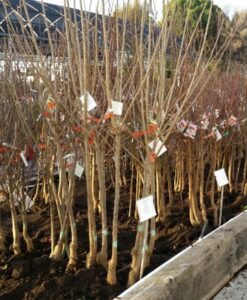
During the winter months fruit-producing trees go dormant. This dormancy helps protect them from freezing in the cold months by stopping them from growing and producing fruit. The good news is that dormant trees can be out of soil for short amounts of time in those winter months without dying, making it easier to transport them. 

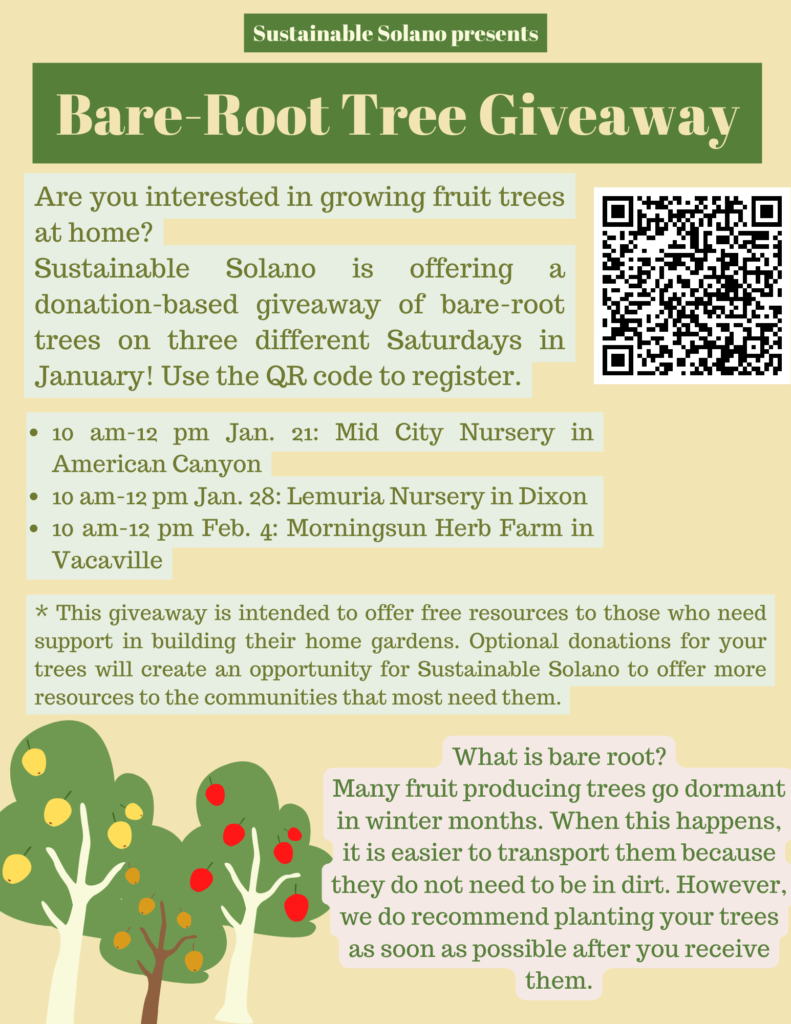
That makes it a great time to get trees for the garden! Sustainable Solano will be partnering with three local nurseries in January to give away bare-root trees to the community. We are especially aiming to give these trees to folks who otherwise may not have access to fruit trees. As part of the free giveaway, we will accept donations toward the cost of the trees. Donations will increase our ability to continue giveaways in the future, but are optional so that everyone has a chance to get a tree, regardless of ability to pay.

Photo credit: Mid City Nursery

The giveaways will be

  • 10 am-12 pm Jan. 21 at Mid City Nursery in American Canyon
  • 10 am-12 pm Jan. 28 at Lemuria Nursery in Dixon
  • 10 am-12 pm Feb. 4 at Morningsun Herb Farm in Vacaville

All available trees have already been reserved. Please check back in the future for other opportunities.

The giveaways will be held in three different locations to increase accessibility. If you are unable to transport yourself or your trees to or from any of these giveaways, please let us know. We are happy to explore options for how we can help you get your trees home. Likewise, if you have little garden experience or have never grown fruit trees, there is a plethora of knowledge on tree planting and care to be found online, specifically on YouTube.

Bare-Root & Fruit Tree Resources

SuSol’s plant resources (click here and scroll down for fruit tree planting and pruning resources)

Winter Fruit Tree Care (watch this video to learn about how to care for your fruit trees in the winter, including planting bare-root fruit trees, from Lemuria Nursery’s Kristina Fink)

Planting a Bare-Root Fruit Tree (watch this short video for quick tips on planting your tree)

How to Plant a Fruit Tree (this video gives details on planting bare-root vs. potted trees)

Solano Gardens Expands Program to Get More Resources to Community

By Lauren Gucik and Michael Wedgley, Program Managers

Solano Gardens is growing!

This year, in addition to installing fruit and vegetable gardens, we also have resources to offer such as chickens, chicken coops, beehives and aquaponics kits to our communities. Our goal is to increase communities’ ability to grow food for themselves and their neighbors to improve our mental and physical health and foster abundance and collective power.

We have been supporting community gardens and personal home spaces with food forests and water-saving pollinator gardens for many years and this year we are able to expand our offerings. Our goal is to install 2-3 Hubs around the county. These Hubs would have a large amount of space to demonstrate multiple different growing methods, be able to host educational events and supplies giveaways, and have a kitchen space to prepare some of what is growing for the community as part of education, sharing healthy food, and creating social enterprises.

SuSol will also cutivate a satellite network of home growers, which can be anyone with a home garden. We’d like to provide you with the materials that fit your space, no matter how big or small, and curate classes and circles of knowledge-sharing among the satellites. We hope that everyone in that network can lend support to each other when it comes to growing your own food. We will be providing free plants, trees, chickens, bees, etc. for satellite gardens. Anyone interested in growing food at home can fill out an interest form here.

Solano Gardens will also host two internship tracks focused on sustainable Urban Agriculture and Youth Culinary Arts. Each will provide hands-on activities to practice the skills and concepts related to the topic, in addition to several online portions.

The Urban Agriculture track will focus on multiple ways of growing food and building valuable food production experience. They will learn plant needs, methods of planting and harvesting, crop planning, composting and market gardening. They will gain insight into permaculture, the Soil Food Web and square-foot gardening.

In the Culinary internship students will learn how to prepare fresh local food, explore concepts of food as medicine, and help us pilot a prepared food enterprise in the county. Interns will grow their comfort in the kitchen and learn basic food preparation skills while working together to cook in large batches. Interns will take food home after class to be shared with their families, and students will receive their food handler’s card through our coursework.

Additionally, our team will lead an inquiry throughout the county to see how to link farmers with underutilized agricultural land in the county to increase the amount of food grown locally that stays in Solano County and support young entrepreneurs in creating social enterprises that heal their communities.

The goal is to increase food production in Solano County through empowering communities with resources, materials, and opportunities to share skills and knowledge.

We’re Seeking Satellite Gardens & Hubs!

If you are interested in growing a garden, stewarding chickens or bees or an aquaponics kit, please fill out this interest form and join our network of satellite gardens.

Dixon Partnership Brings Together 2 Programs to Create New Garden Site

By Sustainable Solano
We are excited to build upon two of our garden programs to support a new demonstration food forest and community garden in Dixon that will provide produce for the community, educate children about connecting with food and the local agricultural community, and build another example of waterwise, sustainable gardening that can inspire and educate others.
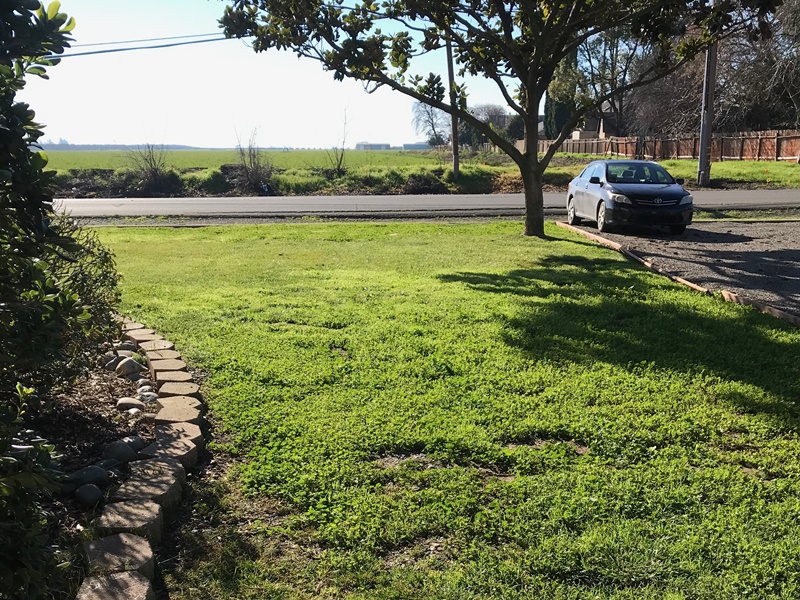
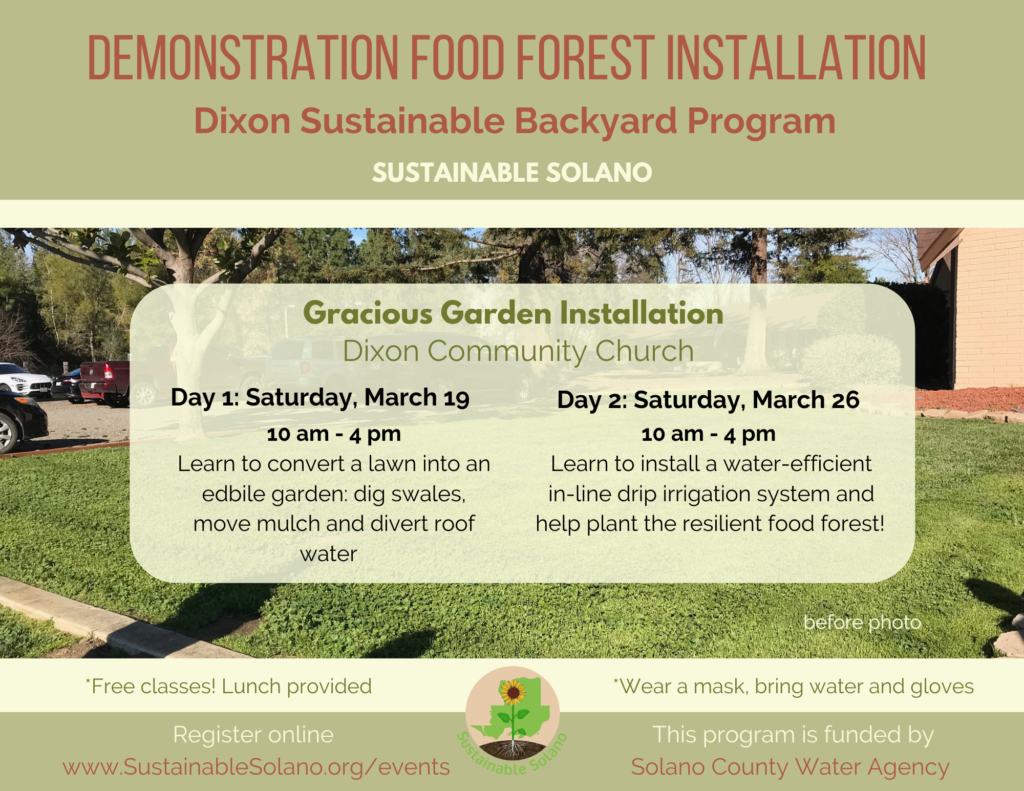
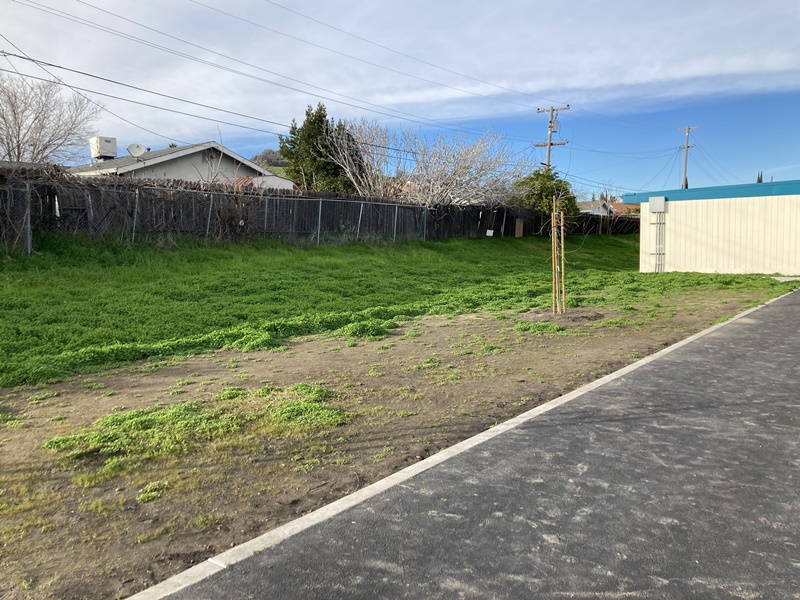
This Dixon Community Church site will soon be converted from grass to a lush, waterwise community garden

The new Dixon garden, Gracious Garden, will be developed in partnership with Dixon Community Church and the Neighborhood Christian School. Neighborhood Christian School serves preschool through eighth grade and has been a part of the community for more than 40 years. The school partnered with Dixon Community Church in relocating the campus this past year. The church has served Dixon for more than 100 years and is on East A Street, where the garden will be highly visible to passers-by.

“We anticipate creating a first in the community food forest, filled with perennials and other diverse crops,” Principal Eden Callison said. “As much as 80% of the yield would be donated to our local food bank partners: Dixon Family Services, CornerStone Baptist Church … as well as in the future create a farmers market style event to continue to highlight and provide opportunity for students and families to sell items made from the garden and provide a full circle educational experience to students within our school and community.”

The vision is to combine efforts through Sustainable Solano’s Solano Sustainable Backyards and Solano Gardens programs to develop different aspects of the completed garden, creating a more robust demonstration site in the process. This is the first time the two programs would work together on a site from design through installation, and we hope it can create a model for future projects.

“I am thrilled that this will be our second demonstration food forest in Dixon and it will serve to educate a large population on how to replace a lawn with a water-efficient food forest garden that includes a section for annual food production,” said Solano Sustainable Backyards Program Manager Nicole Newell.

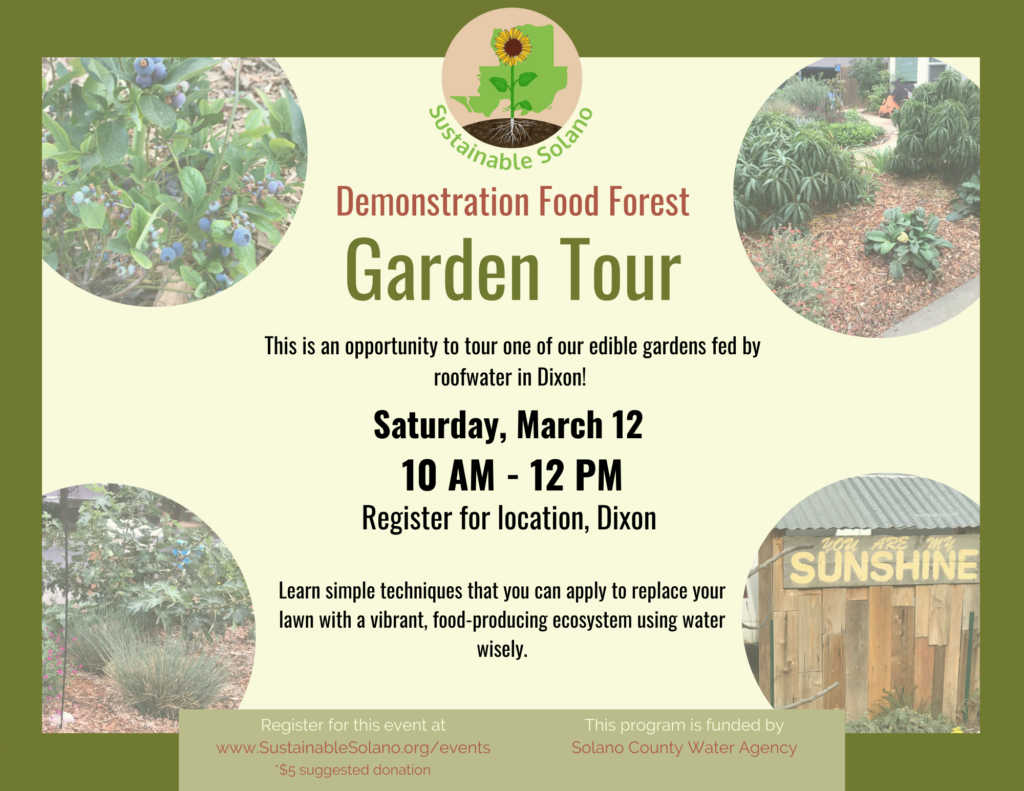
Tour a Demonstration Food Forest March 12

Solano Sustainable Backyards previously brought a demonstration food forest to a Dixon home in 2020, transforming that lawn into a sustainable landscape.

On March 12, the public can tour that two-year-old residential demonstration food forest garden, named Pollinators Paradise, and see how the site captures rainwater and roofwater in the ground to build healthy soil and provide more readily accessible water to the plants in the garden. This site was originally a water-hungry lawn, but now provides food for the occupants and habitat for wildlife, particularly through an abundance of plants to support pollinators. During the tour, permaculture designer John Scott will go over the steps to transform a lawn into a thriving, water-efficient ecosystem.

Learn about how to install a food forest garden by watching the series of videos below created during the installation of Pollinators Paradise.


Learn Hands-on Garden Techniques March 19 & 26

The installation of Gracious Garden will create an opportunity for hands-on learning about creating gardens that grow food, build community and support a healthier environment. On March 19 and March 26, hands-on workshops will install the first phase with a water-efficient demonstration food forest garden through the Solano Sustainable Backyards program, funded by the Solano County Water Agency. Designer Phil Gray will lead those workshops.

The community garden portion of the design will begin installation in April, and is supported through the Solano Gardens program, funded by Solano County. Designer John Davenport will lead workshops for that part of the project on dates that will be announced soon.

Farm-to-School Program Brings Permaculture Campus to Markham Elementary

By Sustainable Solano

The Farm-to-School program will create a permaculture campus at Markham Elementary in Vacaville, turning areas of the school grounds such as this one into educational garden opportunities

Recognizing the importance of connecting children with food and the natural world, Sustainable Solano’s new Farm-to-School program will bring a permaculture campus to Markham Elementary School in Vacaville this spring.

This distributed permaculture garden of raised beds and fruit tree guilds will be installed by the school community with input from students, teachers and parents.

The Markham project is funded through a USDA Food and Nutrition Service Farm to School Turnkey Grant awarded in July 2021. For this school year, there were 176 grants awarded.

Patrick Murphy

While Sustainable Solano has established and supported school gardens through its Solano Gardens and Solano Sustainable Backyards programs, the new Farm-to-School program reflects the need to bring these approaches to more schools in a way that fits with educational curriculum and growing youth connection with urban agriculture. Farm-to-School Program Manager Patrick Murphy was hired to bring this project to fruition. Murphy is a lifelong Solano County resident and holds a degree in environmental science from Cal State East Bay.

“This project will not only provide seasonal fruits and vegetables to students, but will act as a living laboratory on the campus, allowing students to learn about the natural world and the science that drives our daily lives,” Murphy said. “I’m hopeful the project will grab the attention of students and spark a fascination with ecology and husbandry.”

The program will work closely with the Markham community to advance the permaculture campus project. The food produced on campus will be used by the school. The project also will create a toolkit for the process of establishing an educational school garden, that will include food safety, best practices from growing to harvesting, plant and soil resources, and relevant legal information. The hope is that similar programs can use this toolkit as a guide and resource.

The program is a partnership between Sustainable Solano, the Vacaville Unified School District, and the Vacaville Public Education Foundation, and will support a Wellness-Science-Agriculture Collaborative Program started by the district and the foundation that needs edible gardens to support science- and ag-based curriculum. The Markham permaculture campus fits into a larger farm-to-school plan in Solano County and will serve as a pilot site for growing the program within the Vacaville school district through the Wellness-Science-Agriculture Collaborative Program. The Solano County Office of Education is interested in developing curriculum that aligns with science standards to support the expansion of edible gardens at schools throughout the county.

We look forward to sharing more information about the project once it gets underway this spring. If you have questions about the Farm-to-School program, contact Patrick Murphy at patrick@sustainablesolano.org