2022 Benicia & Vallejo Tour: Featured Gardens

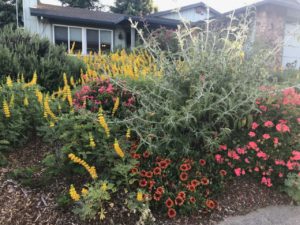
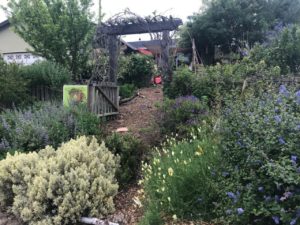
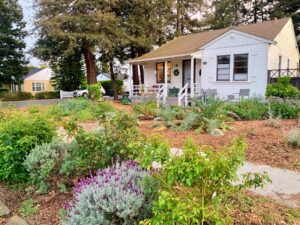
Scroll through the list below to read about the Benicia and Vallejo gardens that are featured on this year’s tour, and to learn about special offerings at some of the gardens!

Register for the April 23 tour here!

Benicia Demonstration Food Forest Gardens

The Curious Garden

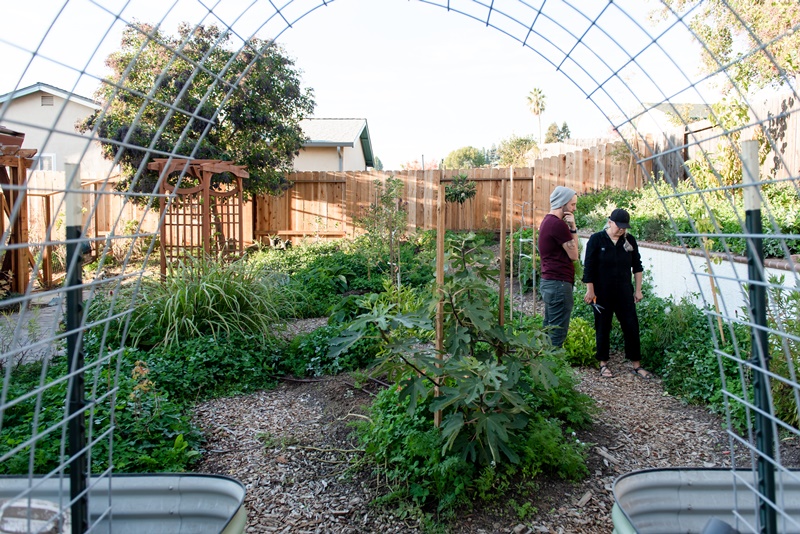
Mature front yard food forest has mostly fruit trees and native plants that attract pollinators year-round. It has a laundry-to-landscape greywater system.

The garden is designed for a young family, including space to enjoy the outdoors and hidden forts. It also has a very steep hill, which presents its own unique issues.

Learn more

Giardino su una Collina (Garden on a Hill)
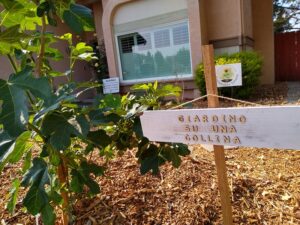
A 2-year-old food forest and pollinator garden installed in 2020 that includes a swale that captures roof water and mediterranean trees and plants mixed with native pollinating and nectar plants to attract bees and butterflies. This site is home to a Monarch Waystation that grows  a variety of plants to support Western Monarch Butterflies. The Monarch Milkweed Project and monarch education will be highlighted, milkweed seeds and maybe milkweed plants available for a donation.

Learn more

Greyhawk Grove

Greyhawk Garden after installationA 7-year-old established food forest with two swales that are dug out and refreshed every 2-3 years, laundry-to-landscape greywater to fruit trees, and chickens. The drip irrigation system was removed 2 years ago and the garden is thriving! Annual beds are hand-watered once a week during the growing season. Greyhawk Grove is a “high-traffic-survival-of-the-fittest-have-three-young-children garden”. There may be lemonade and baked goods for sale by children, as well as products from the garden to give away (dried calendula, lavender, herbs, eggs, fruit, etc.).

Learn more

Living and Learning

Established front yard food forest that replaced a lawn in 2016 with 2 swales, a laundry-to-landscape greywater system and a diverse group of plants and fruit trees that has now expanded throughout the property. Small spaces for relaxing and enjoying are throughout the garden. One of the food forest keepers is a teacher and will be present to share knowledge about growing and preserving tomatoes.

Learn more

Redwood Guild

Food forest garden and greywater system installed as part of Sustainable Solano’s Permaculture Design Certificate course, with students transforming the front lawn with rain-capturing swales and planted berms and converting the sprinkler system to drip irrigation. The side yard is watered by a laundry-to-landscape greywater system and also includes edible plants and native pollinators. This home has its own redwood grove, and certain plants were selected that do well in the unique conditions created by redwoods. The food forest keepers are using that knowledge to add other plants to the garden that will thrive alongside the redwoods.

Wild Cherry Way
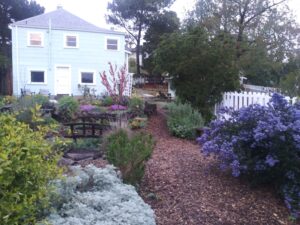
Southern slope food forest focused on pollinators, shrubs and native plants. It also includes fruit trees, perennial and edible plants, swales and a laundry-to-landscape greywater system. Food is Free Solano and the Solano Gleaning Initiative will be highlighted.

Learn more

Vallejo Demonstration Food Forest Gardens

Colibri Ochoa (Hummingbird Ochoa)

Front yard food forest garden has a laundry-to-landscape greywater system, a swale, repurposed logs to create planting areas and a variety of plants to provide food for people and pollinators. On the day of the tour there will be a Spanish translator. 

Sustainable Solano partnered with two other organizations to install this garden in 2021 and begin to provide resources in Spanish. Planting Justice partnered with Sustainable Solano on a Spanish-speaking installation. They offer permaculture services and also have an organic nursery in Oakland that sells rare and heirloom varieties. Club Stride translated an educational program about Patio Sostenibles and created a food forest video in Spanish, Entrevista de Patio Sostenible. Both organizations are doing incredible work to reduce inequities. Check out their websites to find out more on how to support their work. 

Learn more

Enchanted Cottage Garden

Front yard lawn replaced in May 2017 with 2 swales, above-ground rainwater collection and a variety of fruit trees, grapes, herbs, and year-round pollinator plants mixed with annual vegetables. There is a path through it with seating for anyone who walks by. The food forest concept extends to the back garden. This yard has inspired several neighbors to transform their landscapes. Produce from the garden is used in the food forest keeper’s small home-based restaurant and they donate excess produce.

Learn more

Loma Vista Farm

Food forest garden that provides a beautiful demonstration to the public at Loma Vista Farm on how to plant their own yard in a variety of fruit trees, perennial vegetables, herbs, native plants and pollinator plants.

The food forest tour will be on the same day as Loma Vista Farm’s annual Spring Open House, making it an extra special day to visit. Plants that the students have grown will be available in the greenhouse for sale, animal feeding will be available, as well as entertainment, such as a puppet show. For more information check out: Lomavistafarm.org.

Learn more

Morningside Botanical Bounty Resilient Neighborhood

Four gardens on one block were installed collaboratively through the Resilient Neighborhoods Program to show how a neighborhood can be an example of a resilient urban ecosystem that mimics nature.

Highlights: hugelkultur mound, 2 laundry-to-landscape greywater systems, fruit trees, swales, drip irrigation, bee-friendly plants, herb spiral, native plants, shade trees and a little free library.  Native plant information will be available.

Learn more

Ripple Effect

Compact urban yard with an artistic style and creative use of repurposed items, rainwater barrel, laundry-to-landscape greywater and guild planting worked into an existing landscape. This food forest keeper recognizes the benefits of “weeds in the garden” and is enthusiastic about compost, worm bins and building healthy soil.

Learn more

Terraza Dominicana (St. Patrick-St. Vincent Catholic High School)

SPSV Food Forest comprises six planting guilds, each with a central tree and underplanting on a steep hillside. It is used as a living laboratory for students to explore soil health, water conservation and pollination. The food forest highlights design features to address erosion control as well as techniques using repurposed materials for terracing a hillside. The site will highlight local food that is available in Vallejo, and Scott Dodson, the owner of Bee Tribe Honey Farms, will be educating about bees and hive maintenance and selling his raw honey.

Learn more

Vallejo Unity Garden (Vallejo Project)
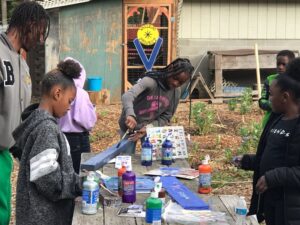
This garden was inspired through collaboration with Sustainable Solano. Vallejo Project youth leaders attended Sustainable Solano workshops and became an organizational partner. This is a newly established garden with the beginning of a food forest with fruiting trees, eight chickens, a worm bin and a compost system. Over the last six months the soil has been nourished with fava beans and other nitrogen-fixing plants and the garden has been a training ground for mulching. This garden is a Vallejo Project-supported venture to build youth resiliency and forge a relationship between transitional families and youth to sustain the community for years to come.

Learn more

We are incredibly grateful for the generous support of our funders. The first seven food forest gardens were made possible through funding from the Benicia Sustainability Commission; the Solano County Water Agency continues to support the Sustainable Backyard Program throughout the county. Solano Sustainable Backyard Program short videos: Waterwise and Building Gardens and Community. Occasionally we combine funding from other programs to make larger projects possible.
DIY Sustainable Landscape Design Class a Hit for Homeowners

By Heidi Varian
Heidi participated in the DIY Sustainable Landscape Design class offered earlier this year. She wanted to use the class to gain design ideas for a historic home in Benicia that she is restoring with some friends to create a site people can visit for an “eco-vacation.” We appreciate her sharing her reflections on the class and process!
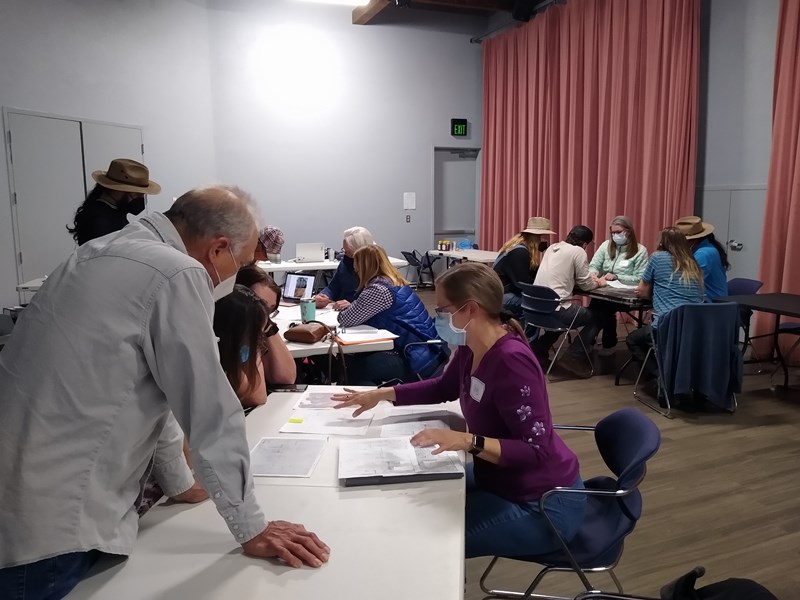
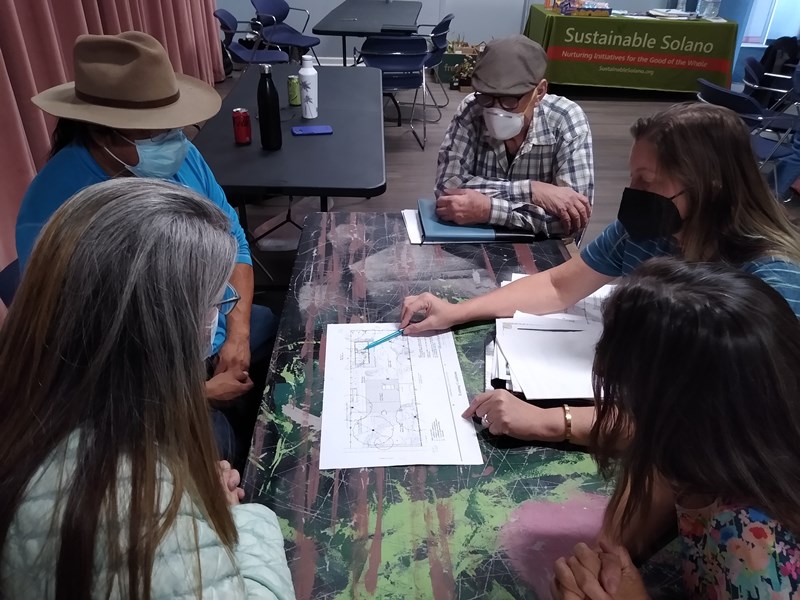
Heidi Varian (center right) goes over the proposed design for her site with other DIY design students and professional designers

A new DIY Landscape Design class from Sustainable Solano was a hit for homeowners.

I joined the class because I’m restoring a historic home in Benicia with some friends. Our interests are arts and music, health and healing, ecology and sustainability, food as medicine. We seek to model these community visions for future generations. The house we chose was built before the industrial revolution, and designed to take advantage of the elements. So we thought we would blend 21st century eco-conscious innovation with the era of conservation, where the houses were small, the land loomed large, and the same soap was used for the dishes, the laundry, and the conservator.

People could enjoy a learning eco-vacation right in the Bay Area. My son, Tyler Varian, touched on permaculture when getting his degree in landscape architecture, writing a book as his capstone, so we had a language. I reached out to Sustainable Solano about what we could learn and was overjoyed to meet such a thoughtful, conscientious team who gently guided me in the direction of best opportunities to facilitate the goals of both organizations.

The four sessions of the DIY class were split between online and in-person workshops. The first two online classes were a great introduction to the material as participants could meet in a COVID-safe environment at the height of omicron and learn to navigate the incredible online resources that the organization has amassed through years of community outreach and team-building.

Instructor Ojan Mobedshahi had to work fast to introduce all the tools he intended for the group to share, while encouraging hands-on learning from the outset, creating an online community, and facilitating collaboration and support. The shared folder of class work is a plethora of valuable information from class contacts and individual ideas and projects to videos and workshop presentations to DIY resources and contractors. The online class was a period of DIY observation and planning. The class materials introduced water reclamation and irrigation, solar and wind considerations, soil composition, tree guilds and planting, and methods of design.

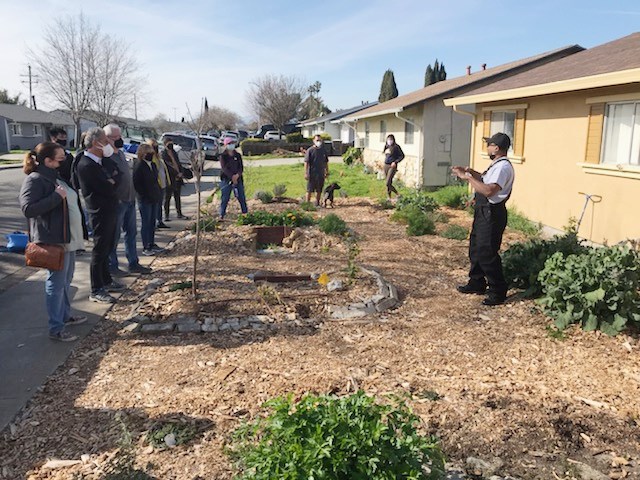
Participants in the DIY design class tour El Bosquecito, a demonstration food forest garden, with designer John Davenport, who talked about how the garden captured rainwater and prevented flooding

When we met in person in Suisun City, it was as though everyone was already acquainted. Program Manager Nicole Newell heightened the feeling by creating a space that was comfortable and inviting, where participants shared ideas and plantings alike. Arranging to visit a recent Sustainable Solano demonstration food forest garden nearby was not only a helpful participatory excursion, but also a chance to feel welcomed by a host food forest family and feel a part of a project that was ongoing and alive. John Davenport, designer for the El Bosquecito (Little Forest) garden gave the DIY class a private tour explaining the flood zone design, laundry-to-landscape greywater system, swales and plant selection. Having an additional viewpoint from a second designer throughout to reinforce that permaculture is as much about the participants as the concepts was enlightening.

Participants gather in groups to offer feedback on the designs created by classmates in the DIY design class

The final in-person workshop was the most exciting of all because the workshop attendees shared their designs with each other, offered ideas, and each received feedback from various professional designers specifically brought in for the class. This was extremely inspiring because everyone had an idea that was unique and intriguing, meaning that with the same material, each DIY home design had a personal artistic element. The flip side was that the professional contractors, designers, and design-build teams each noticed something or had a vision that the DIY classmates had not considered. It’s a very short time to cover a large body of material. I was asked if I felt empowered by the class and, in some ways, I did feel more empowered. In others, I realized that old adage, “You don’t know all that you don’t know!”

One of the best takeaways of the class is that I do feel that I can understand the language of sustainable design and the concept of permaculture. In that way, I can communicate in a more meaningful way with a professional that would potentially collaborate on a project if I feel overwhelmed at the prospect of tackling such a project on my own. And that’s a great takeaway. In the inaugural DIY permaculture class, we were lucky that a volunteer garden installation was happening concurrently. Being able to participate in the install definitely highlighted the lessons of the workshops, heightened understanding, boosted confidence, and offered an opportunity to experience the community and camaraderie of sustainability and permaculture.

Dixon Partnership Brings Together 2 Programs to Create New Garden Site

By Sustainable Solano
We are excited to build upon two of our garden programs to support a new demonstration food forest and community garden in Dixon that will provide produce for the community, educate children about connecting with food and the local agricultural community, and build another example of waterwise, sustainable gardening that can inspire and educate others.
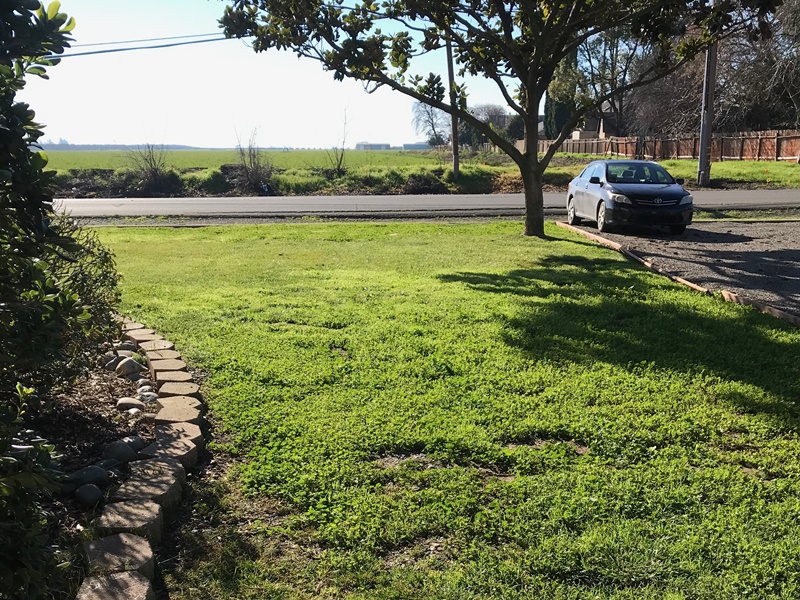
This Dixon Community Church site will soon be converted from grass to a lush, waterwise community garden

The new Dixon garden, Gracious Garden, will be developed in partnership with Dixon Community Church and the Neighborhood Christian School. Neighborhood Christian School serves preschool through eighth grade and has been a part of the community for more than 40 years. The school partnered with Dixon Community Church in relocating the campus this past year. The church has served Dixon for more than 100 years and is on East A Street, where the garden will be highly visible to passers-by.

“We anticipate creating a first in the community food forest, filled with perennials and other diverse crops,” Principal Eden Callison said. “As much as 80% of the yield would be donated to our local food bank partners: Dixon Family Services, CornerStone Baptist Church … as well as in the future create a farmers market style event to continue to highlight and provide opportunity for students and families to sell items made from the garden and provide a full circle educational experience to students within our school and community.”

The vision is to combine efforts through Sustainable Solano’s Solano Sustainable Backyards and Solano Gardens programs to develop different aspects of the completed garden, creating a more robust demonstration site in the process. This is the first time the two programs would work together on a site from design through installation, and we hope it can create a model for future projects.

“I am thrilled that this will be our second demonstration food forest in Dixon and it will serve to educate a large population on how to replace a lawn with a water-efficient food forest garden that includes a section for annual food production,” said Solano Sustainable Backyards Program Manager Nicole Newell.

Tour a Demonstration Food Forest March 12

Solano Sustainable Backyards previously brought a demonstration food forest to a Dixon home in 2020, transforming that lawn into a sustainable landscape.

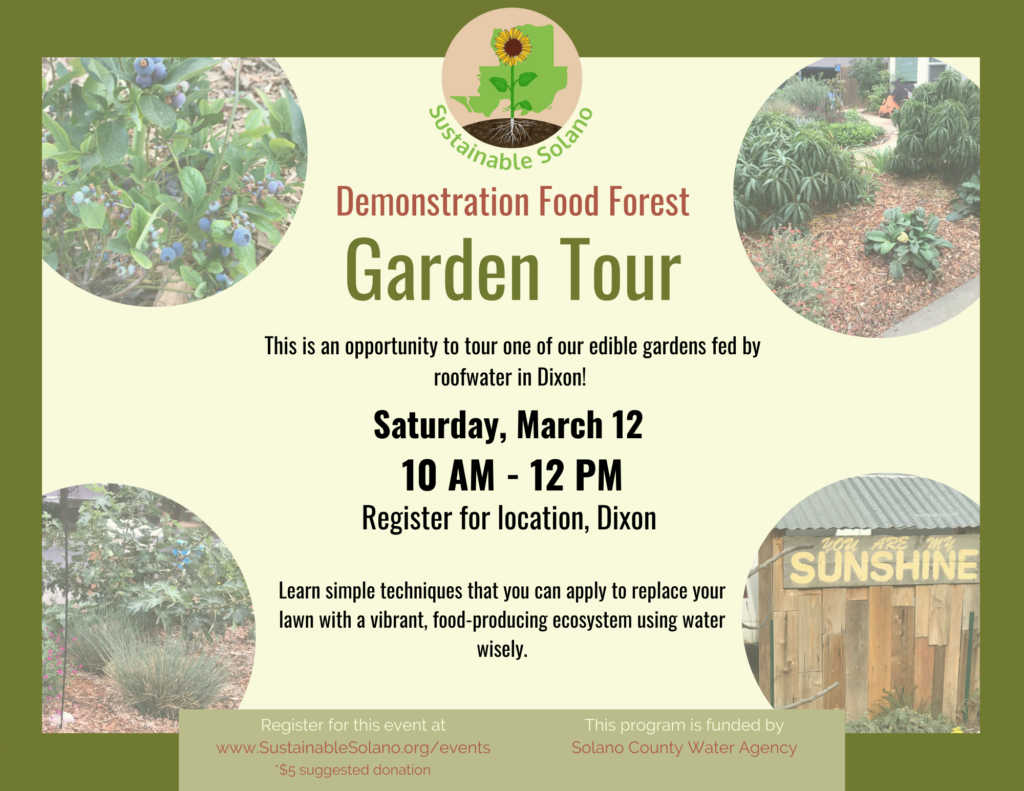
On March 12, the public can tour that two-year-old residential demonstration food forest garden, named Pollinators Paradise, and see how the site captures rainwater and roofwater in the ground to build healthy soil and provide more readily accessible water to the plants in the garden. This site was originally a water-hungry lawn, but now provides food for the occupants and habitat for wildlife, particularly through an abundance of plants to support pollinators. During the tour, permaculture designer John Scott will go over the steps to transform a lawn into a thriving, water-efficient ecosystem.

Learn about how to install a food forest garden by watching the series of videos below created during the installation of Pollinators Paradise.


Learn Hands-on Garden Techniques March 19 & 26

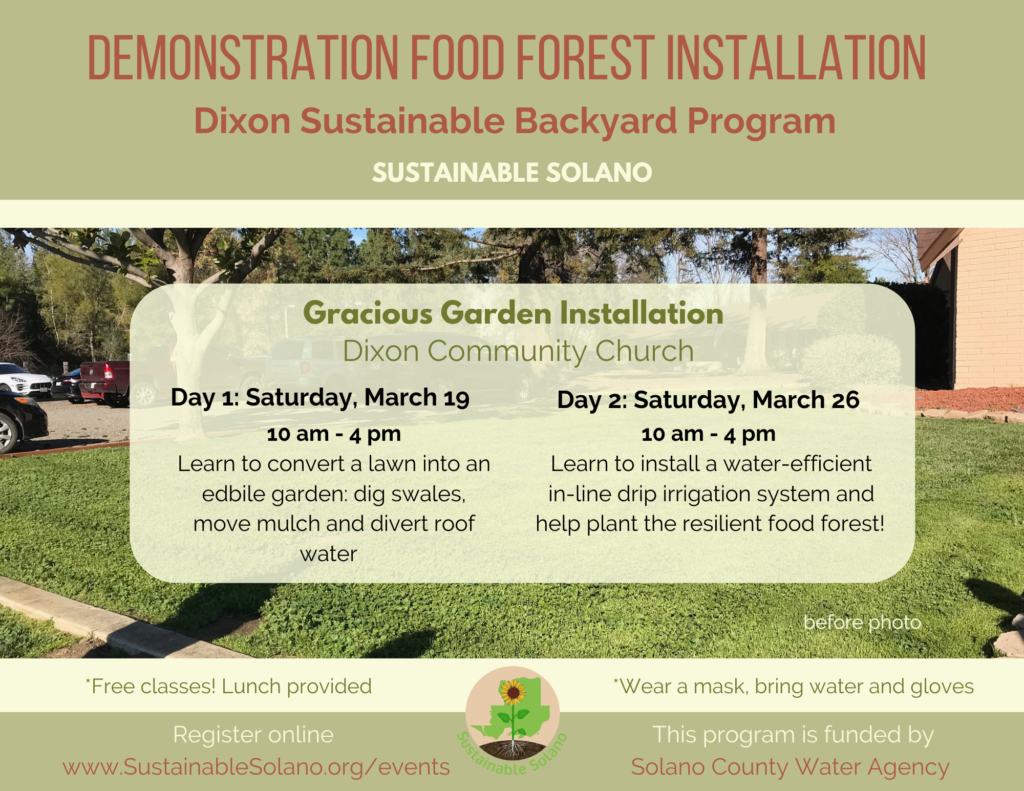
The installation of Gracious Garden will create an opportunity for hands-on learning about creating gardens that grow food, build community and support a healthier environment. On March 19 and March 26, hands-on workshops will install the first phase with a water-efficient demonstration food forest garden through the Solano Sustainable Backyards program, funded by the Solano County Water Agency. Designer Phil Gray will lead those workshops.

The community garden portion of the design will begin installation in April, and is supported through the Solano Gardens program, funded by Solano County. Designer John Davenport will lead workshops for that part of the project on dates that will be announced soon.

Growing Healthier Plants and Ecosystems Regeneratively With Biology

By Michael Wedgley, Permaculture Designer and Soil Food Web Lab Technician

We are excited to be working with Michael and Hampton Bay HOA on the designs for two pilot sites that will demonstrate how lawn in common areas can be replaced with low-water, low-maintenance sustainable landscaping that is healthy, beautiful and natural. Here, Michael shares about the importance of healthy soil biology as part of that equation.

Michael Wedgley meets with a client in a permaculture garden he designed with healthy soil biology in mind.
Photo courtesy of GMC Photography and Video

Growing with biology is a decision to strike symbiosis with the natural world and allow natural systems to support the life of your plants. We can create greener, more vibrant ecosystems that support wildlife and humans more effectively and abundantly. We eliminate the need for toxic and time-consuming applications to “feed” plants and keep disease and pests at bay. By introducing biology into systems that are lacking and nurturing their establishment we can achieve balance in a system that allows us to let go of the wheel and let nature take over. This blog is meant to give a brief introduction to the natural process in action that allow for this transition.

Learn more about the Hampton Bay HOA project and Permaculture Designer Michael Wedgley on our HOA Projects page.

Who Are the Players

Fungi – Mushrooms are the fruiting body of a group of organisms known as Fungus. There are Fungi that break down material like leaves and wood, Fungi that form beneficial relationships with plants, and Fungi that parasitize plants. Fungi is the dominant nutrient-cycler in an old growth forest.

Bacteria – There is aerobic (oxygen preferring) and anaerobic (lack of oxygen preferring) bacteria. Most beneficial soil bacteria is aerobic; most disease forming bacteria is anaerobic. Bacteria help to mine nutrients from parent material and create structure in soil.

Nematodes – Nematodes are like microscopic worms. There are 3 primary groups to be aware of; bacterial feeding, fungal feeding, and root feeding. Root feeding can cause plant disease.

Protozoa – Large single celled organisms that feed on bacteria.

Nutrient Cycling

By ensuring that soil has adequate numbers of each of our microbial populations we eliminate the need for fertilizers. All soils have the necessary nutrients for plants to thrive. The biology in the soil makes those nutrients plant available through the nutrient cycle. This semi-complex interaction starts primarily with bacteria and through predation by nematodes and protozoa, excess nutrients are released into the soil.

Diversification and Disease Prevention

By ensuring that we have high and diverse populations of beneficial microbes we ensure there is no room for disease organisms to dominate and thrive. In general, just as in the human body, disease organisms in the soil and on the surface of the foliage of plants need a weak ecosystem to establish and thrive. By creating a diverse and abundant ecosystem of microbes we create a system that is impenetrable by diseases and pests.

Fungal to Bacteria Ratio and Weed Suppression

By customizing the ratio of the amount of Fungi in the soil to the amount of Bacteria in the soil, we can actually select for which plants we want to grow and eliminate weed species. To understand this, consider an old growth forest. You’ll notice that there are ferns, there are large coniferous trees, but nowhere can you find your typical garden weeds. The reason for this is the form of nitrogen released by fungi. This form of nitrogen (ammonia) is a lower ph. This is why you hear people say “blueberries prefer acidic soil.” On the other end of the spectrum (bacterially dominated) you have early succession plants like grasses. This is because the exudates created by bacteria are more alkaline. You don’t see many trees in prairies. Applying different compost preparations that have higher fungal to bacterial ratios we can begin to affect the ratio in the soil and have healthier plants and select against weed species.

Thermophilic Compost

The process in which we create compost to ensure the highest diversification of beneficial organisms and that we are able to eliminate pest organisms is through Thermophilic Composting. Using a diverse source of material, in the right balance, while maintaining aerobic conditions we are able to raise the temperature of a pile to the point that disease and pest organisms are destroyed while beneficial ones are left to thrive given the rich and diverse foods provided. We monitor the pile’s biology by assessing it under a microscope. Once the biological numbers are at our desired numbers it is ready for a number of applications.

Applications

With a microbially dominant compost that has our desired ratio we can apply the microbes through 3 primary applications.

  1. Direct compost applications – This application is recommended if the organic matter is lacking in dirt we wish to grow in. We can either till in some compost or apply to the surface of dirt.
  2. Compost extract – In this application we actually extract the microbes out of the compost and they become suspended in water. We can then apply this as a root drench to put the biology right where the plants will use it, or at areas of compaction where the bacteria can begin to loosen it up and create aerobic conditions with improved soil structure.
  3. Compost teas – Once we have an extract, we can “brew” it by adding oxygen into the water with some foods for the microbes. We let the extract bubble with aeration for roughly 24 hours while monitoring the growth under a microscope. Given time, bacteria and other microbes are able to multiply and form glues that allow them to stick to surfaces. We then spray this compost tea on the leaves of plants giving them a protective barrier from disease-causing organisms as well as allowing for nutrient exchange on the foliage of plants.

The number of applications necessary to establish a resilient and sustainable colony of beneficial microbes in the soil varies given many variables. The best way to picture what it takes is to think of settlers settling America, according to Elaine Ingham, microbiologist and researcher who created the Soil Food Web approach. Sometimes the first to arrive didn’t survive or few survived. The next ship was better prepared, or there were some settlers previously that made conditions slightly more hospitable so more were able to survive. Every subsequent ship going forward led to increasingly successful population growths until they became sustainable and reproduced and growing. It is the same with the microbes, and varies depending how hospitable or inhospitable the soil is to begin with, and how well it is protected during colonization.

Fertilizers, Pesticides, Salts, and Chemicals in Water

In establishing and maintaining healthy plants and healthy soil in a biological method we need to ensure the health and safety of the organisms. We must become caretakers of the invisible life that populates the soil beneath our feet and the foliage up above. A critical piece of this care is to ensure that their environment is not compromised by salts or chemicals which can completely eradicate the microbial populations. Fertilizers are a form of salts. All salts will dehydrate the cells of the microbes and cause death. Pesticides are created to destroy life. Even “targeted” pesticides have unwanted casualties and can upset the balance. Lastly chlorine and chloramine in water are designed to ensure lack of microbial growth in the pipes and therefore can do the same in your soil and on your plants. It is extremely important that we understand how fragile ecosystems can be. In general, these natural systems are extremely resilient, but when humans come in with their toxic approaches we upset the balance. Nature will always find a way back towards its attempt at turning everything into an old growth forest, but that takes time. If we want to have healthy and natural environments we have to help the biology along and make sure we don’t destroy it with our products.

Winter in the Milkweed Garden

By Annina Puccio, co-founder and co-director of the Monarch Milkweed Project

Annina Puccio and Ann Whittemore started the Monarch Milkweed Project out of Benicia, CA, to increase the supply of milkweed available to Western Monarch butterflies as they make their way along their migratory path. We partnered with the Monarch Milkweed Project for an informative talk on Monarch butterflies, their population decline and how you can help! You can watch the video from the talk at the bottom of this blog post.

It has been a very successful spring and summer here in Solano County, spreading the word about how to support the Monarch butterfly population locally and spotting many of these iconic insects floating through our yards this year. Winter is the season to clean up the milkweed garden, as the last few caterpillars pupate in the fall and the final Monarch butterflies take flight for their over-wintering sites. It is also the time to begin preparing the garden bed for next year!

With shorter days, and chillier nights, native milkweed begins naturally to yellow and collapse. The roots continue to store energy for next year, so keep them watered and your plants should come back bigger and stronger than ever in the spring.

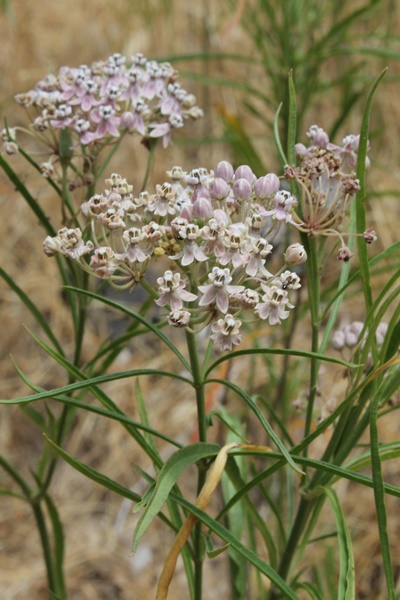
Native narrowleaf milkweed

However, if you have been growing tropical milkweed (asclepias curassavica), it is recommended that you remove it and replace it with native milkweed now. At the very least, cut the plants back almost to the ground.  This variety of milkweed remains evergreen and even may flower through the winter, which allows the protozoan parasite Ophryocystis Elektroscirrha (“OE”) to build up in the plant. This disease affects the Monarch butterflies’ overall fitness, reduces their ability to reproduce successfully, and can interfere with their migration. Instead, look for seeds of native milkweed. In our local area, showy milkweed (asclepias speciosa) and narrowleaf milkweed (asclepias fascicularis) are the recommended varieties to grow, so collect seeds to sow now or in the early spring.

When planting milkweed, the seeds need “stratification,” which is the process of breaking down the seed coating with moisture and cold temperatures. If you plant seeds directly outdoors now, the rains and winter cold will stratify the seeds naturally, and they will develop strong root systems by spring.

A very good resource for fall planting instructions can be found on the Monarch Butterfly Garden website, at https://monarchbutterflygarden.net/fall-planting-milkweed-10-steps/

Alternatively, you can store moistened seeds in the refrigerator for a few months throughout the winter (lay them out on moistened paper towels in layers in a large flat container), and then start them indoors in the spring in small pots or starter cells. Keep them warm and watered, and when they have 3-4 sets of leaves, plant them outdoors after the last frost has passed.

While you are planning your milkweed garden, do not forget about nectar plants to attract and nourish the butterflies. You can find a good list, tailored to California, by the Xerces Society at: https://xerces.org/publications/plant-lists/monarch-nectar-plants-california

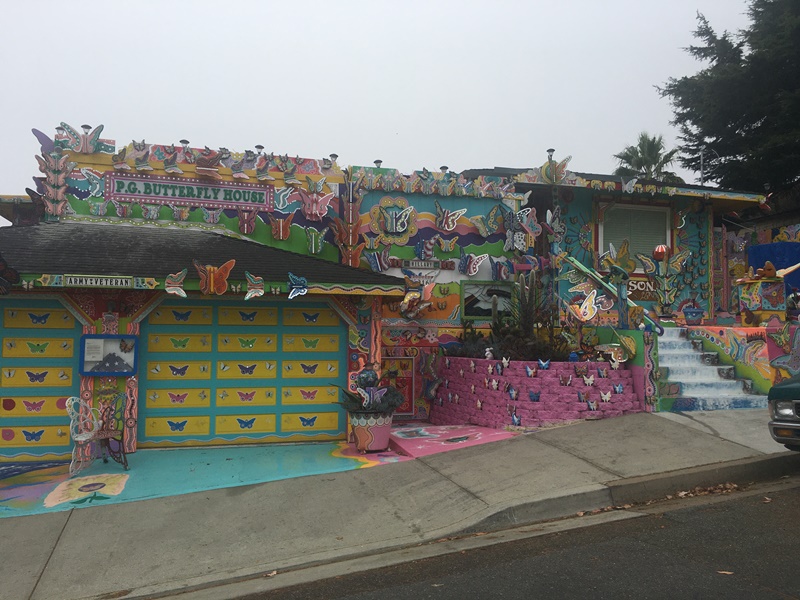
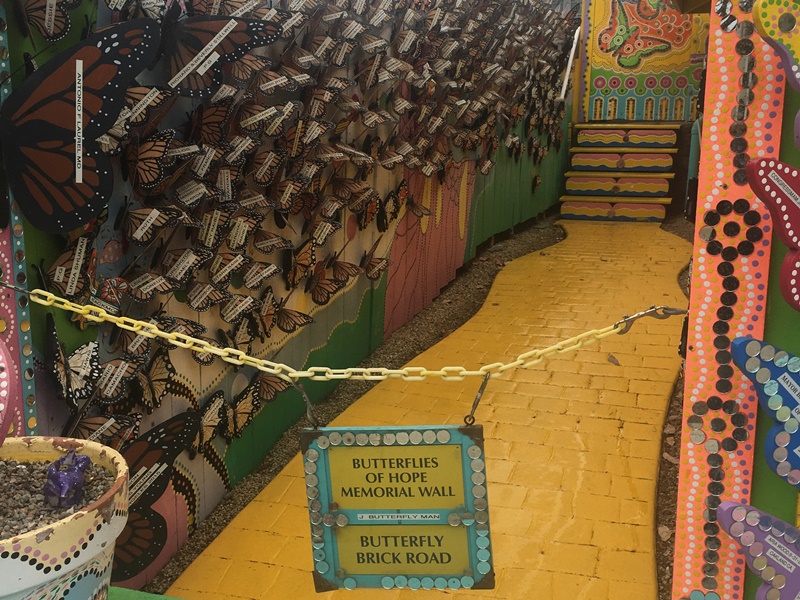
While you are looking ahead to next year, a fun and educational winter activity is to visit a Monarch overwintering site. The most well-known and largest are at Natural Bridges, Pacific Grove (those are pictures of the Pacific Grove Butterfly House above), and near Pismo Beach, but they also have been spotted nearby on Mare Island and at Point Pinole. Use the map from Western Monarch Count here to find a site: https://www.westernmonarchcount.org/find-an-overwintering-site-near-you/

Thank you to everyone who has worked so hard in Benicia, Vallejo and all over Solano County to support the Monarch Butterfly. The overwintering population numbers are WAY up! A 3500% increase in Pismo Beach alone.

As the Monarchs move to their over-wintering sites, we are hopeful for other increases in population as well. Keep up the good work raising Monarchs and if you haven’t already, please consider joining our Monarch MilkWeed Project group on NextDoor: https://nextdoor.com/g/our9txeuo/

Learn more about the Monarch Milkweed Project here

Climate & Environmental Festival Reconnects Community to Create Change

By Jonathan Erwin, Resilient Neighborhoods Program Manager

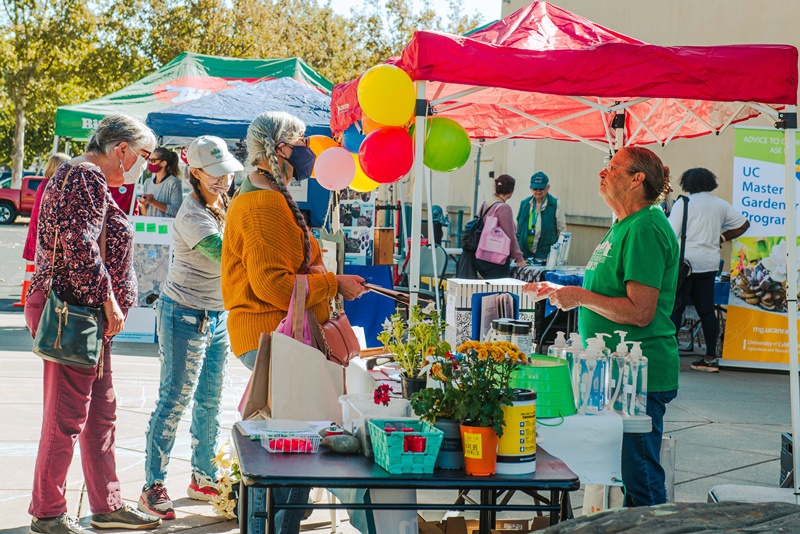
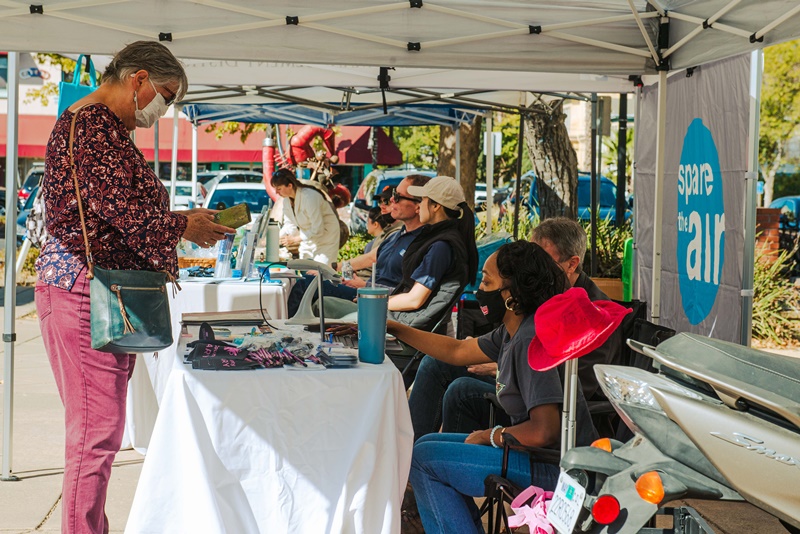
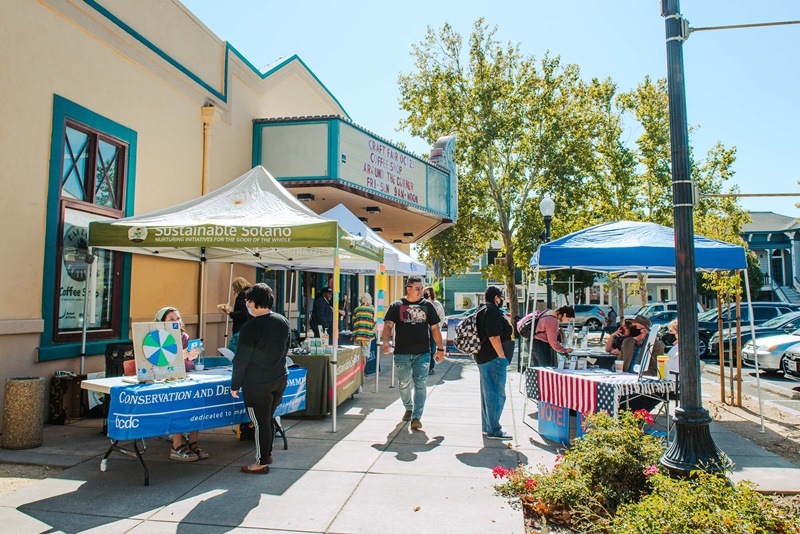
Sustainable Solano hosted Suisun City’s first Climate and Environmental Festival in October. From the long slumber of in-person events through the pandemic, it was great to finally see some friendly masked faces and engage with a like-minded community in Suisun City. Over the course of the day, presentations from San Francisco Bay Conservation and Development Commission, Pathways Climate Institute and Vital Cycles provided a vision and tools for the future while an engagement fair highlighted many organizational efforts across the area as well as broader Solano County.

Amidst the hubbub of the festivities, this event made me realize the importance of connecting with each other. For the past few months, I have found it hard to stay optimistic about the future. With climate impacts happening every day, it wears on my mental state just how insurmountable the climate crisis can feel. Coupled with the pandemic, isolation and physical disconnection from our support networks can leave us feeling the brunt of unsolvable doom.

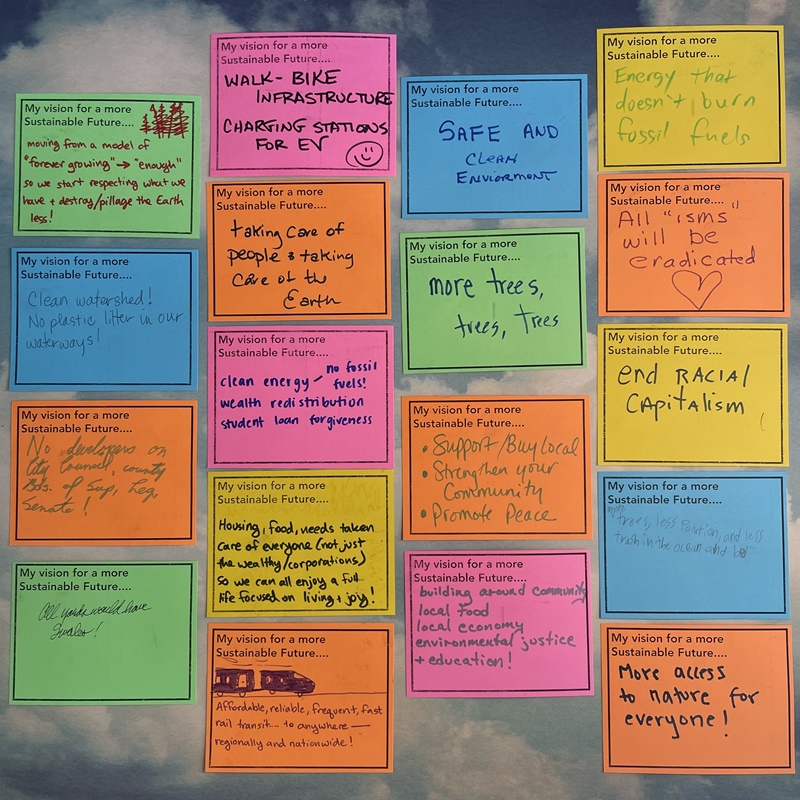
But there is light in the end. Our conversations through the event both with old and new faces, reconnected us with the larger community across Solano County working and advocating for issues around the climate crisis. We have power in numbers, and our community is energized as ever for change. From resource management, transportation and sewer districts, we have advocates for this type of work across a spectrum of organizations. And the ideas that the 120-plus attendees from the festival came up with represent broad and different strategies that we can use to advance our work at Sustainable Solano and across the efforts of Solano County.

We hope to see you out and about over the next few months to learn more about what your vision is for a more sustainable future. Have an idea now? Feel free to reach out to us at info@sustainablesolano.org

Check out some of the presentations from the day in the videos below.

2021 Suisun City Climate & Environmental Festival Educational Talks

Adapting to Rising Tides in Suisun City & Solano County
Protecting the Marsh: A New Suisun Marsh Protection Plan
Nature-Based Solutions to Address Climate Change